
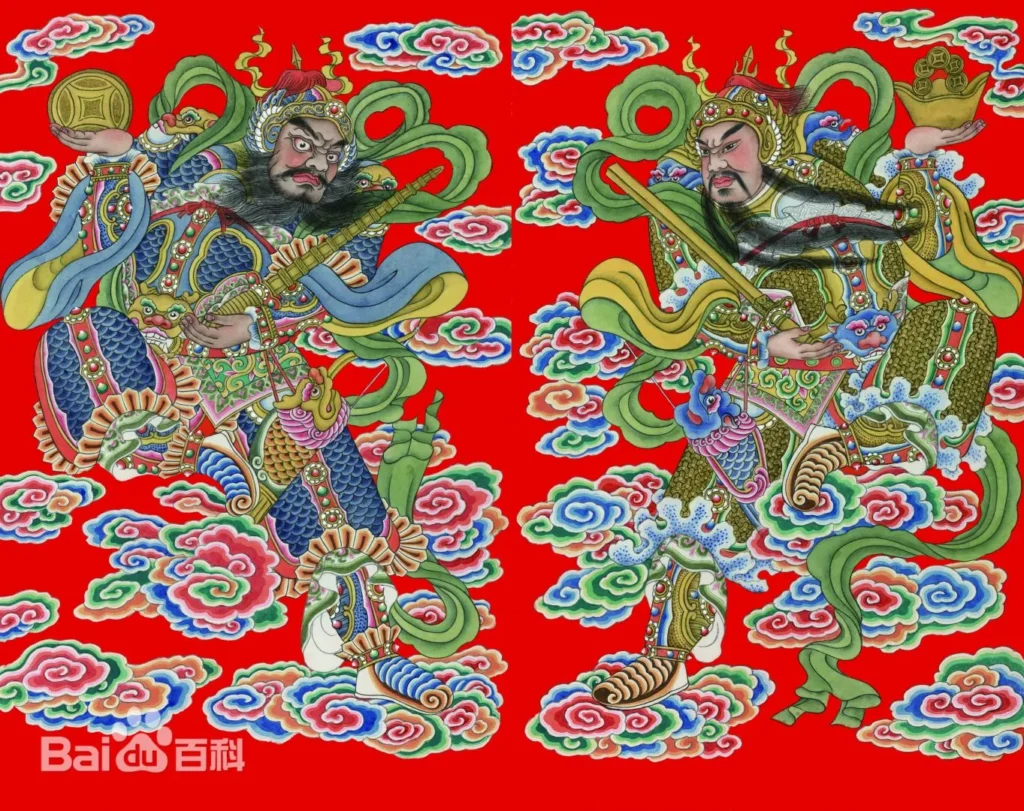
In Chinese culture, the front door has never been just a door. It is the boundary between the family and the outside world, between safety and uncertainty, between daily life and the unseen forces people once believed moved through the night.
That is where Men Shen, or the Chinese Door Gods, come in.
Men Shen are guardian deities traditionally placed on doors to protect a household from evil spirits, bad luck, illness, and misfortune. Their images are most often seen during Chinese New Year, when families refresh old door prints with bright new ones as a way of welcoming protection, peace, and good fortune into the home.
Although many people today see them as festive New Year decorations, Men Shen carry a much older meaning. Their story reaches back into early Chinese ritual, mythology, Daoist belief, folk religion, and the long history of Chinese woodblock New Year prints.
What Does Men Shen Mean?
The term Men Shen comes from two Chinese words:
Men means “door” or “gate.”
Shen means “god,” “spirit,” or “deity.”
So Men Shen literally means Door Gods.
In traditional belief, these gods stand guard at the entrance of a home, temple, palace, or important building. Their role is simple but powerful: they protect the space inside.
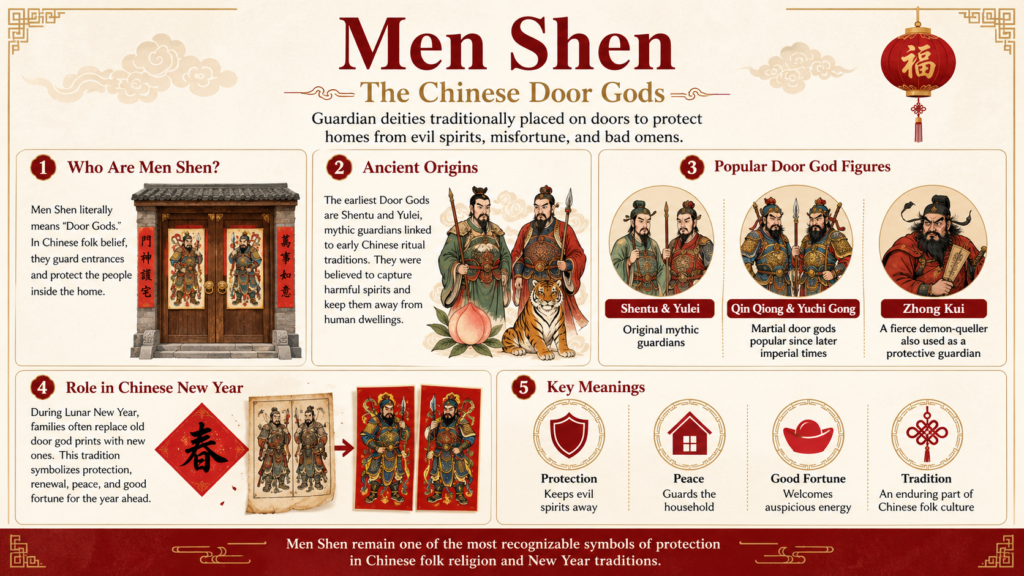
In old Chinese households, the door was seen as one of the most important parts of the home. It was where people entered, where guests arrived, where danger might come in, and where blessings could also be welcomed. Because of this, the door became a natural place for ritual protection.
The Earliest Men Shen: Shentu and Yulei
The oldest and most famous pair of Men Shen are usually known as Shentu and Yulei.
In ancient mythology, Shentu and Yulei were powerful guardians who watched over a ghostly gate near a giant peach tree. This tree was said to grow on a sacred mountain, and beneath it was a place where spirits passed in and out. The two gods inspected the spirits and stopped those that meant harm to human beings.
In many versions of the legend, evil ghosts were tied with reed ropes and fed to tigers. That image may sound fierce, but it explains why early Door Gods were not gentle or elegant figures. They were meant to frighten away danger.
This is also why early Men Shen were closely connected with three protective symbols:
- Peach wood, believed to drive away evil
- Reed ropes, used to bind harmful spirits
- Tigers, powerful animals associated with exorcism and fearlessness
Before paper door prints became common, people used peach wood charms or wooden tablets. Names of the Door Gods could be written on them and hung by the entrance. Over time, this developed into the custom of pasting images of Men Shen on the two sides of a door.
Men Shen and Chinese New Year Traditions
The custom of placing Men Shen on doors became especially important during Chinese New Year.
At the end of the lunar year, families cleaned their homes, removed old decorations, and put up new images to welcome the new year. Door Gods were part of this renewal. Their bright colors, serious faces, armor, weapons, and symmetrical placement all carried a feeling of strength and order.
Traditionally, Men Shen are pasted in pairs on double doors. The two figures should face each other, not turn away from one another. This creates a sense that they are guarding the doorway together.
For many families, the meaning is not only religious. It is also cultural and emotional. A pair of Men Shen on the door says: this home is protected, this family wishes for peace, and the new year should begin under good signs.
Qin Qiong and Yuchi Gong: The Warrior Door Gods
Although Shentu and Yulei are the older mythological Door Gods, the most widely recognized Men Shen today are often Qin Qiong and Yuchi Gong, also known as Yuchi Jingde.
They were famous military figures associated with the Tang dynasty. A popular legend says that Emperor Taizong of Tang was troubled by ghosts and could not sleep peacefully. Two loyal generals stood guard at the palace gate, and after that, the spirits no longer disturbed him.
Because the generals could not stand guard every night forever, their painted portraits were placed on the palace doors instead. The story spread among the people, and Qin Qiong and Yuchi Gong gradually became two of the most popular martial Door Gods in China.
In art, they are usually shown wearing armor, holding weapons, and looking stern. Their job is to block evil before it enters.
Zhong Kui as a Door Guardian
Another important figure connected with door protection is Zhong Kui.
Zhong Kui is famous in Chinese folklore as a ghost-catcher and demon-queller. He is often shown with a fierce face, a scholar-official’s hat, and a commanding presence. His image was used to drive away evil spirits and protect homes, especially in paintings and talismanic art.
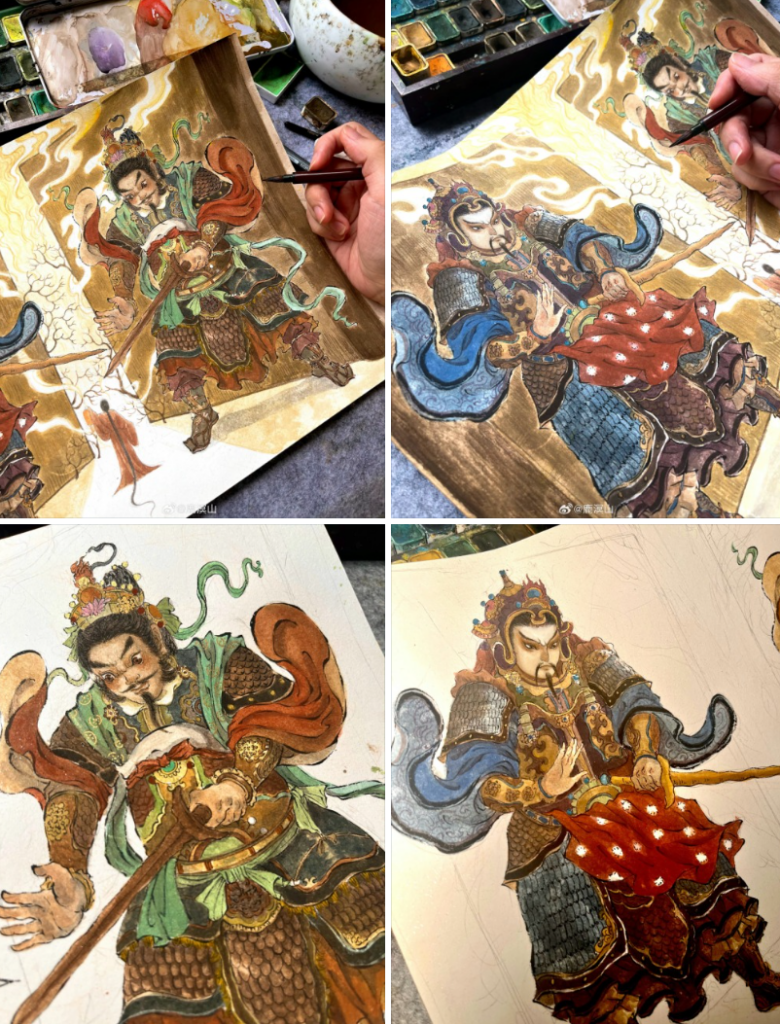
Unlike the paired Door Gods, Zhong Kui is often shown alone. Still, his function is similar: he stands between the household and harmful supernatural forces.
Different Types of Men Shen
As the tradition developed, Men Shen were no longer limited to one pair of ancient gods. Different regions, families, and social groups developed their own preferences.
Martial Door Gods
These are the most familiar type. They are usually generals or warrior figures with weapons and armor. Their purpose is to frighten away evil spirits and guard the home.
Famous examples include:
- Qin Qiong
- Yuchi Gong
- Shentu
- Yulei
- Guan Yu
- Zhang Fei
- Zhao Yun
Civil Door Gods
Civil Door Gods are usually shown as officials or scholars. Instead of weapons and military power, they represent order, justice, career success, and moral authority.
Figures such as Wei Zheng, Bao Gong, and Wen Tianxiang have been used in some traditions as civil-style Door Gods.
Blessing Door Gods
Over time, people wanted Door Gods not only to block evil but also to bring good things into the home. This gave rise to blessing-themed Men Shen.
These might include images connected with:
- Fortune
- Longevity
- Official promotion
- Wealth
- Children
- Harmony
- Good luck
This type shows how the meaning of Men Shen expanded from protection to blessing.
Why Are Men Shen Usually Pasted in Pairs?
Men Shen are commonly shown as a pair because traditional Chinese doors often had two leaves. Each god guarded one side.
The pair also reflects a deeper sense of balance. Chinese visual culture often values symmetry, especially in ritual and festive design. A pair of Door Gods creates a complete protective structure: left and right, inside and outside, strength and order.
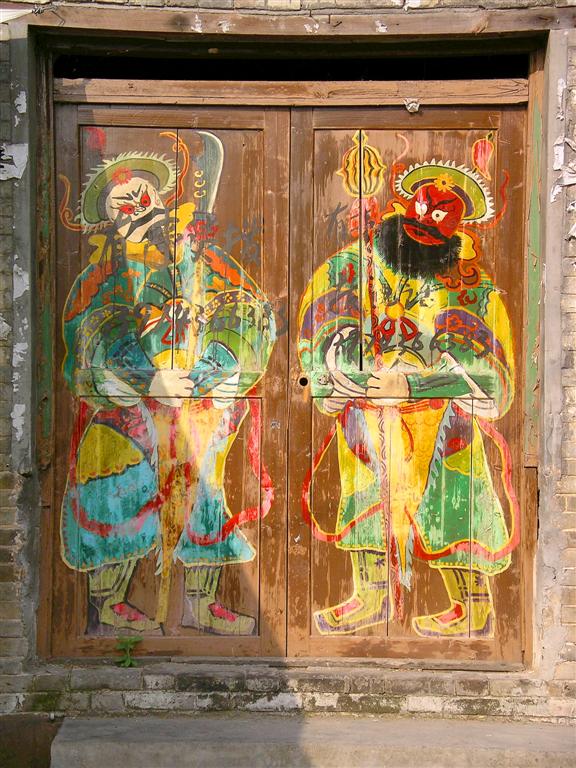
In many customs, placement matters. For example, Qin Qiong and Yuchi Gong are often arranged according to traditional left-right rules, and the two figures should appear to face each other when the doors are closed.
Men Shen in Chinese Folk Religion and Daoism
Men Shen belong mainly to Chinese folk religion, but they were also absorbed into Daoist religious culture over time.
This is common in Chinese religious history. Local gods, household spirits, legendary heroes, and mythological figures often moved between folk practice, temple worship, literature, and Daoist systems. Men Shen are a good example of this flexible tradition.
They are not just one fixed pair of gods. They are a category of protective beings whose identities changed across dynasties and regions.
Men Shen in Art and Woodblock Prints
Men Shen are closely connected with Chinese New Year woodblock prints, especially in places known for folk art traditions.
Traditional Door God images are bold, colorful, and easy to recognize. Common features include:
- Bright red, green, yellow, and blue colors
- Strong facial expressions
- Large eyes and thick beards
- Armor and weapons
- Symmetrical poses
- Auspicious symbols such as bats, deer, flowers, peaches, and official hats
These details are not random decoration. Many of them carry wordplay or symbolic meaning. For example, a deer may suggest official income because the Chinese word for deer sounds like the word for salary or rank. A hat may suggest promotion. Peaches may suggest longevity.
In this way, Men Shen prints combine protection, blessing, folk art, and visual symbolism in one image.
Are Men Shen Still Used Today?
Yes, Men Shen are still used today, especially during Chinese New Year.
In modern cities, many people paste printed Door Gods on apartment doors more as a cultural tradition than as a literal religious practice. In rural areas and historic communities, the custom may still feel more closely connected with folk belief.
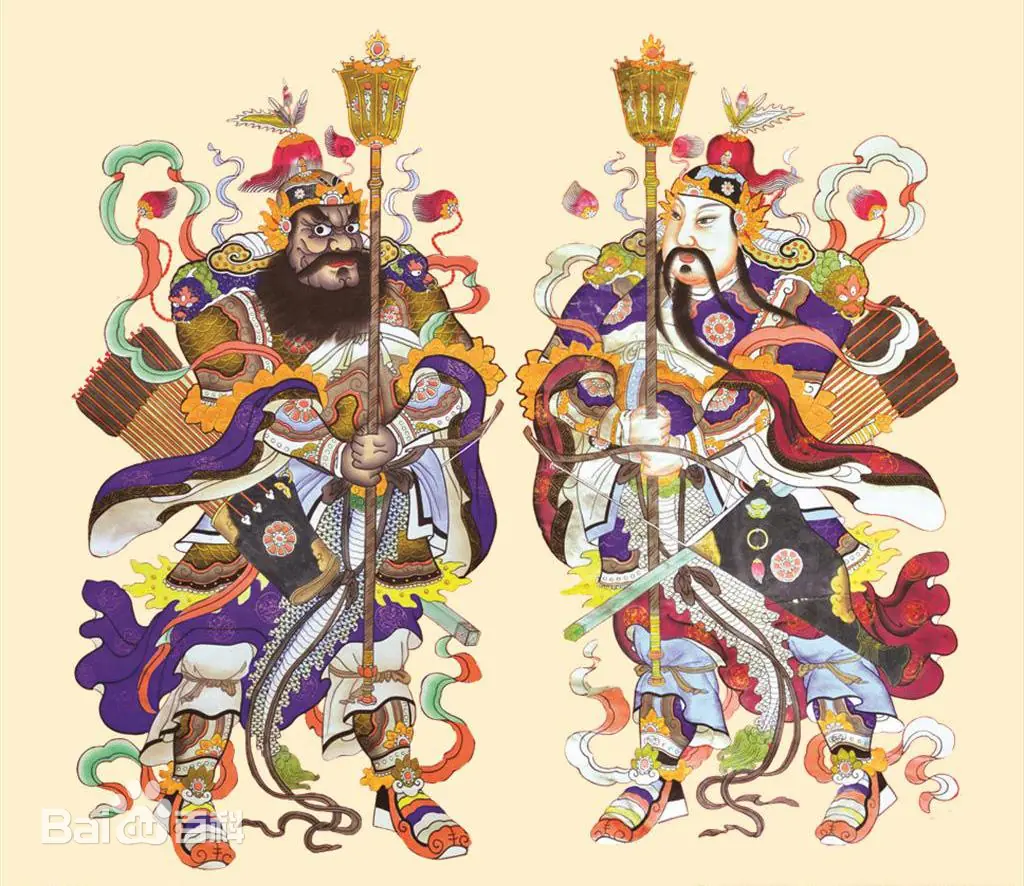
Men Shen also appear in museums, temple art, cultural festivals, digital illustration, animation, and modern design. Their visual language remains powerful because it is instantly recognizable: two guardians, a doorway, and the wish for safety.
Even when the religious meaning becomes softer, the emotional meaning remains clear. People still want the home to feel protected.
Why Men Shen Still Matter
Men Shen are more than old decorations. They show how Chinese culture understands the home as a protected space.
They also reveal something very human. Across history, people have always looked for ways to draw a line between danger and safety. For ancient Chinese families, that line was the door. And at that door stood the Men Shen.
Their faces may be fierce, but the wish behind them is gentle:
may this home be safe, may evil stay away, and may the new year bring peace.
FAQ About Men Shen
What are Men Shen?
Men Shen are Chinese Door Gods. They are guardian deities traditionally placed on doors to protect homes, temples, and buildings from evil spirits, misfortune, and bad omens.
Who are the original Men Shen?
The earliest famous Men Shen are Shentu and Yulei, two mythological guardians who were believed to capture harmful spirits and protect people from evil.
Why are Men Shen pasted on doors during Chinese New Year?
During Chinese New Year, families paste new Door God images to renew protection, drive away bad luck, and welcome peace and good fortune for the coming year.
Who are Qin Qiong and Yuchi Gong?
Qin Qiong and Yuchi Gong are two famous Tang-dynasty military figures who became popular martial Door Gods. In legend, their images protected Emperor Taizong from disturbing spirits.
Is Zhong Kui a Men Shen?
Zhong Kui is not always shown as one of the paired Door Gods, but he is often used as a door guardian because of his role as a powerful ghost-catcher and demon-queller.
How should Men Shen be placed?
Traditionally, Men Shen are pasted as a pair on double doors, with the two figures facing each other. This creates a complete protective arrangement.
Are Men Shen religious or cultural?
They are both. Men Shen come from Chinese folk religion and were also connected with Daoist belief, but today many people use them mainly as a Chinese New Year cultural tradition.
Do people still use Men Shen today?
Yes. Men Shen are still commonly seen during Chinese New Year, especially on home entrances, temple doors, folk art prints, and festive decorations.
wish you all the best