
Mazu is one of the most beloved goddesses in Chinese culture. Known as the goddess of the sea, she is especially worshipped by sailors, fishermen, merchants, travelers, and coastal communities who have long depended on the ocean for survival.
Her story begins not with a distant celestial being, but with a quiet girl named Lin Mo, believed to have lived on Meizhou Island in Fujian during the tenth century. Over time, this young woman became remembered as a protector of those in danger at sea, then honored as Mazu, and later elevated with grand titles such as Tianhou, the “Empress of Heaven.”
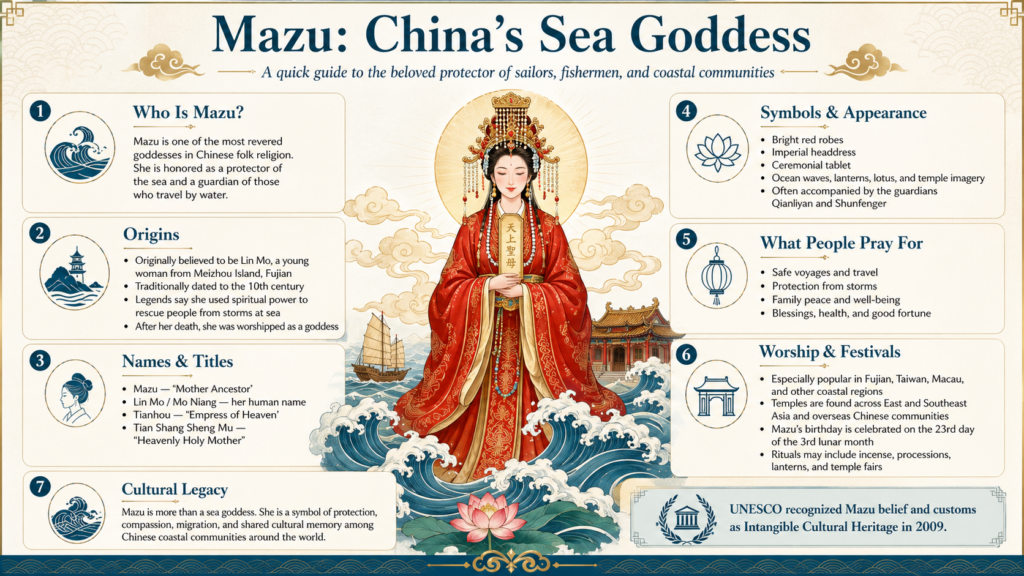
Today, Mazu is more than a figure from Chinese mythology. She is a living cultural presence. Her temples can be found across Fujian, Guangdong, Macau, Taiwan, Southeast Asia, and overseas Chinese communities around the world.
Who Is Mazu?
Mazu, written as 媽祖 or 妈祖, is usually translated as “Mother Ancestor.” The name itself carries warmth. It does not sound distant or severe. It feels close, almost familial.
Before she became a goddess, Mazu was said to be Lin Mo, also called Mo Niang, meaning “Silent Girl.” According to tradition, she did not cry when she was born and remained unusually quiet throughout her life. Because of this, people remembered her as a calm, mysterious child with a deep spiritual nature.
In later religious tradition, she became known by several titles:
Tianhou — Empress of Heaven
Tian Shang Sheng Mu — Heavenly Holy Mother
Linghui Furen — Lady of Light and Kindness
A-ma — a familiar southern Chinese term meaning mother or grandmother
This mix of intimate and imperial names says a lot about Mazu. To some worshippers, she is a heavenly queen. To others, she is a protective mother who answers prayers quickly, especially in moments of fear.
The Human Origin of Mazu: Lin Mo of Meizhou Island
Unlike many mythological figures, Mazu is widely believed to have begun as a real person. Lin Mo is traditionally said to have been born around 960 CE on Meizhou Island, off the coast of Fujian.
Her family was poor and connected to fishing life. Her father was Lin Yuan, and she had four older brothers. From an early age, Lin Mo was believed to have unusual gifts. She could predict the weather, sense danger, and enter deep spiritual trances. Some traditions also describe her as a healer who understood medicine and helped local villagers.
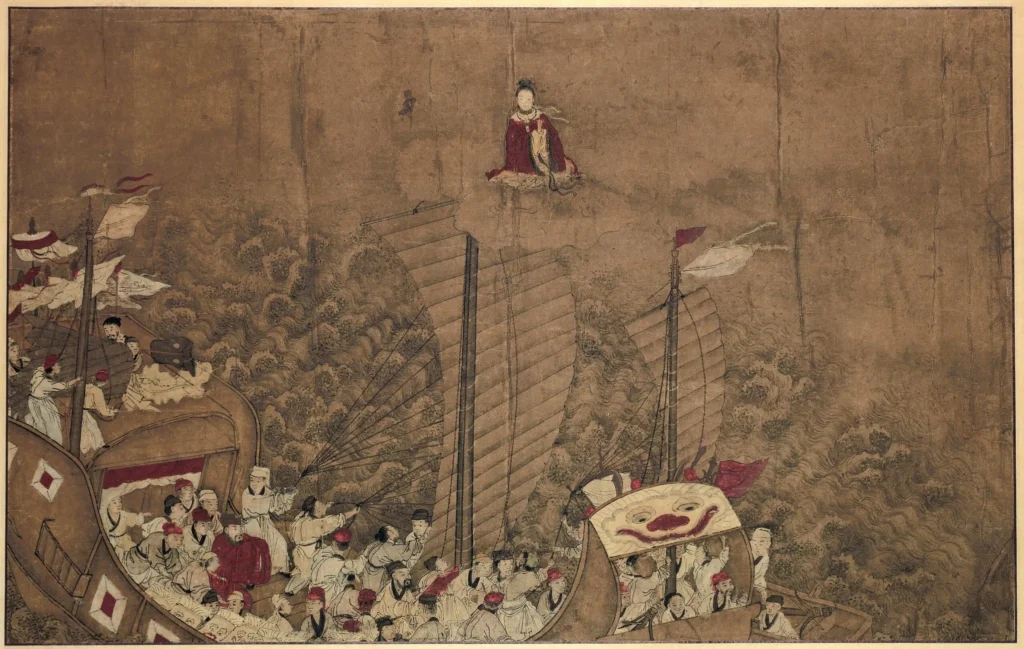
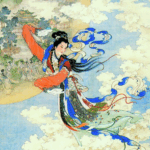
One of the most famous stories tells of a violent storm that struck while her father and brothers were at sea. At home, Lin Mo suddenly fell into a trance while weaving. In her spiritual form, she flew out over the waves to rescue them. She managed to save her brothers, but her mother, not understanding what was happening, woke her before she could save her father.
This tragedy became one of the emotional centers of the Mazu legend. It presents her not simply as a powerful deity, but as a daughter shaped by love, grief, and sacrifice.
How Lin Mo Became Mazu
There are several versions of Lin Mo’s death. In some accounts, she drowned while trying to rescue shipwreck victims. In others, she climbed a cliff and ascended to heaven in a beam of light. Some Taoist versions describe her transformation as a kind of spiritual liberation.
After her death, local people began to honor her. They believed her spirit continued to protect boats, calm storms, and guide those lost at sea. Shrines appeared on Meizhou Island, and her reputation slowly spread along the Fujian coast.
From there, Mazu’s worship grew with the movement of sailors, merchants, fishermen, and migrants. The more people traveled by sea, the more they carried her name with them.
Why Mazu Became the Goddess of the Sea
Mazu’s rise makes sense when we think about the world of coastal China. For fishing families and sea traders, the ocean was both a source of life and a constant danger. Storms, shipwrecks, pirates, illness, and unpredictable weather were not abstract fears. They were part of daily reality.
Mazu became the goddess people called upon when human skill was not enough.
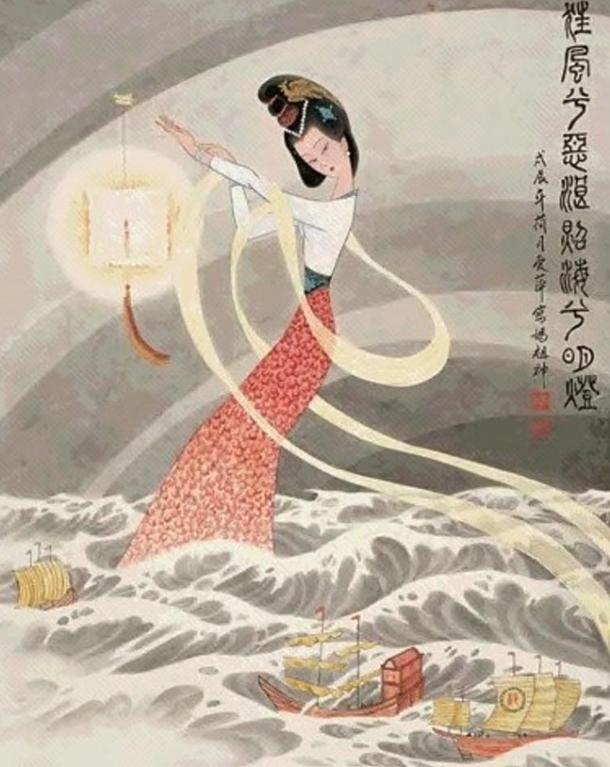
She was believed to:
Guide ships through dangerous waters
Warn sailors before storms
Rescue people from shipwrecks
Protect fishermen and travelers
Heal illness
Bring peace, fertility, and family well-being
Support communities facing hardship
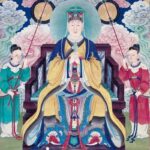
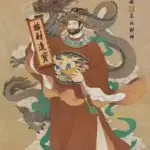
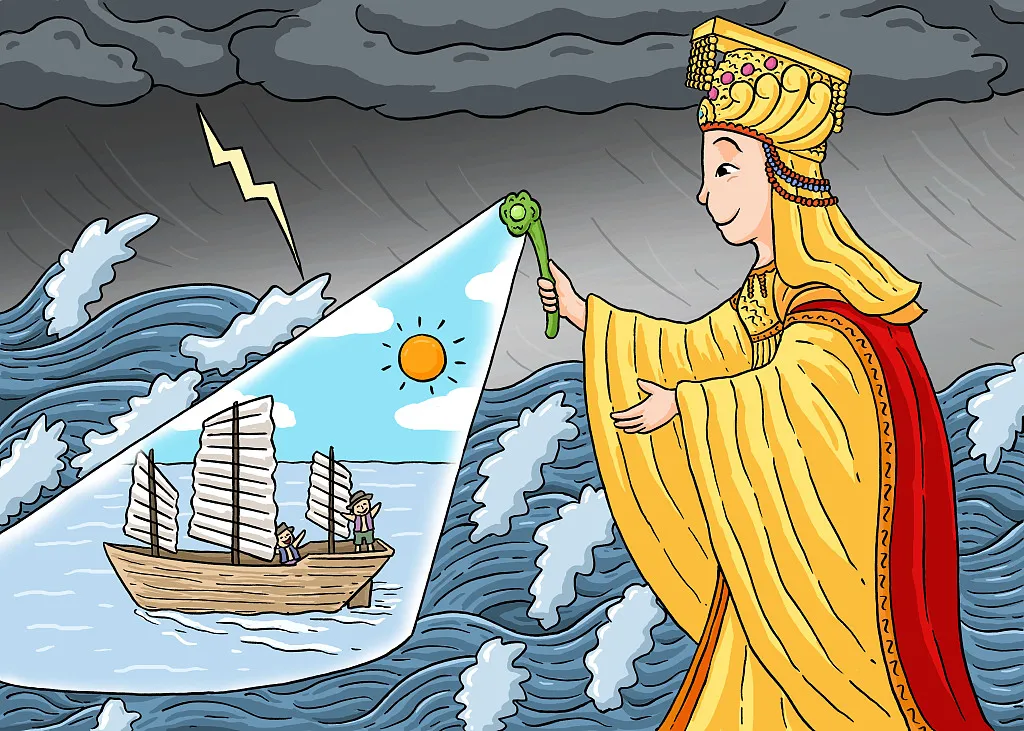
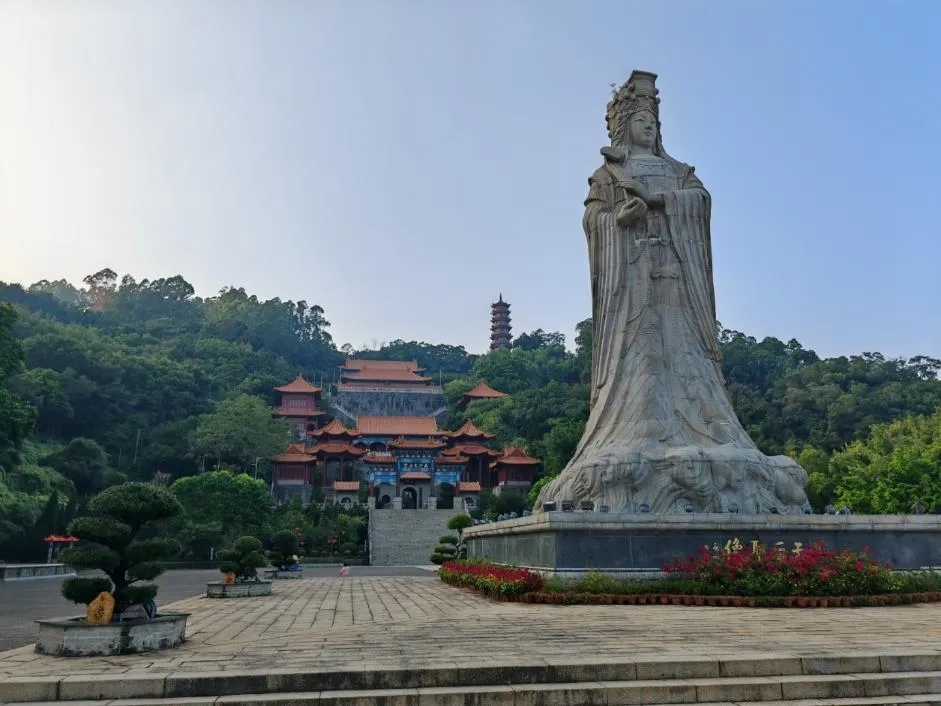
In art, Mazu is often shown wearing bright red robes, a color that could be imagined as visible across the sea. She may hold a ceremonial tablet and wear an imperial headdress, reflecting both her wisdom and her divine status.
Qianliyan and Shunfenger: Mazu’s Two Guardians
Many Mazu temples include two fierce-looking guardian figures beside her: Qianliyan and Shunfenger.
Qianliyan means “Eyes That See a Thousand Miles.”
Shunfenger means “Ears That Hear the Wind.”
In legend, they were once demons who wanted to marry Mazu. She agreed only if they could defeat her in combat. Instead, she overcame them with her skill and spiritual power. After their defeat, they became her loyal protectors.
Their roles are easy to understand. A sea goddess needs eyes that can see distant danger and ears that can hear the wind before a storm arrives. Together, they symbolize Mazu’s power to perceive suffering before it reaches disaster.
Mazu, Guanyin, and Chinese Religious Tradition
Mazu is often associated with Guanyin, the bodhisattva of compassion. Some legends even say that Lin Mo’s birth was connected to Guanyin’s divine intervention.
But Mazu does not belong neatly to only one religious system. Her worship has absorbed elements of Taoism, Buddhism, Confucianism, and local folk religion.
In Confucian terms, she represents filial piety, loyalty, kindness, and sacrifice.
In Taoist tradition, she is linked with spiritual powers, talismans, healing, and heavenly ascension.
In Buddhist-influenced stories, she reflects compassion and mercy.
In folk religion, she remains a practical protector who helps with storms, illness, childbirth, travel, and family concerns.
This is one reason Mazu has remained so powerful. She is not limited to one doctrine. She lives in ritual, memory, place, and personal experience.
Mazu Temples and Coastal Community Life
Mazu temples are especially common in coastal regions of southern China, particularly Fujian and Guangdong, as well as in Macau, Taiwan, Malaysia, Singapore, Vietnam, and other places shaped by Chinese migration.
For many communities, a Mazu temple is not only a religious site. It is also a cultural center, a hometown symbol, and a place where families gather during festivals.
Common practices may include:
Lighting incense
Offering flowers and fruit
Praying for safe travel
Carrying Mazu statues in procession
Hanging lanterns
Burning candles
Holding temple fairs
Watching dances, opera, and folk performances
UNESCO recognized Mazu belief and customs as part of the Representative List of the Intangible Cultural Heritage of Humanity in 2009, highlighting their importance in coastal Chinese culture and community identity.
Mazu’s Birthday and Festivals
Mazu’s birthday is traditionally celebrated on the 23rd day of the third lunar month. This is one of the most important dates in the Mazu calendar.
During festivals, worshippers may bring offerings, join processions, and visit temples to ask for protection and blessings. In some places, statues of Mazu are carried through streets or along pilgrimage routes, allowing the goddess to symbolically visit the people.
These rituals are not just performances. For believers, they renew the relationship between the goddess and the community. Mazu is not imagined as far away. She moves through the streets, watches over families, and remains involved in everyday life.
Mazu in Taiwan and the Chinese Diaspora
Mazu is especially important in Taiwan, where she is one of the most widely worshipped deities. Many temples are dedicated to her, and large pilgrimages attract huge numbers of devotees each year.
Her importance also spread with Chinese migration. In the nineteenth and twentieth centuries, Chinese immigrants carried Mazu worship to Southeast Asia, North America, and beyond. After surviving long and dangerous sea journeys, many communities built temples to thank her for protection.
This is why Mazu is also a goddess of migration. She protects people not only when they cross water, but also when they leave home, enter uncertainty, and try to build a life elsewhere.
For overseas Chinese communities, Mazu can become a link to ancestry, language, memory, and shared identity.
The Symbolism of Flowers in Mazu Worship
Flowers play an important role in some Mazu traditions. They can symbolize purity, compassion, fertility, and divine blessing.
The lotus is especially meaningful. Like the lotus rising clean from muddy water, Mazu is often understood as a figure of purity and compassion. In some traditions, flowers are also connected with prayers for children, prosperity, longevity, and family harmony.
This softer symbolism balances the dramatic image of Mazu as a storm-rescuing sea goddess. She is not only a protector in danger. She is also a giver of life, peace, and emotional comfort.
Why Mazu Still Matters Today
Mazu continues to matter because her story speaks to universal human concerns: danger, travel, family, loss, hope, and protection.
Even for people who do not personally worship her, Mazu offers a fascinating window into Chinese folk religion and coastal culture. She shows how a historical young woman could become a local spirit, then a regional protector, then an imperial goddess, and finally a global symbol of Chinese identity.
Her power lies in this layered identity.
She is Lin Mo, the silent girl.
She is Mazu, the motherly protector of the sea.
She is Tianhou, the Empress of Heaven.
She is also the goddess carried in processions, visited in temples, and remembered by families far from home.
That is why Mazu is not just a mythological figure from the past. For millions of people, she remains present: in incense smoke, temple bells, ocean winds, red robes, lantern light, and the quiet hope that someone is watching over the journey.
FAQ About Mazu
Who is Mazu?
Mazu is the Chinese goddess of the sea. She is worshipped as a protector of sailors, fishermen, travelers, coastal families, and people facing danger or uncertainty.
Was Mazu a real person?
Mazu is traditionally believed to have been based on a real young woman named Lin Mo, who lived on Meizhou Island in Fujian during the tenth century.
What does the name Mazu mean?
Mazu means “Mother Ancestor.” The name combines the Chinese characters for mother and ancestor, giving the goddess a warm and protective image.
What is Mazu the goddess of?
Mazu is mainly the goddess of the sea, but she is also associated with protection, healing, safe travel, fertility, family peace, and community well-being.
Why is Mazu important in Taiwan?
Mazu is one of Taiwan’s most widely worshipped deities. Her temples and pilgrimages play an important role in local religious life, cultural identity, and community tradition.
What is the difference between Mazu and Tianhou?
Mazu is her more familiar name, while Tianhou means “Empress of Heaven.” Tianhou reflects her elevated divine status, especially after imperial recognition in Chinese history.
When is Mazu’s birthday?
Mazu’s birthday is celebrated on the 23rd day of the third lunar month. Many temples hold festivals, processions, and worship ceremonies on this day.
Where can Mazu temples be found?
Mazu temples can be found across coastal China, especially Fujian and Guangdong, as well as Taiwan, Macau, Hong Kong, Southeast Asia, and overseas Chinese communities around the world.