Chinese Gods and Longevity Symbols
Shou Xing: The Chinese God of Longevity
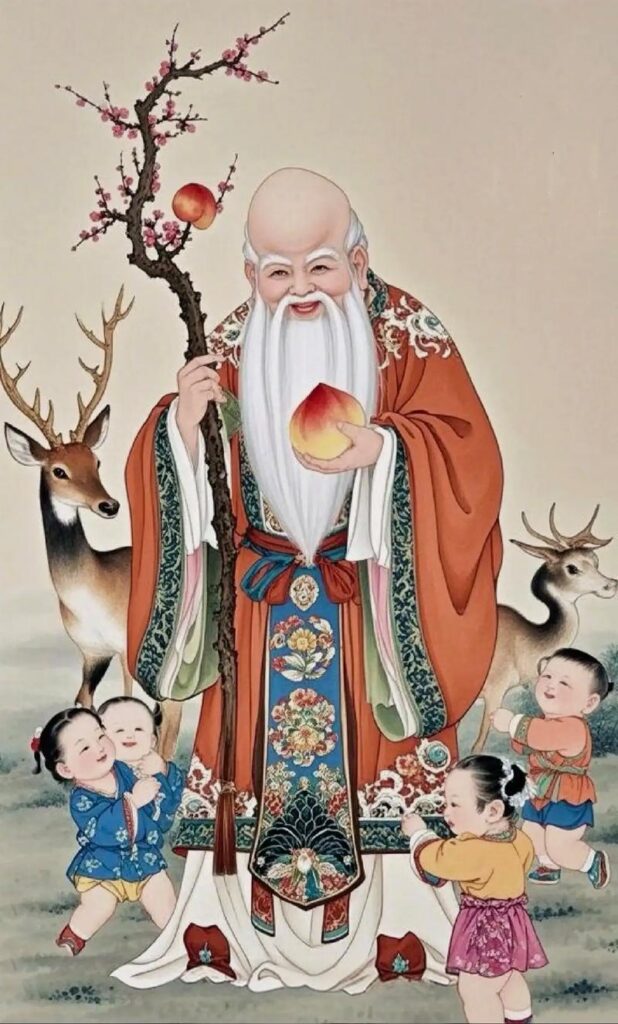
The Chinese god of longevity Shou Xing (寿星 or 壽星, Shòuxīng) is a star deity and auspicious elderly figure associated with long life. He is usually recognized by his unusually high forehead, white beard, walking staff and peach. His name means “Longevity Star,” reflecting his older identity as the personification of a southern celestial body identified with Canopus. In later Chinese art and popular religion, he became one of the three Fu Lu Shou gods representing blessing, status and longevity. Shou Xing is not a creator god, a verified historical person or the supreme ruler of the Daoist heavens.
| Quick fact | Details |
|---|---|
| Chinese name | 寿星 in simplified Chinese and 壽星 in traditional Chinese |
| Pinyin | Shòuxīng |
| Name meaning | “Longevity Star” |
| Other names | Shou Lao, the Old Man of the South Pole and, in later contexts, Nanji Xianweng |
| Main role | Personification of longevity and the blessing of a long life |
| Celestial association | The Old Man Star, generally identified with Canopus |
| Common symbols | Peach, staff, gourd, deer, crane, pine and an enlarged forehead |
| Famous group | Fu Lu Shou, the Three Stars of blessing, official prosperity and longevity |
| Religious context | Chinese star worship, state ritual, popular religion, Daoist-associated tradition and auspicious art |
Who Is Shou Xing?
Shou Xing is the best-known Chinese divine figure representing longevity. English sources may call him the Chinese god of longevity, the Longevity Star, Shouxing, Shou Hsing or Shou Lao. These names normally point to the same familiar elderly figure, although the vocabulary developed across different periods and sources.
The character shou, 寿 or 壽, means longevity or long life. Xing, 星, means star. Shou Xing therefore began as a celestial title rather than the personal name of a human being. Shou Lao, written 寿老 or 壽老, may be translated as the “Old Man of Longevity.” Another important title is Nanji Laoren, 南极老人 or 南極老人, the “Old Man of the South Pole.”
In this name, “South Pole” refers to the southern region of the traditional Chinese sky. It does not mean that Shou Xing was believed to live in Antarctica. The celestial figure was connected with a conspicuous star low in the southern sky, now generally identified as Canopus.
Modern readers often place Shou Xing under the broad category of Chinese gods and deities. That description is useful, but his identity is more specific: he is a personified star, an auspicious god and a figure shared across popular, artistic and Daoist-associated traditions.
From the Old Man Star to the God of Longevity
The early celestial tradition
Shou Xing did not begin with one complete mythological biography. His older background lies in Chinese astronomy, astrology and state ritual. The celestial treatise in the Records of the Grand Historian describes a large star in the southern sky called the Old Man. Its appearance was interpreted as an auspicious sign of peaceful government, while its absence could be read as a warning of conflict.
Other early and medieval works similarly connected the Old Man Star with order, royal longevity and favorable conditions. These passages describe celestial signs rather than the smiling, peach-carrying grandfather familiar from later statues. The human image emerged gradually as the star was personified and incorporated into religious and artistic culture.
An important naming complication: “Shou Xing” was not always a completely unambiguous astronomical label. Some ritual commentaries identified the Longevity Star with the Old Man Star, while other discussions connected the term with the Jiao and Kang lunar lodges. Later popular iconography largely standardized Shou Xing as the elderly personification of longevity.
Imperial rites for the Longevity Star
Historical records show that the Longevity Star was not confined to private folklore. A Tang imperial edict from the Kaiyuan era ordered the establishment of a Shou Xing altar and prescribed rites for the Old Man Star together with related celestial asterisms. Later ritual histories continued to discuss ceremonies for the Longevity Star around the autumn equinox.
These records do not prove that every later story about Shou Xing was already known in the Tang dynasty. They demonstrate something more specific: the celestial power associated with longevity had a place in official ritual before the fully developed popular image became widespread.
The elderly divine figure
Over time, the abstract star acquired a human form. Paintings, carvings, ceramics and birthday images represented him as a benevolent old man. His age made longevity visible, while his vigorous posture, smile and healthy appearance suggested that a long life should ideally be accompanied by vitality and good fortune.
By the late imperial period, this anthropomorphic Shou Xing had become one of the most recognizable auspicious figures in Chinese art. Individual artworks nevertheless vary. One image may show only the old man and a staff, while another surrounds him with peaches, cranes, deer, children, pine trees or attendants.
What Does Shou Xing Look Like?
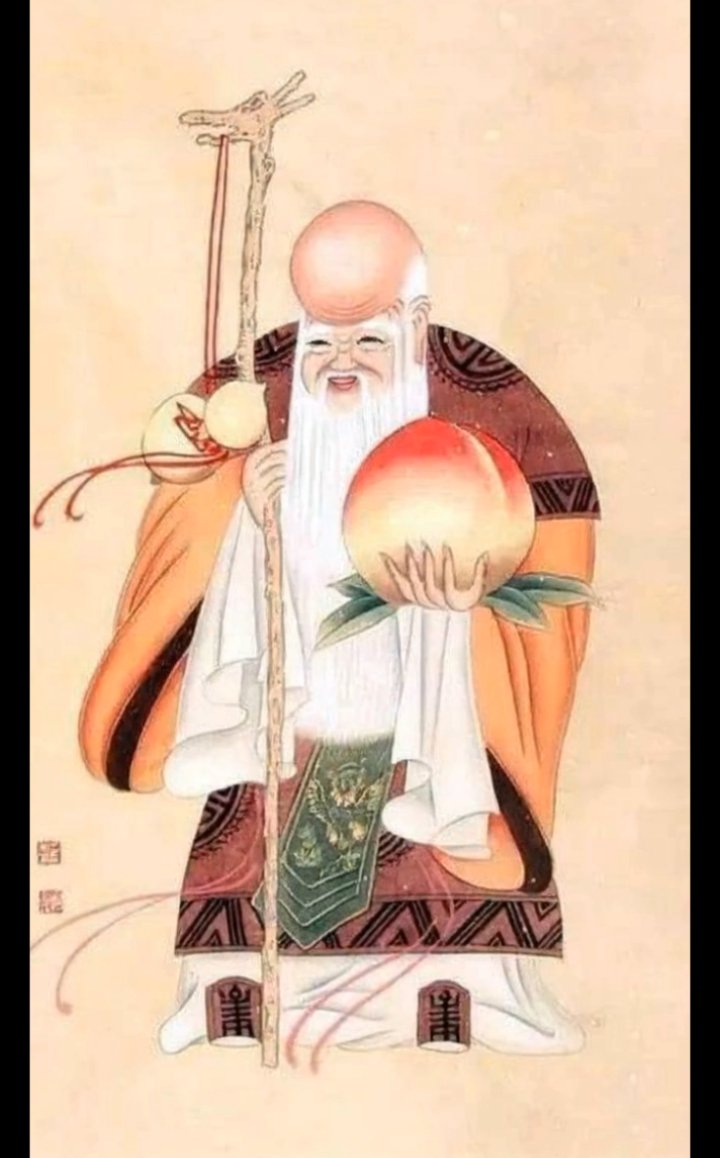
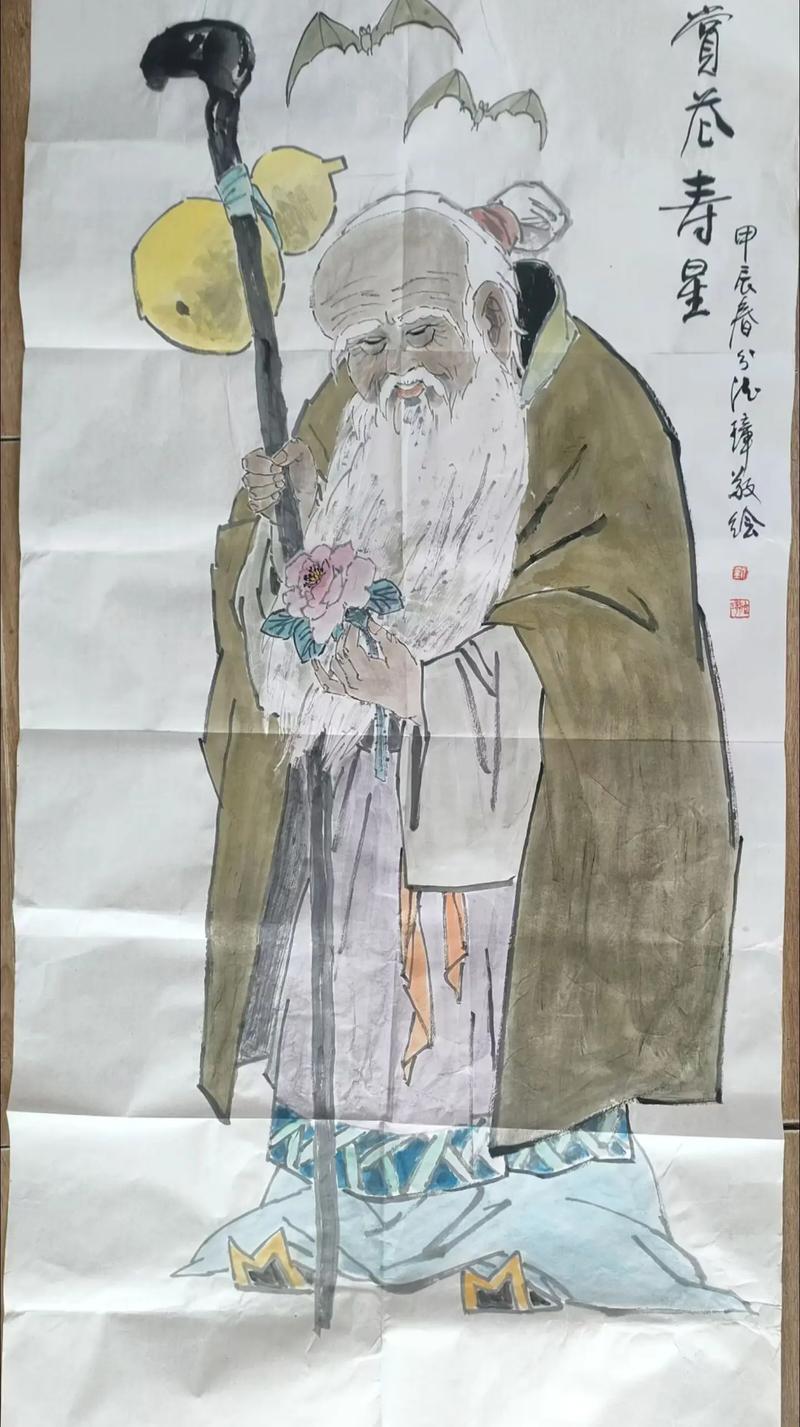
Shou Xing is identified by a cluster of visual features rather than by one universally fixed portrait. His most distinctive characteristic is his enlarged, rounded forehead. He is also commonly shown with a bald or partly bald head, long white eyebrows, a flowing beard and loose robes.
Later stories sometimes invent extraordinary explanations for his unusual head, birth or age. Such tales belong to later folklore and should not be treated as one authoritative ancient biography. In visual art, the forehead primarily functions as an iconographic marker: it allows viewers to identify the longevity god immediately.
The Peach
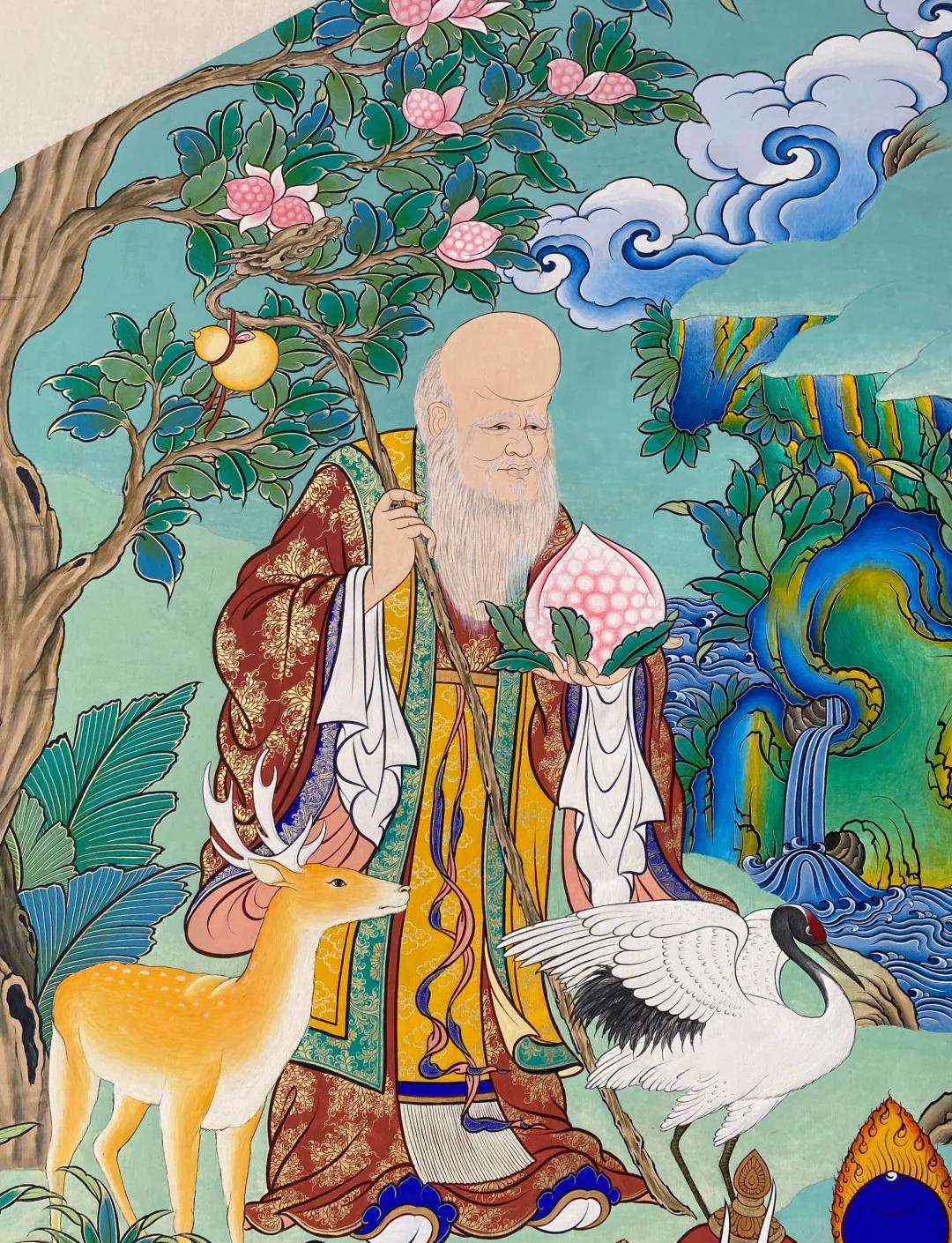
The peach is one of the most familiar Chinese symbols of longevity. Shou Xing may hold a single oversized peach or stand beside a peach tree. The fruit connects him with long life, divine blessing and the immortal realm.
The Walking Staff
The staff emphasizes advanced age, dignity and travel. A scroll or gourd may be attached to it. Some later interpretations say the scroll contains records of human lifespans, but that detail is not universal.
The Gourd
Gourds in Daoist-associated art may hold medicines, elixirs or extraordinary substances. With Shou Xing, a gourd strengthens the association with health, vitality and supernatural longevity.
The Deer
Deer appear frequently in longevity scenes and in art featuring immortals. The word for deer, lù, also resembles the pronunciation of lù meaning official emolument, creating an additional link with prosperity and status.
The Crane
The crane represents longevity, elevation and movement between the human and celestial worlds. It may accompany Shou Xing or other immortal figures, but it is not his exclusive animal.
Pine and Tortoise
Evergreen pines suggest endurance, while tortoises signify exceptional lifespan and stability. They belong to a wider visual vocabulary of longevity rather than to one fixed Shou Xing story.
The peach carried by Shou Xing is sometimes automatically described as one of the magical fruits belonging to Xiwangmu, the Queen Mother of the West. That connection is understandable because Xiwangmu’s immortal peaches became famous in later mythology. In many works of art, however, a peach can simply function as a general longevity emblem. The image does not always illustrate a particular episode involving Xiwangmu.
Shou Xing and Fu Lu Shou
Shou Xing frequently appears with Fu Xing and Lu Xing as the Three Stars, known as Fu Lu Shou, 福禄寿 or 福祿壽. Together they represent three highly valued blessings:
- Fu, 福: blessing, happiness or good fortune
- Lu, 禄 or 祿: official salary, rank, career success and prosperity
- Shou, 寿 or 壽: longevity and a long life
These figures are not a Chinese equivalent of a creator trinity, nor are they necessarily the three highest gods in a theological hierarchy. They are an auspicious group whose images express hopes for a complete and flourishing life.
Fu Xing is often dressed as a respected official and may appear with children, emphasizing blessing and family happiness. Lu Xing commonly wears official robes and represents rank or successful public service. Shou Xing appears as the elderly longevity god. Their visual identities were shaped by popular art, religious culture and the social ideals of late imperial China.
Lu Xing should not automatically be confused with Caishen, the Chinese God of Wealth. Lu originally refers more specifically to an official’s emolument and the prosperity associated with rank. Caishen represents a broader and differently developed category of wealth deities.
Is Shou Xing a Daoist God?
Shou Xing is often called a Daoist god, but “Daoist-associated longevity deity” is usually more precise than treating him as the product of one exclusive tradition. His background includes ancient celestial observation, imperial ritual, popular religion, auspicious visual culture and later Daoist interpretation.
Daoist religion developed extensive systems of star deities, celestial officials, perfected beings and powers associated with human destiny. Shou Xing could therefore be placed naturally within a Daoist sacred universe. He also appears in collections and popular explanations alongside figures commonly classified as Daoist deities and immortals.
That does not mean he has one universally fixed rank in every Daoist school. Chinese religious traditions changed over time, and local temples, ritual texts and popular images did not always organize divine figures in the same way.
Shou Xing, Longevity and Immortality
Longevity and immortality overlap in Chinese religious culture, but they are not identical ideas. Shou Xing primarily embodies the blessing of a long lifespan. A Daoist immortal, or xian, is more often associated with transcendence, spiritual transformation and freedom from ordinary human limitations.
This distinction helps explain why Shou Xing should not simply be classified as another member of the Eight Immortals. The Eight Immortals are a specific group of legendary transcendents with individual names, stories and attributes. Shou Xing is a personified stellar power and longevity god.
Chinese traditions also describe multiple routes to extraordinary life: celestial blessing, moral cultivation, breathing practices, inner transformation, sacred medicines and fictional elixirs. These ideas are examined more fully in the guide to immortality in Taoism. They should not be reduced to the claim that Shou Xing personally grants physical immortality to everyone who honors his image.
Birthday Art and Popular Customs
Shou Xing became especially important in imagery celebrating elderly people. Paintings, porcelain figures and carvings of the longevity god could be displayed or presented as wishes for a long and healthy life. Museum collections contain numerous examples of Shou Xing sculptures associated with birthday blessings.
He also appears within larger birthday scenes containing children, peaches, deer, cranes, pine trees and the character shou. These images communicate auspicious wishes even when they are not used as objects of formal worship.
Longevity peaches and peach-shaped birthday buns belong to the same broad symbolic world. However, serving peach-shaped buns at a birthday meal does not necessarily mean that the family is conducting a ritual for Shou Xing. Decorative symbolism, family custom and religious devotion can overlap without being identical.
Practices also vary by region and community. It is therefore misleading to claim that every Chinese family worships Shou Xing in the same manner or celebrates one universally accepted birthday for him. Local religious calendars may assign particular festival dates, but these should not be presented as a single rule for all Chinese traditions.
Later Stories and Literary Versions
As Shou Xing became a recognizable divine personality, folklore and literature supplied him with additional stories. The title Nanji Xianweng, 南极仙翁 or 南極仙翁, meaning the “Immortal Elder of the South Pole,” appears in later religious and literary settings. Ming-period fiction could portray this figure as an active celestial immortal with teachers, attendants, animals and specific adventures.
These stories helped popularize Shou Xing’s personality, but they are later developments rather than eyewitness accounts of ancient belief. A role assigned to Nanji Xianweng in a novel should not automatically be treated as part of the earliest astronomical tradition.
Modern television dramas, games, comics and fantasy novels continue to adapt the longevity god. They may give him new powers, relationships or positions within a standardized heavenly bureaucracy. Such portrayals are creative interpretations, not evidence that all temples or historical sources described him in the same way.
Common Misunderstandings About Shou Xing
| Misunderstanding | More accurate explanation |
|---|---|
| Shou Xing was a historical old man who became a god. | His core identity developed from a personified star. Later tales may give him human-like biographies, but he is not a verified historical individual. |
| He is the supreme god of Chinese mythology. | Shou Xing represents longevity. He is not the ruler of Heaven or the highest deity in every Daoist system. |
| Shou Xing and Laozi are the same figure. | They are distinct. The word lao can mean old or venerable, but Shou Lao is not another name for Laozi. |
| Every peach he carries comes directly from Xiwangmu’s garden. | Some images invite that association, but the peach also functions independently as a general symbol of longevity. |
| Fu Lu Shou are the three highest Daoist gods. | They are popular auspicious star figures representing blessing, status and long life, not a universal supreme triad. |
| The Old Man of the South Pole lives at Earth’s South Pole. | The title refers to the southern celestial region in traditional Chinese astronomy, not Antarctica. |
Why Shou Xing Still Matters
Shou Xing gives a human face to an enduring hope: not merely survival, but a long life accompanied by health, dignity, family continuity and good fortune. His development also shows how Chinese divine figures could move between astronomy, imperial ritual, religious interpretation, folklore and art.
The earliest Old Man Star was read as a celestial sign. Later artists transformed that distant star into an approachable grandfather carrying familiar auspicious objects. As one of Fu Lu Shou, he became part of a compact visual expression of the good life. His peach, staff and smiling face remain recognizable because they communicate a blessing without requiring one fixed mythological narrative.
Frequently Asked Questions
Who is the Chinese god of longevity?
Shou Xing is the best-known Chinese god of longevity. His name means “Longevity Star,” and he developed from the personification of the Old Man Star in the southern sky.
What does the name Shou Xing mean?
Shou, 寿 or 壽, means longevity, while xing, 星, means star. The combined name Shòuxīng therefore means “Longevity Star.”
Why does Shou Xing have such a large forehead?
The enlarged forehead is an artistic feature that makes the deity easy to recognize and emphasizes his extraordinary age. Later folklore offers imaginative explanations, but there is no single early text that establishes one universal origin story for it.
What does Shou Xing hold in his hands?
He commonly holds a peach and a walking staff. Depending on the artwork, the staff may carry a scroll or gourd, and he may be accompanied by a deer, crane or other longevity symbols.
Is Shou Xing one of Fu Lu Shou?
Yes. Shou Xing represents longevity within Fu Lu Shou. Fu represents blessing or good fortune, while Lu represents official emolument, rank and prosperity.
Is Shou Xing a Daoist deity?
He is frequently represented in Daoist-associated contexts, but his history also includes older star worship, imperial ritual and Chinese popular religion. It is therefore more accurate to recognize his identity as shared across several overlapping traditions.
References and Further Reading
- Chinese Text Project, Records of the Grand Historian: Celestial Officials Treatise.
- Chinese Text Project, Tang imperial edict concerning the Shou Xing altar.
- The Metropolitan Museum of Art, “Shouxing, Stellar God of Immortality”.
- The British Museum, collection biography for Shoulao.
- Princeton University Art Museum, “God of Longevity”.
- University of Michigan Museum of Art, “The Three Stars: Gods of Happiness, Prosperity and Longevity”.
- Science Museum Group Collection, “Statue Depicting Shou Lao (Shou Xing)”.