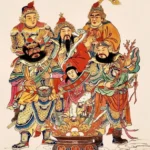
The Kitchen God, better known in Chinese as Zao Shen or Zao Jun, is one of the most familiar household gods in Chinese folk religion. He may not be the highest-ranking deity in the Chinese pantheon, but in everyday family life, he has always held a surprisingly intimate place.

Traditionally, Zao Jun was believed to live near the stove or hearth, watching over the household throughout the year. Before the Lunar New Year, he would return to heaven and report the family’s behavior to the Jade Emperor. Because of this, families treated him with respect, offerings, and sometimes a little sweet persuasion.
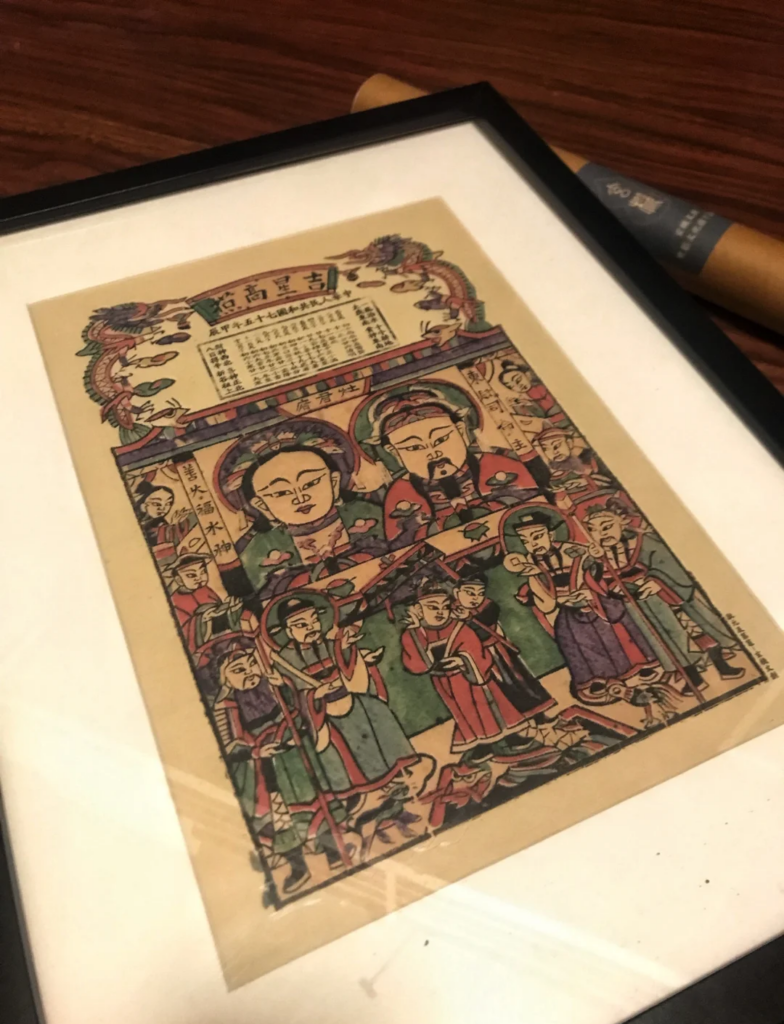
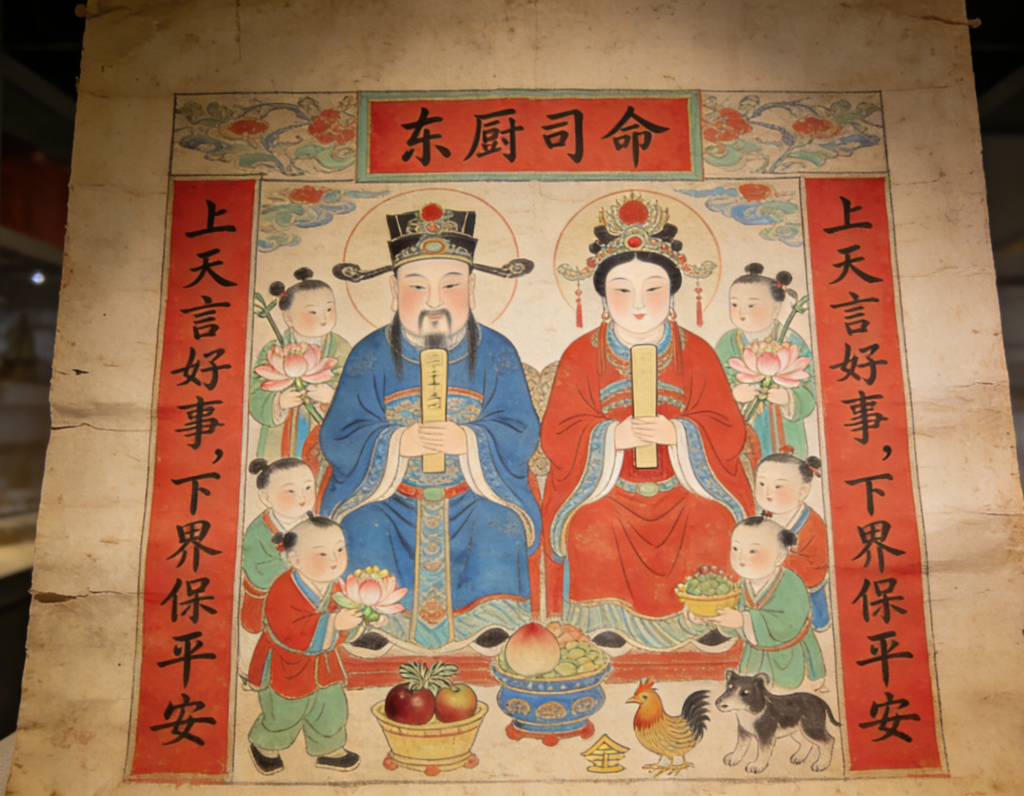
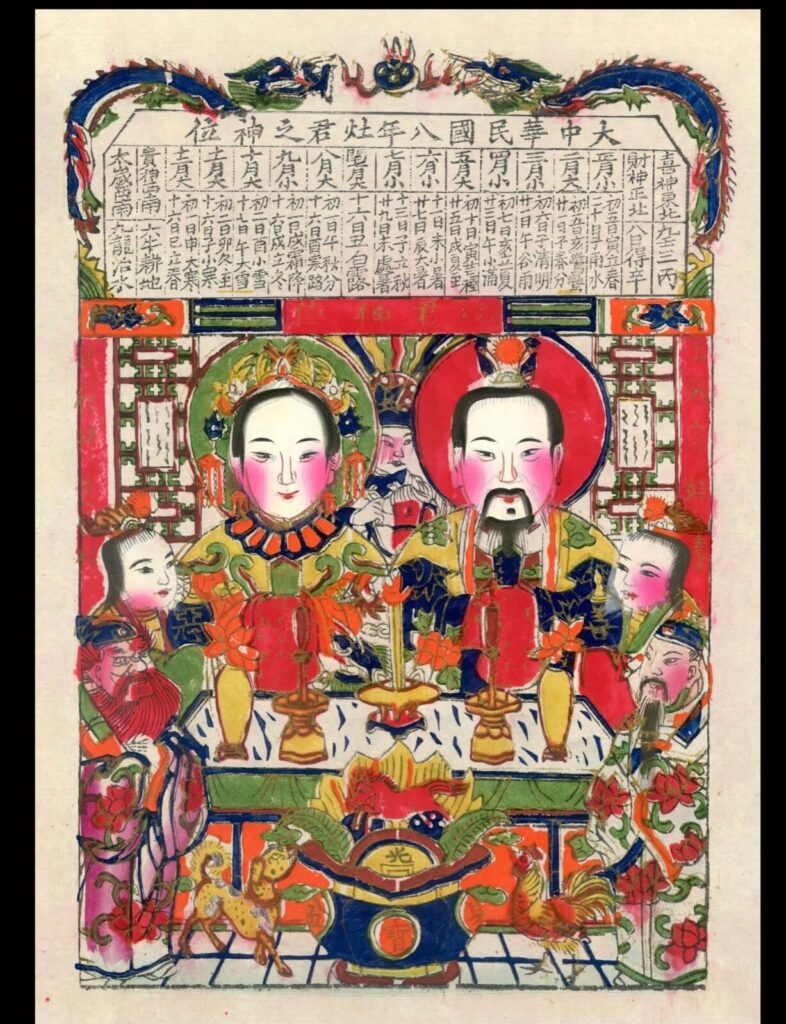
In many old Chinese homes, a paper image of the Kitchen God and his wife was placed above the stove. Even today, his story still tells us a great deal about Chinese ideas of family, morality, domestic order, and the sacred meaning of the kitchen.
Who Is the Kitchen God?
The Kitchen God is a household deity associated with the stove, cooking, family unity, and moral supervision. His most common names include:
- Zao Shen — “Stove God”
- Zao Jun — “Stove Master”
- Zao Jun Gong — “Lord Stove Master”
- Zao Wang — “Stove King”
- Dongchu Siming — often translated as “Controller of Fate of the Eastern Kitchen”
In Chinese belief, the kitchen was never just a practical room. It was the warm center of the household, the place where food, family rhythm, and daily survival came together. The stove represented domestic continuity, so the god of the stove naturally became a guardian of the home.
Although Zao Jun is often described as a lower-ranking god, he is important because he acts as a direct messenger between ordinary families and the heavenly court.
The Meaning of Zao Shen and Zao Jun
The name Zao Shen comes from two Chinese characters:
Zao means stove or kitchen hearth.
Shen means god or spirit.
So Zao Shen simply means “Stove God.”
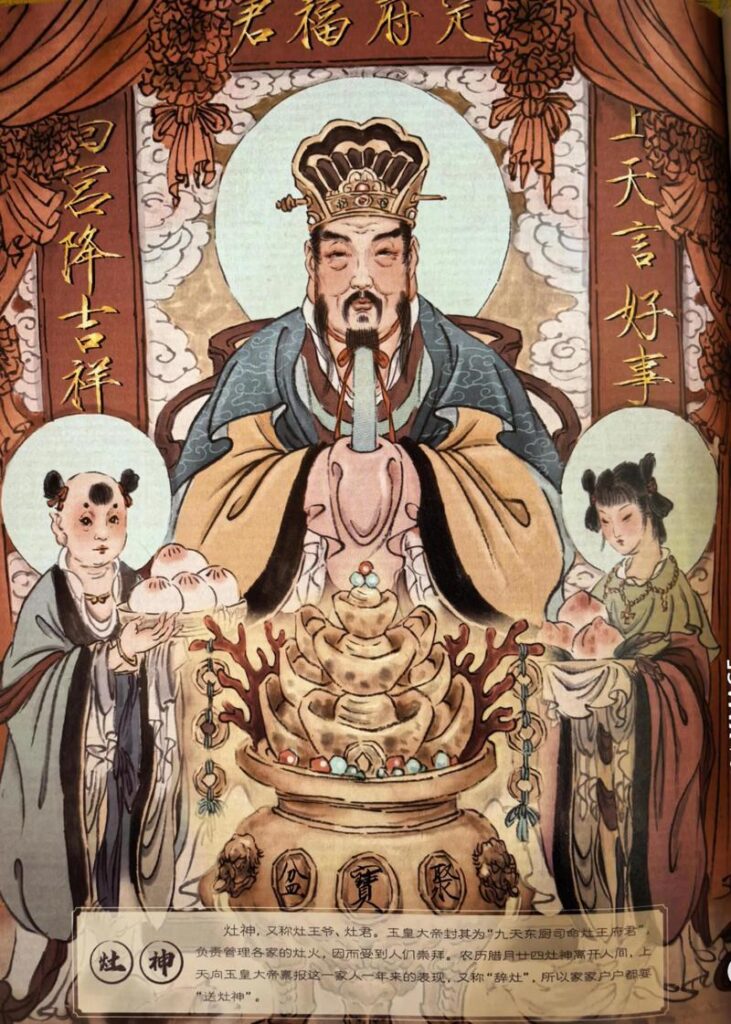
Zao Jun, meanwhile, can be translated as “Stove Master” or “Lord of the Stove.” This title gives him a slightly more official tone, fitting the way he is often shown in art: dressed like a Chinese official, wearing formal robes and a scholar’s cap.
This official appearance is important. Zao Jun is not just a warm household spirit. He is also a divine observer, recorder, and reporter. In many stories, he watches the family’s conduct and carries that record to the Jade Emperor.
The Origin of Zao Jun: From Mortal Man to Kitchen God
There are many explanations for the origin of the Kitchen God. Some traditions connect him with ancient fire worship, some with early hearth rituals, and others with legendary figures such as the Yellow Emperor, Zhu Rong, or Suiren, the mythical discoverer of fire.
But the most famous folk story says that Zao Jun was once a mortal man named Zhang Dan.
According to this version, Zhang Dan was married but later abandoned his wife for a younger woman. As punishment for his betrayal, heaven struck him blind. His young lover eventually left him, and Zhang Dan became poor, helpless, and forced to beg for food.
One day, without realizing it, he came to the home of the wife he had abandoned. She recognized him, but instead of turning him away, she treated him with kindness. She gave him food, listened to his suffering, and showed compassion despite the pain he had caused her.
Moved by guilt, Zhang Dan said he wished he could see his former wife again and ask for forgiveness. At that moment, his sight returned, and he recognized her. Overcome with shame, he threw himself into the stove fire and died.
When he awoke, he found himself not in hell, but before the Jade Emperor. Because of his remorse, he was appointed as the Stove Master and given the duty of watching over human households.
It is a strange origin story: moral failure, punishment, regret, suicide, and divine appointment all in one. But that is part of what makes Zao Jun so interesting. He is not a perfect god from the beginning. He is a flawed figure transformed into a household guardian.
Why the Kitchen God Matters in Chinese Family Life
The Kitchen God became important because the stove itself was important.
In traditional Chinese households, the stove represented the unity of the family. Food was prepared there, ancestral continuity was symbolized there, and the rhythms of daily life were centered around it.
In late imperial China, when a large family divided into separate households, the stove could mark the split. Two married brothers who no longer lived as one family could not simply share one Kitchen God. A new household needed its own stove and its own divine guardian.
This tells us something essential: Zao Jun was not only a god of cooking. He was a god of household identity.
To have a stove was to have a family center. To have a Kitchen God was to be recognized as a complete domestic unit.
Zao Jun and His Wife
In many traditional images, Zao Jun appears with his wife. Sometimes he is shown with one wife; in some folk prints, he may appear with two female figures.
His wife is usually not given an independent name in popular stories. She is often simply called Zao Jun’s wife or the Kitchen God’s wife. In some versions of the Zhang Dan story, the wife who forgave him later becomes his assistant or scribe, helping him record what happens in the household.
This detail is small but meaningful. The Kitchen God watches, but his wife helps preserve the record. Together, they form a divine pair above the stove, reflecting the traditional image of a complete household.
At the same time, the way Zao Jun’s wife is treated in folklore also reflects older family values. She is often present, necessary, and morally powerful, yet not always given the same formal identity as the male deity.
What Does the Kitchen God Look Like?
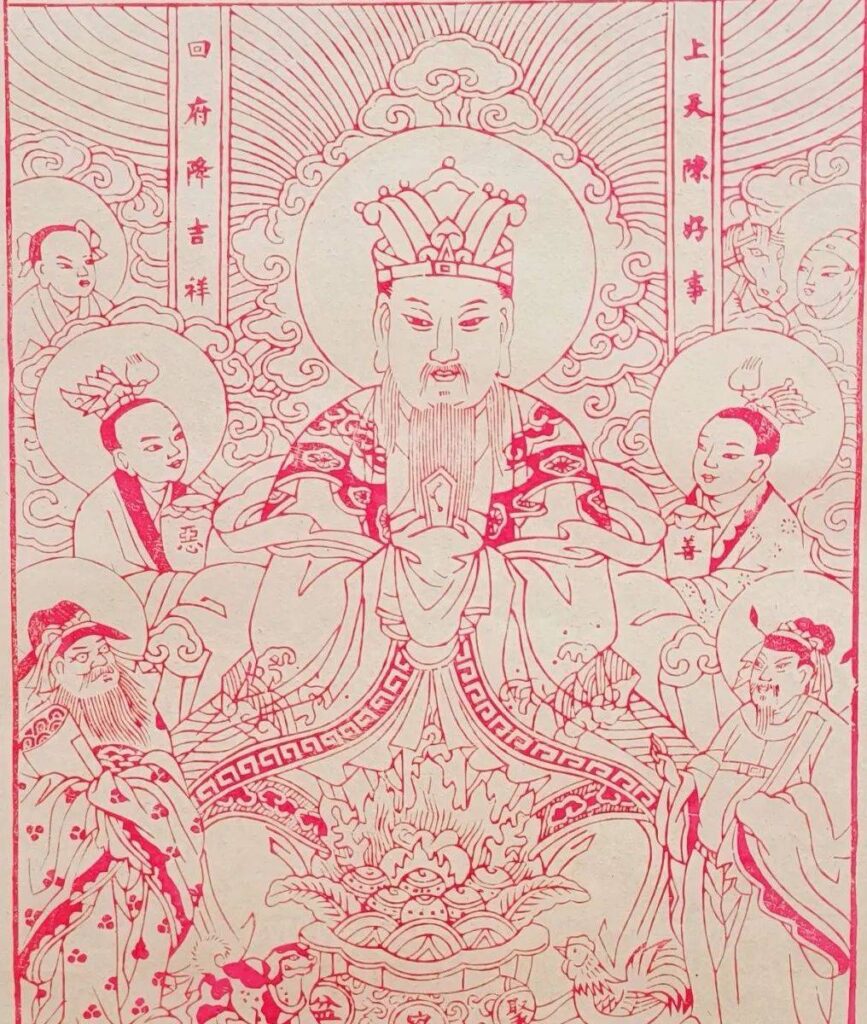
Traditional images of Zao Jun usually show him as an older male official. He often has:
- Formal Chinese robes
- A long beard and mustache
- A scholar-official cap
- A seated, dignified posture
- His wife or wives beside him
In early traditions, however, the Kitchen God was not always imagined this way. Some older sources describe the stove deity as female, youthful, or connected more directly with fire itself. Over time, especially as Daoist and folk religious systems developed, Zao Jun became increasingly personified as a male household official.
By the Ming and Qing periods, popular images often showed him as a worldly, sometimes plump, old-fashioned figure. This more humanized appearance made him feel close to ordinary life rather than distant and majestic.
The Kitchen God’s Annual Report to the Jade Emperor
The most famous tradition surrounding Zao Jun is his yearly journey to heaven.
Near the end of the lunar year, usually on the twenty-third day of the twelfth lunar month, the Kitchen God is believed to leave the household and report to the Jade Emperor. His report includes the family’s good and bad actions over the past year.
This belief made Zao Jun both comforting and slightly intimidating. He protected the family, but he also observed it. Nothing that happened around the home was entirely private.
The kitchen, in this sense, became a moral space. Everyday behavior mattered. Family harmony mattered. How people treated one another mattered.
Why People Offer Sweets to Zao Jun
One of the best-known Kitchen God customs is offering him sticky sweets before his trip to heaven.
Families traditionally gave Zao Jun sweet cakes, malt sugar, honey, or other sticky desserts. The meaning is playful but serious:
The sweets would “sweeten” his words so he would say good things to the Jade Emperor.
The sticky texture might seal his mouth so he could not report bad things.
The offering showed respect and asked for family protection in the coming year.
In some households, honey was even rubbed on the mouth of the Kitchen God’s paper image. After prayers and offerings, the old image would be burned, symbolically sending him up to heaven. Around the New Year, a fresh image would be placed above the stove, welcoming him back.
This ritual is one of the reasons Zao Jun remains so memorable. It combines reverence, humor, anxiety, and hope in a very human way.
The Kitchen God and Chinese New Year
Zao Jun plays an important role in the lead-up to Chinese New Year.
Before the New Year begins, the household must be ritually renewed. The Kitchen God’s departure and return fit naturally into this cycle. Families clean the home, replace old images, prepare offerings, and welcome a new beginning.
The burning of the old Kitchen God image does not mean disrespect. It is a way of sending him to heaven. When a new image is installed, it marks the renewal of the household’s relationship with the divine world.
In this way, the Kitchen God tradition is not only about fear of judgment. It is also about resetting the home, repairing moral balance, and hoping for peace in the year ahead.
Zao Shen in Daoism and Folk Religion
The Kitchen God exists in both Chinese folk religion and Daoist tradition.
In folk belief, he is a familiar household deity, close to daily life. Families worship him through simple offerings, paper images, kitchen shrines, and New Year rituals.
In Daoist thought, Zao Jun became part of a more organized religious system. His duties expanded beyond food and fire. He was linked with ideas of fate, moral accounting, household fortune, and divine bureaucracy.
This blend of folk practice and Daoist structure helped Zao Jun endure for centuries. He was simple enough for ordinary families to worship, but also important enough to be included in broader religious cosmology.
Is Zao Jun a Fire God?
The Kitchen God is closely connected with fire, but he is not always identical to a fire god.
Scholars often see hearth worship as one of the roots of Zao Jun belief. In very early communities, fire was sacred because it provided warmth, cooked food, protected people, and gathered the group together. Over time, the sacred fire of the home became associated with a more personal stove deity.
This may explain why traditions about the Kitchen God vary so much. In some places, he is linked to fire worship. In others, he is a moral official. In some stories, he began as a historical or legendary man. In others, he is part of Daoist divine administration.
Rather than one single origin, Zao Jun is better understood as a layered figure built from fire worship, family ethics, folk storytelling, and religious imagination.
The Kitchen God Beyond China
The worship of the Kitchen God also influenced other parts of Asia, especially places shaped by Chinese cultural traditions.
Vietnamese traditions, for example, include household kitchen deities connected with the Lunar New Year season. These beliefs developed through a mixture of local culture and Chinese influence.
This wider spread shows how powerful the idea of a kitchen guardian can be. Almost every culture understands the home as more than a building. The hearth, stove, or cooking space often becomes a symbol of family life itself.
Why Zao Jun Still Feels Relevant Today
Modern kitchens look very different from ancient hearths. Gas stoves, electric cooktops, microwaves, and apartment living have changed the way families cook and gather.
Yet the Kitchen God remains culturally meaningful.
He reminds us that the home is watched not in a frightening way, but in a moral and emotional sense. The small things that happen inside a family matter. Meals matter. Kindness matters. Betrayal, forgiveness, and renewal matter.
That may be why Zao Jun’s story has survived for so long. He belongs to the kitchen, but his meaning reaches far beyond food. He represents the household as a living moral space.
Final Thoughts on the Kitchen God
The Kitchen God, Zao Shen or Zao Jun, is one of the most personal figures in Chinese mythology. He is not a remote cosmic ruler or a warrior deity. He is a god of the stove, the family, and the everyday life that unfolds around meals and domestic routines.
His annual report to the Jade Emperor gives him authority. His origin story gives him human weakness. His wife gives his image a sense of household completeness. His New Year rituals bring sweetness, renewal, and a little humor into religious practice.
To understand Zao Jun is to understand how deeply Chinese tradition connects the sacred with ordinary family life. The kitchen is not just where food is made. In this tradition, it is where the home is spiritually held together.
FAQ
Who is the Kitchen God in Chinese mythology?
The Kitchen God is a Chinese household deity known as Zao Shen or Zao Jun. He is believed to live near the stove or hearth, watch over the family, and report the household’s behavior to the Jade Emperor before the Lunar New Year.
What does Zao Shen mean?
Zao Shen means “Stove God” in Chinese. “Zao” refers to the stove or kitchen hearth, while “Shen” means god or spirit.
What is the difference between Zao Shen and Zao Jun?
Both names refer to the Kitchen God. Zao Shen means “Stove God,” while Zao Jun means “Stove Master” or “Lord of the Stove.” Zao Jun sounds more like an official title.
Why does the Kitchen God report to the Jade Emperor?
In Chinese folk belief, Zao Jun observes the family throughout the year and reports their good and bad actions to the Jade Emperor. This report may influence the household’s fortune in the coming year.
Why do people give sweets to the Kitchen God?
People offer sticky sweets, honey, or sugar cakes to Zao Jun before his journey to heaven. The sweets are meant to make his words pleasant or keep his mouth too sticky to report bad behavior.
When is the Kitchen God worshiped?
The Kitchen God is especially honored before Chinese New Year, often on the twenty-third day of the twelfth lunar month. Families may burn his old paper image to send him to heaven and later place a new image above the stove.
Who is Zao Jun’s wife?
Zao Jun’s wife is usually unnamed in folklore. In many images, she appears beside him as part of the household shrine. In some stories, she helps him record the actions of the family.
Was Zao Jun originally a human?
In one popular legend, Zao Jun was once a mortal man named Zhang Dan. After betraying his wife and later feeling deep remorse, he died in the stove fire and was appointed by the Jade Emperor as the Kitchen God.
Is the Kitchen God still worshiped today?
Yes, though practices vary. Some families still place images of Zao Jun in the kitchen, especially around Lunar New Year. Even where active worship has faded, the Kitchen God remains an important figure in Chinese cultural memory.