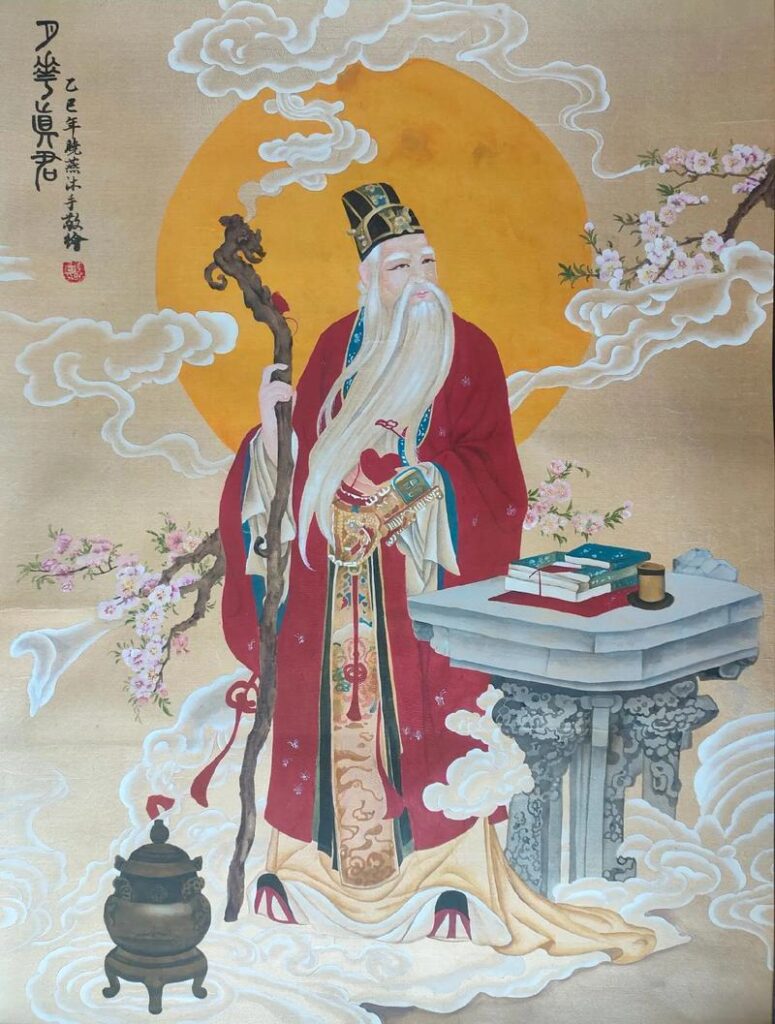
In Chinese mythology, Yue Lao is the gentle but mysterious god of love and marriage. Also known as Yue Xia Lao Ren — the “Old Man Under the Moon” — he is believed to bring destined couples together with an invisible red thread.
Unlike dramatic war gods or fearsome underworld deities, Yue Lao feels quiet, poetic, and deeply human. His world is not built around thunder, punishment, or cosmic battles. It is built around a simple question almost everyone understands: Are some people meant to meet?
For centuries, Yue Lao has represented the hope that love is not entirely random. Somewhere beyond ordinary sight, an old immortal beneath the moonlight reads from a marriage register, holding a red thread that can quietly connect two lives.
Who Is Yue Lao?
Yue Lao is the Chinese folk deity who presides over love, marriage, and matchmaking. His full name, Yue Xia Lao Ren 月下老人, literally means “the old man under the moon.”
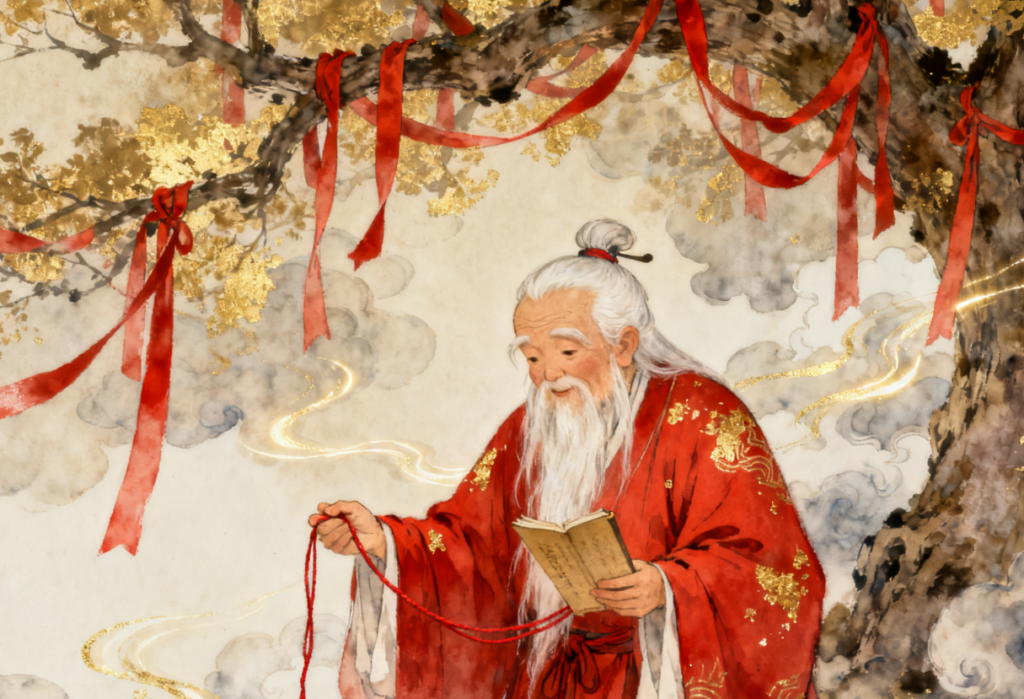
In Chinese folklore, he is often described as an elderly immortal who appears under moonlight, carrying a book of marriages and a red silk thread. This thread is used to bind together people who are destined to become husband and wife.
Over time, Yue Lao became so closely associated with matchmaking that his name itself came to mean a matchmaker. Even today, the phrase “Yue Lao” can be used when speaking about someone who helps bring a couple together.
What Does Yue Lao Look Like?
Traditional depictions of Yue Lao usually show him as a kind old man with a long white beard. He may wear yellow or imperial-style robes and carry a staff or a marriage register.
His most important symbol is the red thread of fate.
This red thread is not simply decoration. In Yue Lao’s mythology, it represents a destined romantic bond. Once Yue Lao ties two people together with this thread, distance, social status, family conflict, or personal resistance cannot fully break the connection.
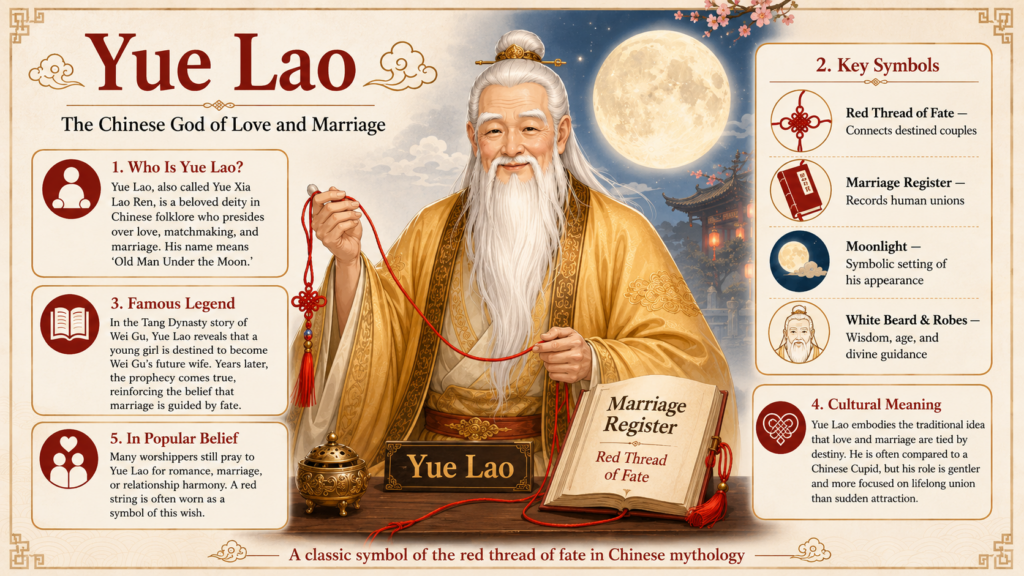
Common Yue Lao symbols include:
- A red silk thread — the bond between destined lovers
- A marriage register — the book recording human marriages
- Moonlight — the poetic setting of his appearance
- An old immortal figure — wisdom, fate, and unseen guidance
This imagery is one reason Yue Lao remains one of the most memorable figures in Chinese mythology. He turns the abstract idea of romantic destiny into something visual: a single red thread quietly linking two people.
The Meaning of Yue Lao’s Red Thread
The red thread associated with Yue Lao is one of the most famous love symbols in East Asian folklore. It suggests that two people may be connected before they even meet.
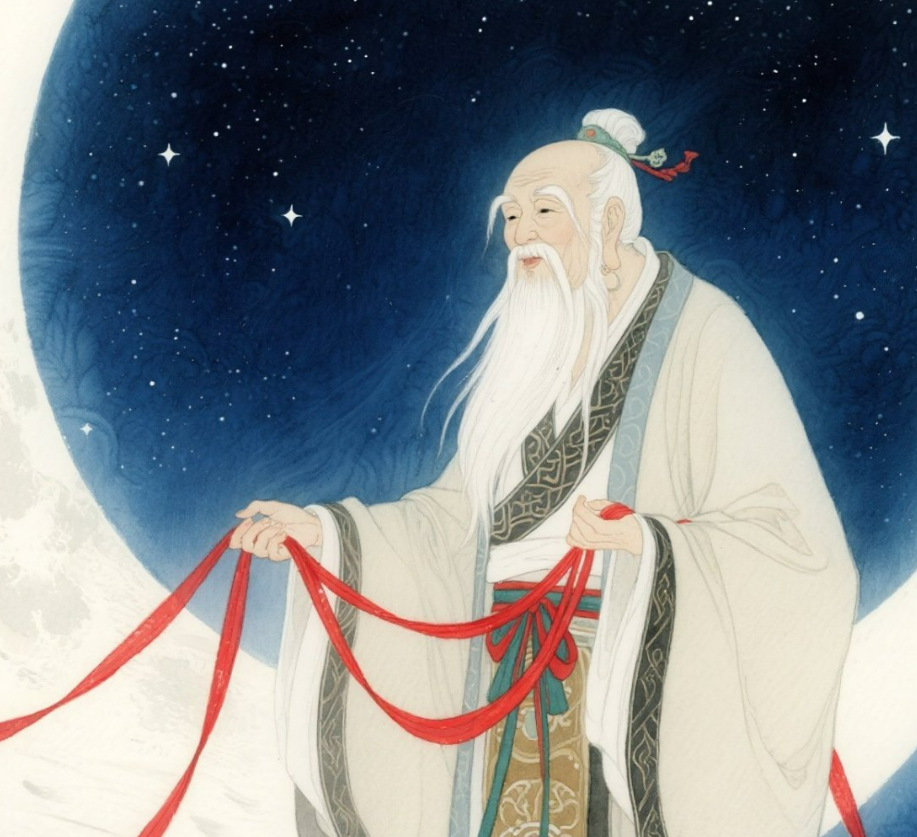
In some versions, Yue Lao ties the thread around the feet of a man and a woman. In later popular imagination, people often picture it around the wrist or finger. The exact detail may vary, but the meaning stays the same: love and marriage are guided by fate.
This is why Yue Lao is often compared to Cupid in Western culture. But the comparison is not perfect.
Cupid is usually imagined as a youthful figure who shoots arrows of love. Yue Lao, by contrast, is an elderly immortal who reads from a register and ties threads according to destiny. His role is less impulsive and more administrative, almost like a cosmic matchmaker working through an unseen system of fate.
The Tang Dynasty Legend of Wei Gu and Yue Lao
The best-known Yue Lao story comes from the Tang Dynasty and centers on a young man named Wei Gu.
According to the legend, Wei Gu was traveling through Songcheng when he encountered an old man reading a mysterious book by moonlight. The old man sat with a cloth bag beside him. Curious, Wei Gu asked what he was reading.
The old man replied that the book contained the marriage records of all people in the world.
Wei Gu then asked what was inside the bag. The old man explained that it contained red threads used to bind the feet of future husbands and wives. Once two people were tied together by this thread, they would eventually marry, no matter how unlikely the match seemed.
Wei Gu asked who his future wife would be. The old man pointed to a very young girl from a poor family and said that she was destined to marry him years later.
Wei Gu was shocked and angry. He could not accept the idea that he, an educated man, would marry such a child from such a humble background. In some versions of the story, he ordered a servant to harm the girl. The attack left a scar between her eyebrows.
Years passed. Wei Gu eventually became an official and was rewarded with marriage to a beautiful young woman from an important household. On their wedding night, he noticed that his bride always covered her forehead. When he asked why, she revealed a scar between her eyebrows and explained that she had been injured as a child.
Wei Gu then realized the truth: his wife was the same girl Yue Lao had shown him many years earlier.
The legend is powerful because it does not present fate as sentimental or easy. Wei Gu resists it. He misunderstands it. He even acts cruelly because of it. Yet the thread still holds.
Yue Lao and the Idea of Predestined Marriage
The Yue Lao legend reflects a broader Tang Dynasty belief that marriage was shaped by fate. Love and marriage were not always seen as purely personal choices. They could be understood as part of a larger cosmic order.
This is why the image of Yue Lao became so influential. Instead of explaining marriage destiny as an abstract doctrine, the legend gives it a face, a scene, and a symbol.
An old man reads by moonlight.
A book records human marriages.
A red thread connects two people before they understand why.
It is simple, visual, and emotionally memorable.
At the same time, the story also leaves room for reflection. In modern life, many people may not literally believe that every marriage is fixed in advance. Still, Yue Lao’s red thread remains a beautiful metaphor for unexpected connections, lasting bonds, and the strange feeling that some meetings seem almost impossible to dismiss as chance.
Yue Lao in Chinese Temples and Folk Belief
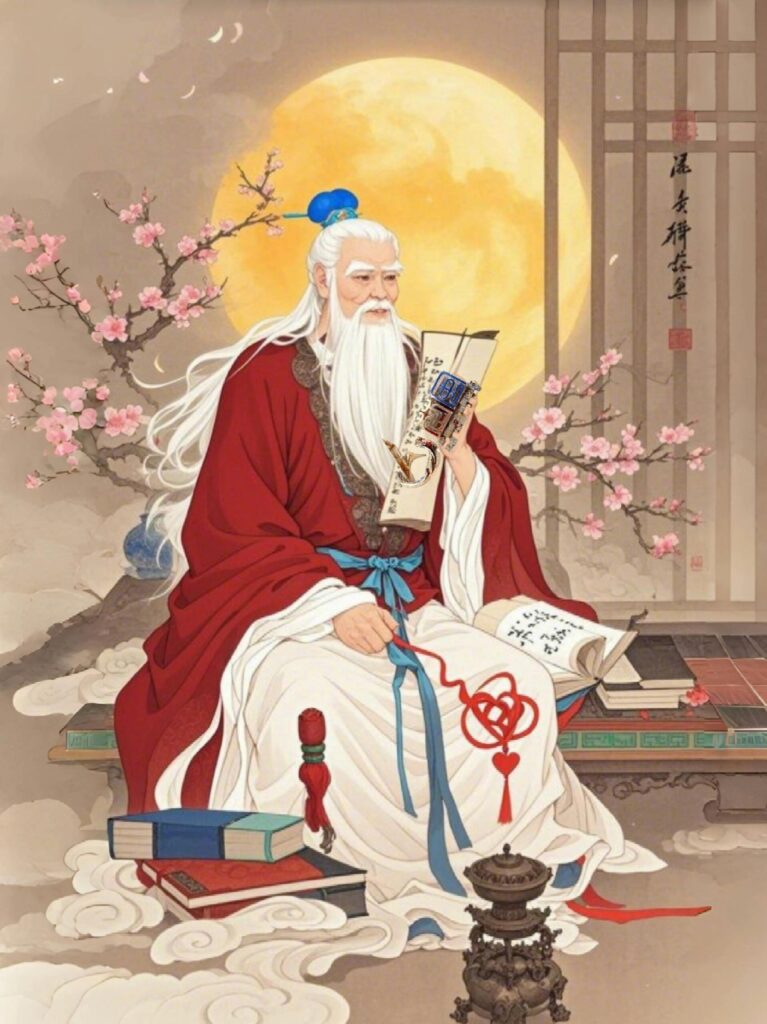
Yue Lao has long been a popular deity among people seeking love, marriage, or a stable relationship. In many places, worshippers visit temples associated with Yue Lao to pray for romantic luck or a good marriage.
A common practice is to pray sincerely and then wear or keep a red string as a sign of the wish. The red string echoes Yue Lao’s legendary thread and symbolizes the hope of being connected to the right person.
Yue Lao worship is especially common among young singles, couples hoping for marriage, and people seeking harmony in relationships. In this way, Yue Lao is not only a figure from old stories. He remains part of living folk culture.
Is Yue Lao the Chinese Cupid?
Yue Lao is often described as the Chinese Cupid, but this is only a convenient comparison.
Both figures are connected with love, but they belong to very different mythological worlds. Cupid is usually linked with passion, attraction, and sudden love. Yue Lao is more closely connected with marriage, destiny, and long-term union.
A better way to understand Yue Lao is as a divine matchmaker. His power is not to make someone fall in love instantly, but to connect people whose marriage has already been written into fate.
That makes Yue Lao gentler, quieter, and perhaps more philosophical than Cupid. He does not shoot an arrow. He ties a thread.
Other Names and Traditions of Yue Lao
Yue Lao is also known as Yue Xia Lao Ren, meaning “Old Man Under the Moon.” Some traditions identify him with the name Chai Daohuang, though this is more common in later local or textual traditions.
He is associated with the Tang Dynasty origin of the famous matchmaking legend, especially the tale often called The Marriage Shop or The Betrothal Shop. Later literature continued to refer to Yue Lao as the divine figure who governs marriage bonds.
In Chinese culture, his name became so familiar that “Old Man Under the Moon” could simply mean a matchmaker. This shows how deeply the legend entered everyday language.
Why Yue Lao Still Matters Today
Yue Lao remains popular because his story speaks to something timeless. People still wonder why certain relationships happen, why some meetings feel meaningful, and why love can appear in unexpected ways.
The red thread of fate gives that mystery a poetic shape.
For some, Yue Lao is a religious figure to pray to. For others, he is a cultural symbol of romance. For writers, artists, and storytellers, he offers one of the most elegant images in Chinese mythology: an old man beneath the moon, quietly tying together lives that have not yet met.
Whether taken literally or symbolically, Yue Lao continues to represent the hope that love is not completely lost in chance. Somewhere, somehow, a thread may already be waiting.
FAQ About Yue Lao
Who is Yue Lao?
Yue Lao is the Chinese god of love, marriage, and matchmaking. He is also called Yue Xia Lao Ren, meaning “the Old Man Under the Moon.”
What does Yue Lao mean?
The name Yue Lao is a shortened form of Yue Xia Lao Ren 月下老人, which means “Old Man Under the Moon.”
What is Yue Lao’s red thread?
Yue Lao’s red thread is a symbol of romantic destiny. In folklore, he uses it to connect men and women who are destined to become husband and wife.
Is Yue Lao the same as Cupid?
Yue Lao is often called the Chinese Cupid, but they are not exactly the same. Cupid is associated with love and attraction, while Yue Lao is more closely connected with marriage, fate, and matchmaking.
What is the legend of Wei Gu and Yue Lao?
The legend tells of Wei Gu, a Tang Dynasty man who met an old immortal reading marriage records under the moon. The immortal predicted Wei Gu’s future wife, and years later the prediction came true despite Wei Gu’s resistance.
Do people still worship Yue Lao today?
Yes. Many people still pray to Yue Lao for love, marriage, and relationship luck. Some worshippers wear or keep a red string after praying as a symbol of their wish.
What does the red thread of fate mean?
The red thread of fate means that two people may be connected by destiny, even before they meet. It suggests that distance, obstacles, or social differences cannot easily break a true destined bond.
Where did the Yue Lao story come from?
The most famous Yue Lao story comes from Tang Dynasty literature, especially the tale commonly known as The Marriage Shop or The Betrothal Shop.
What does Yue Lao look like?
Yue Lao is usually shown as an elderly man with white hair or a long white beard. He may carry a marriage register, a staff, and a red thread.
Why is Yue Lao important in Chinese mythology?
Yue Lao is important because he personifies the idea of predestined marriage. His red thread became one of the most enduring symbols of love and fate in Chinese folklore.