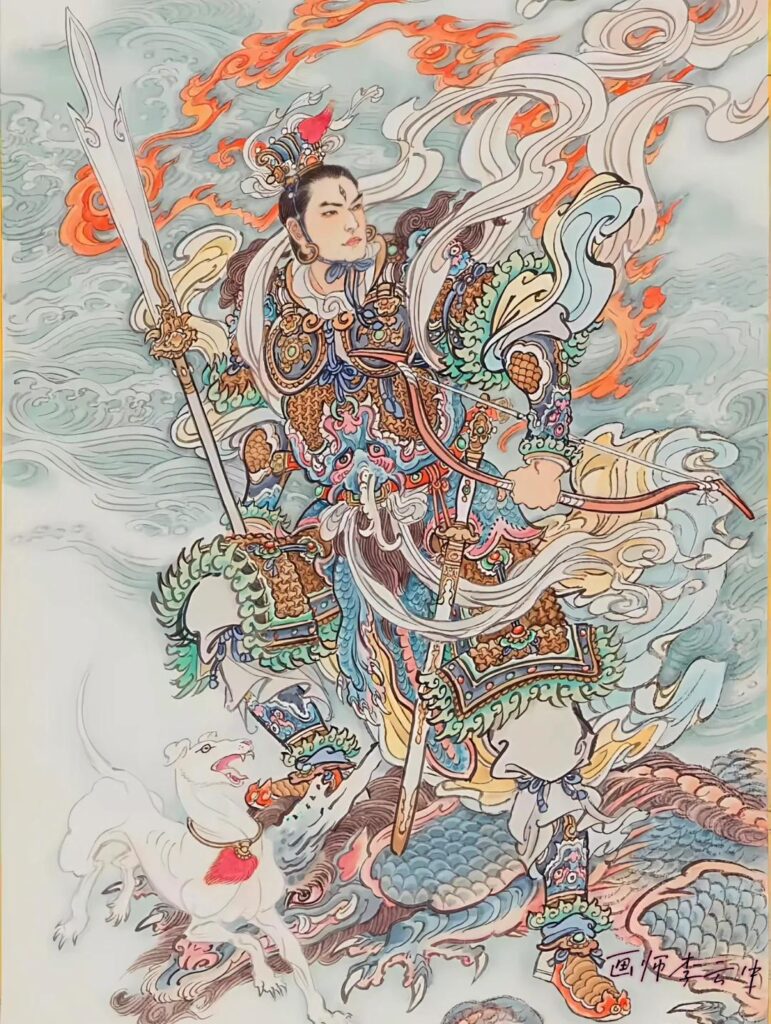
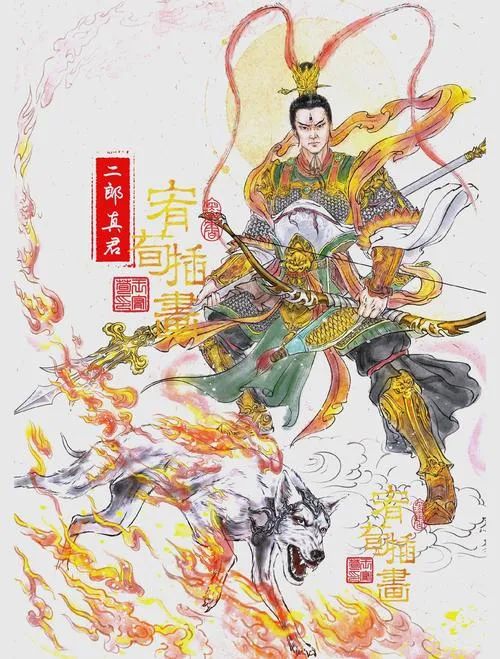
If you have ever dipped into Chinese mythology, chances are you have come across Erlang Shen. He is usually easy to spot: a poised warrior with a celestial weapon, a loyal hound at his side, and a mysterious third eye in the middle of his forehead. In popular imagination, Erlang Shen is one of Heaven’s most formidable gods, a figure associated with strength, discipline, justice, and extraordinary supernatural power.
But once you look closer, Erlang Shen becomes even more interesting.
He is not just one neatly defined mythological figure. Over centuries, stories from different regions, religious traditions, and literary works gradually merged into the Erlang Shen many people know today. In some accounts, he is the heroic son of a divine mother and a mortal father. In others, he is linked to flood control, dragon-slaying, and local cults in Sichuan. In later fiction, he becomes closely associated with Yang Jian, the handsome and highly capable warrior best known from Journey to the West and Investiture of the Gods.
That layered history is exactly what makes Erlang Shen so fascinating. He is not only a warrior god. He is also a window into how Chinese mythology evolves: through folklore, regional worship, religious reinterpretation, and storytelling.
Who Is Erlang Shen?
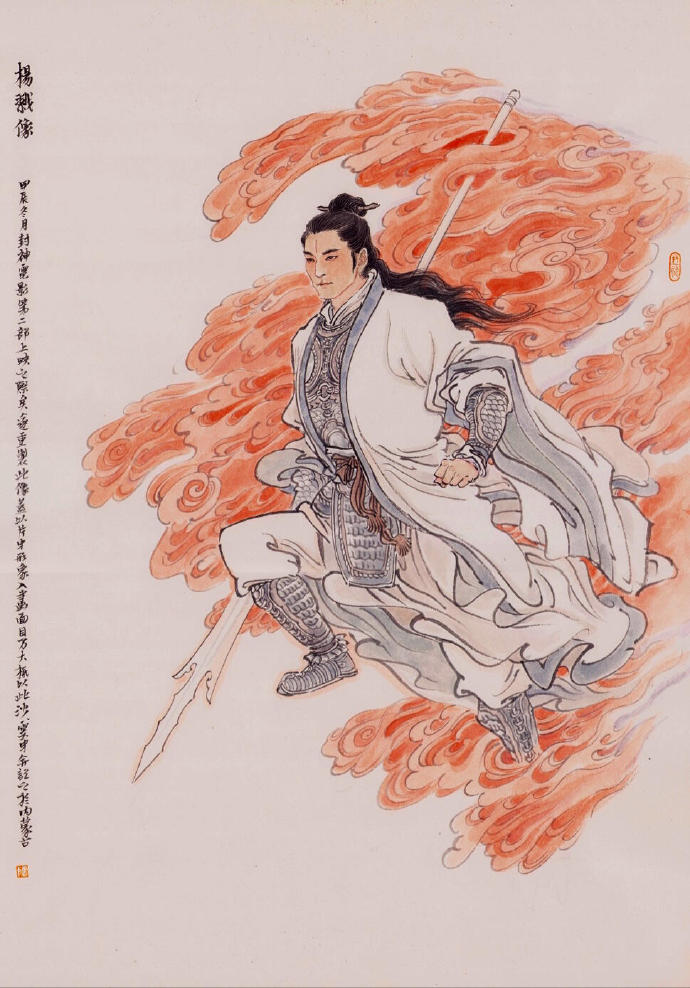
At the most basic level, Erlang Shen is a powerful deity in Chinese mythology and popular religion. He is commonly portrayed as a divine warrior with unmatched combat skills, sharp perception, and an almost unshakable sense of order. His most recognizable feature is his third eye, often described as an all-seeing heavenly eye that allows him to detect truth, expose deception, and perceive what others cannot.
In modern popular culture, Erlang Shen is often treated as one of the strongest gods in Heaven. He is usually shown carrying a three-pointed, double-edged spear, accompanied by his celestial dog, and standing apart from other immortals with an air of cool confidence. Many readers and viewers know him as the god who could fight Sun Wukong on nearly equal footing.
Yet the deeper question is this: who exactly is Erlang Shen supposed to be?
The answer depends on which tradition you follow.
The Meaning of the Name Erlang Shen
The name “Erlang Shen” is usually understood as “Divine Second Son” or “Godly Second Son.”
In Chinese, er (二) means “two” or “second,” lang (郎) can refer to a young man or son, and shen (神) means “god” or “deity.” On the surface, the title sounds simple enough. Traditionally, it suggests a second son with divine or heroic status.
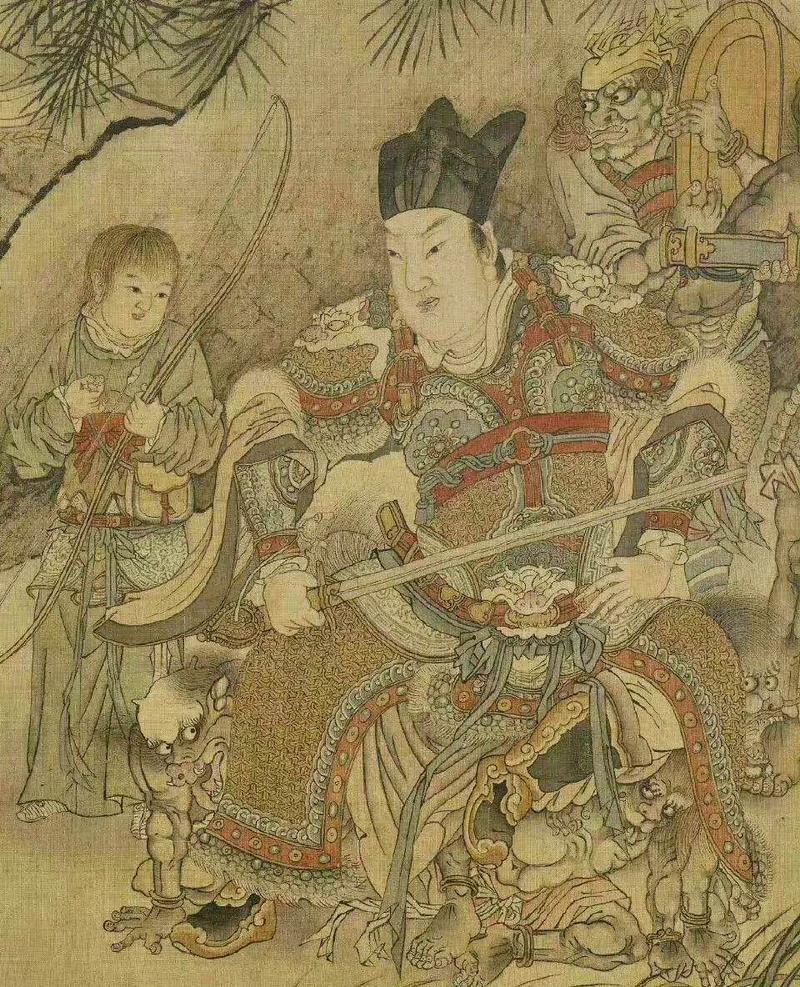
That is why so many legends connect Erlang Shen with a second-born son. In some stories, he is the second son in a divine family. In other traditions, the “second son” idea becomes attached to historical or semi-historical figures who were later deified. Over time, the title “Erlang” became less about one single individual and more about a role, an identity, and a revered image.
This also explains why people sometimes ask a playful but reasonable question: if he is the “second son,” where is the first?
The answer is that Chinese mythology does not always preserve that logic in a neat family-tree sense. Titles, folk memory, local worship, and literary adaptation often matter more than strict consistency.
Erlang Shen and the Famous Third Eye
For many people, the third eye is the defining trait of Erlang Shen.
In visual art, television dramas, comics, and games, that eye is far more than decoration. It signals supernatural vision, insight, and authority. It suggests that Erlang Shen can see through illusions, uncover hidden beings, and judge situations with a clarity beyond ordinary gods or humans.
Interestingly, the third eye may not have belonged equally strongly to every early version of the deity. Some traditions emphasize it heavily, while others focus more on his role as a flood-control hero, dragon-slayer, or local protector. Over time, however, the image of the three-eyed Erlang Shen became so powerful that it effectively defined the character in later popular culture.
That evolution is part of his appeal. Erlang Shen feels ancient, but his familiar image is really the result of centuries of cultural layering. The third eye, in that sense, is both a mythic symbol and a sign of how myths themselves change.
The Many Origins of Erlang Shen
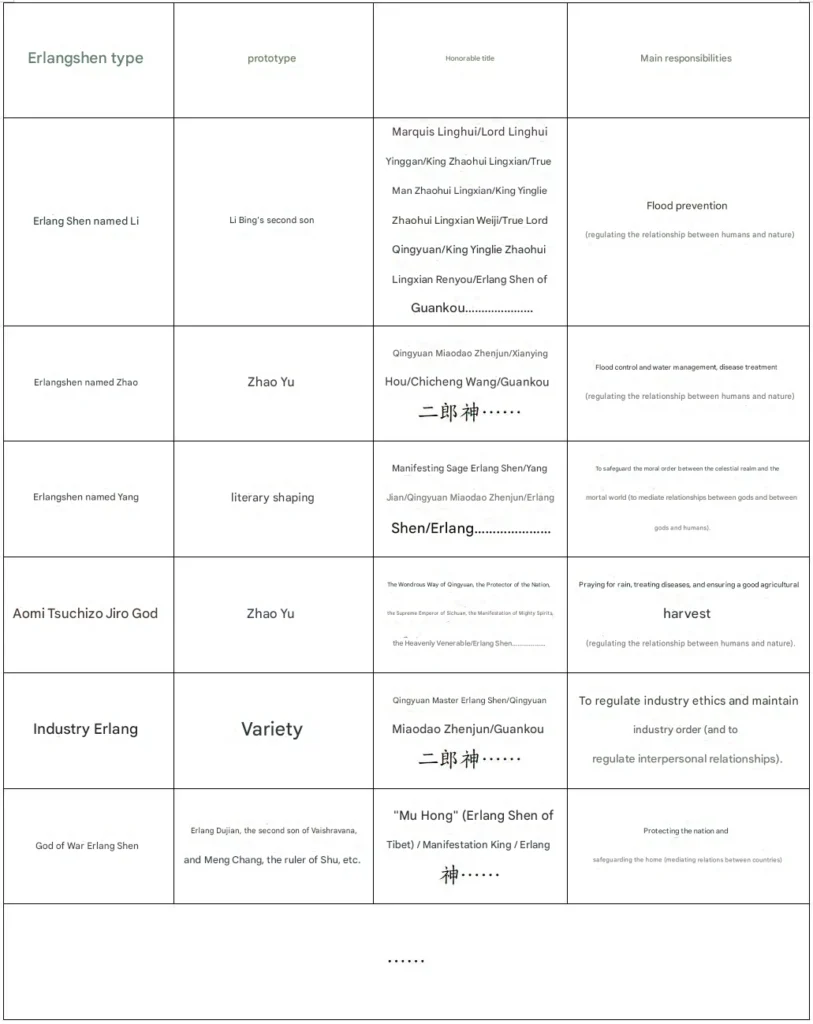
One of the most important things to understand about Erlang Shen is that he does not come from a single origin story.
Like many major figures in Chinese mythology, he seems to have absorbed elements from several traditions. Different communities, texts, and eras all contributed something to the final image.
Erlang Shen as Yang Jian
Today, many people equate Erlang Shen with Yang Jian.
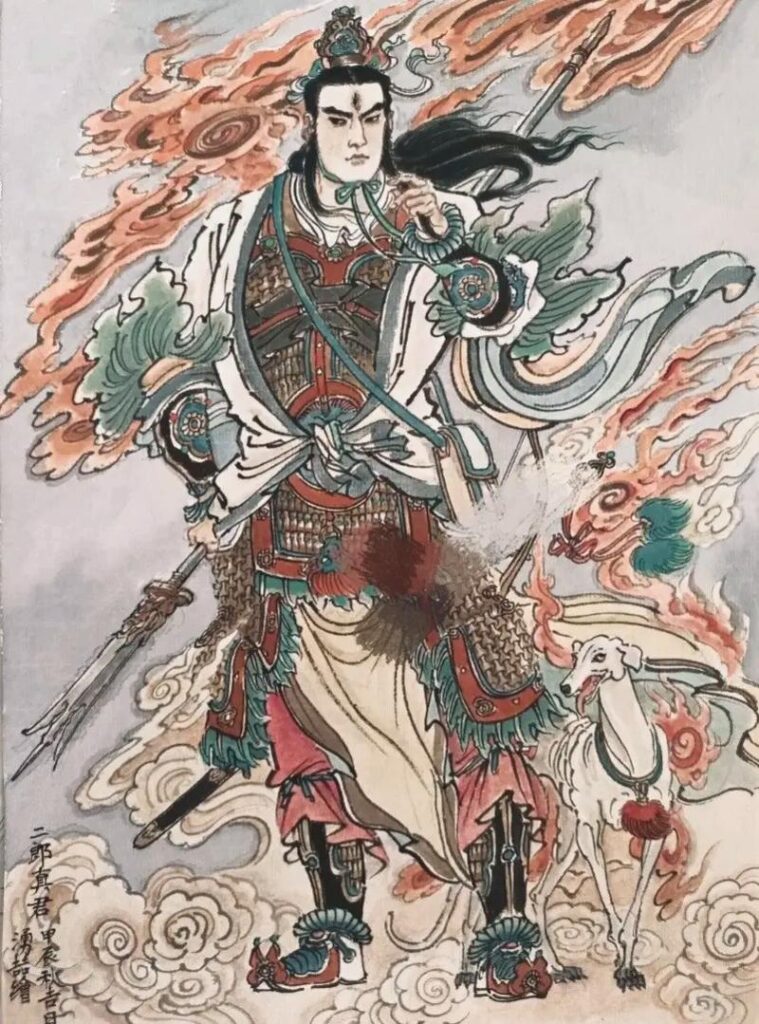
This is the version most readers recognize from classical novels. Yang Jian is a brilliant warrior, a master of transformation, and a divine figure with noble bearing and immense power. In popular retellings, he is often described as the nephew of the Jade Emperor, born from a union between a heavenly woman and a mortal man. He grows up under hardship, trains under a powerful master, and eventually becomes one of Heaven’s greatest fighters.
This is also the version tied to the famous tale of splitting the mountain to save his mother. In that story, Yang Jian’s divine mother is punished and imprisoned beneath a mountain. When he becomes strong enough, he cleaves the mountain open to rescue her. The story gives Erlang Shen emotional depth: he is not only powerful, but also filial, driven, and marked by loss.
Erlang Shen as Li Erlang
Another important tradition connects Erlang Shen with Li Bing and the Dujiangyan irrigation system in Sichuan.
Li Bing was the famous ancient engineer credited with taming the waters and transforming the Chengdu Plain. Later tradition developed the figure of Li Erlang, often described as Li Bing’s second son. In these stories, Erlang Shen is not primarily a heavenly aristocrat. He is a practical hero associated with flood control, river management, and the protection of ordinary people.
One popular legend tells of a river dragon causing devastating floods. Erlang Shen investigates the disaster, confronts the monster, and kills it, bringing peace back to the region. This version strongly reflects local memory: the god is a guardian of the land, a conqueror of chaotic waters, and a bringer of order.
Erlang Shen as Zhao Erlang
A third major stream identifies Erlang Shen with Zhao Yu or Zhao Erlang, another dragon-slaying hero associated with Sichuan.
This version was especially important in Daoist and regional traditions. Like the Li Erlang stories, it emphasizes heroic action, local protection, and the defeat of dangerous aquatic forces. Over time, features from Zhao Erlang and Li Erlang overlapped so much that it became difficult to separate them cleanly in popular belief.
Even Earlier Layers
Some traditions trace aspects of Erlang Shen back even further, including connections with older local deities and the figure known as Dujian Erlang, associated with Buddhist influence. This may sound messy, but it is actually quite typical of Chinese religious history. Gods were not always fixed characters. They were living figures in a shared cultural imagination, reshaped across dynasties, regions, and ritual systems.
So when someone asks, “Who is the real Erlang Shen?” the most honest answer is that Erlang Shen is a composite mythic figure formed through centuries of blending.
Erlang Shen in Journey to the West
For many readers outside China, Journey to the West is the text that makes Erlang Shen unforgettable.
In the novel, he appears as Erlang Xiansheng Zhenjun, often translated as the Illustrious Sage or True Lord Erlang. He is called upon when the Heavenly forces are struggling to contain Sun Wukong. And unlike many divine officials who seem overwhelmed by the Monkey King, Erlang Shen actually stands as a serious match for him.
Their encounter is one of the most memorable in the book because it showcases more than brute strength. It is a battle of skill, perception, transformation, and endurance. Erlang Shen is calm, clever, and relentless. He is not flashy in the same way Sun Wukong is, but he is every bit as dangerous.
This portrayal cemented his image as Heaven’s elite enforcer: the god you send when chaos has become too powerful for ordinary measures.
It also helped popularize several traits now considered standard: his warrior elegance, his association with the celestial hound, and his reputation as one of the most capable divine fighters in Chinese fiction.
Erlang Shen in Investiture of the Gods
In Investiture of the Gods, the figure usually identified with Erlang Shen appears as Yang Jian, a disciple of Yuding Zhenren and one of the outstanding heroes on the side of the Zhou.
Here, Yang Jian is portrayed as highly intelligent, adaptable, and supremely effective in battle. He is known for his transformations, magical abilities, and strategic thinking. If Journey to the West presents him as Heaven’s great troubleshooter, Investiture of the Gods presents him as a disciplined and gifted hero whose presence repeatedly changes the course of conflict.
This version shaped the later popular image of Yang Jian in a major way. The handsome face, the divine confidence, the white horse, the divine dog, the weapon, and the sense of being both noble and lethal all became more firmly attached to him through literary tradition.
Erlang Shen and the Story of Saving His Mother
One of the most emotionally resonant legends linked with Erlang Shen is the tale of saving his mother.
In broad outline, the story goes like this: Erlang Shen’s mother, a heavenly woman, falls in love with a mortal man and bears children with him. This violates heavenly law. She is punished, imprisoned, or crushed beneath a mountain. Erlang Shen survives, grows stronger, studies under a master, and eventually breaks the mountain apart to free her.
This narrative gives him a different dimension from the cold warrior image. He becomes a son shaped by grief, injustice, and duty. He is powerful not merely because he is divine, but because he has something to fight for.
In later folk tradition, stories related to this theme also connect him to his sister, Yang Chan or the Third Holy Mother, and eventually to the famous legend of Chenxiang saving his own mother. These linked family myths helped turn Erlang Shen into more than a battle god. He became part of an ongoing mythic family drama about law, compassion, rebellion, and filial devotion.
What Does Erlang Shen Represent?
At first glance, Erlang Shen seems to represent pure martial power. That is certainly part of his appeal. But beneath that surface, his symbolism is richer.
He often stands for order against chaos.
That idea appears again and again across his many versions. He controls floods. He kills dragons. He fights dangerous demons. He confronts rebellious forces. He protects communities. He enforces heavenly rules, sometimes harshly. Even when he is emotionally complicated, he tends to act from a position tied to structure, law, and balance.
In that sense, Erlang Shen is not simply a god of violence. He is a god of restored boundaries. He steps in when things spill out of control: when rivers destroy fields, when monsters terrorize people, when cosmic order is challenged, or when divine law is broken.
His third eye strengthens this symbolism. It suggests not only sight, but discernment. Erlang Shen sees what is hidden and acts where others hesitate.
Why Erlang Shen Still Matters Today
Erlang Shen remains popular because he combines several things that rarely come together so well in one mythological figure.
He is visually striking.
He is powerful without being dull.
He has emotional depth without losing his edge.
And perhaps most importantly, he feels both ancient and adaptable.
That is why he continues to appear in television dramas, animation, fantasy novels, films, and modern games. Each generation can emphasize a different aspect of him. One version highlights the cool celestial warrior. Another explores the son who defied Heaven for his mother. Another leans into the dragon-slayer, engineer-hero, or stern guardian of cosmic law.
Even now, Erlang Shen is not frozen. He is still evolving, just as he has for centuries.
Final Thoughts on Erlang Shen
Erlang Shen is one of the most compelling figures in Chinese mythology precisely because he is not easy to reduce to a single definition.
He is Yang Jian, but not only Yang Jian.
He is a warrior god, but not only a warrior god.
He is a god of sight, justice, and power, but also a figure shaped by regional worship, literary reinvention, and religious blending.
If you start with the famous third eye, you may first see a cool mythological hero. But if you keep reading, Erlang Shen reveals something deeper: the way myth grows by absorbing history, belief, and storytelling over time.
That may be the real power of Erlang Shen. He does not belong to just one book, one temple, or one legend. He belongs to a long cultural conversation, and that is why he still feels alive.
FAQ
Who is Erlang Shen in Chinese mythology?
Erlang Shen is a powerful deity in Chinese mythology, best known as a warrior god with a third eye. He is often associated with Yang Jian, but his image also draws from older regional and religious traditions.
What does Erlang Shen’s third eye mean?
Erlang Shen’s third eye usually symbolizes supernatural perception, truth-seeing, and spiritual power. In popular culture, it also marks him as a divine judge and an elite warrior.
Is Erlang Shen the same as Yang Jian?
In many later stories and modern adaptations, yes. However, historically the figure of Erlang Shen appears to have absorbed several traditions, including associations with Li Erlang and Zhao Erlang, not only Yang Jian.
Why is Erlang Shen called the “second son”?
The name “Erlang” literally suggests a second son or second young lord. Different legends explain this in different ways, often by placing him as the second-born child in a divine or heroic family.
Is Erlang Shen stronger than Sun Wukong?
In Journey to the West, Erlang Shen is one of the very few gods who can seriously challenge Sun Wukong. Their battle is portrayed as extremely close, which is one reason Erlang Shen has such a strong reputation.
What is Erlang Shen the god of?
He is often linked with warfare, justice, protection, flood control, and the restoration of order. Depending on the tradition, he may also be associated with engineering, dragon-slaying, or the defense of heavenly law.