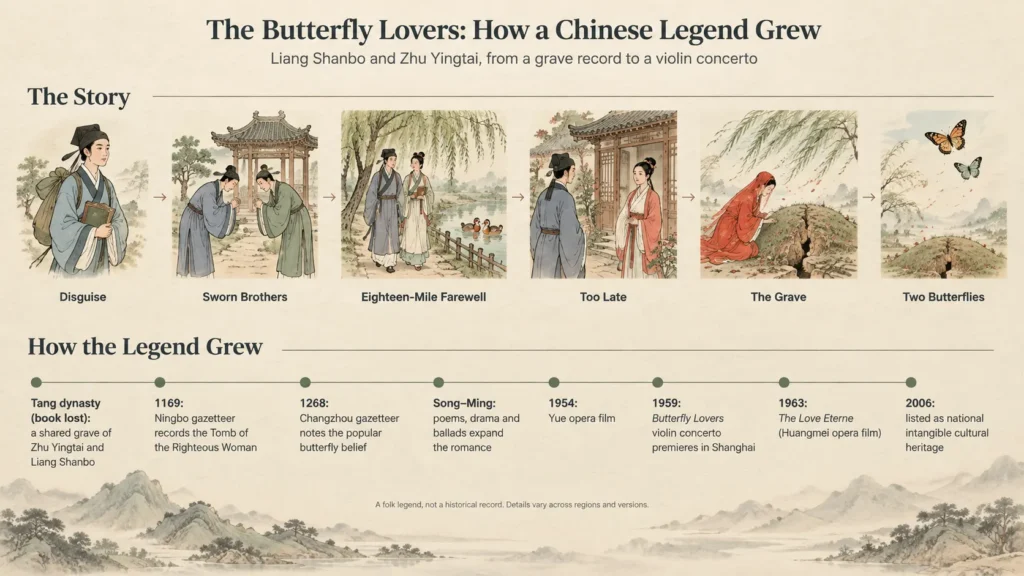
The Butterfly Lovers (梁祝, Liáng Zhù) is the Chinese folk legend of Liang Shanbo and Zhu Yingtai. Zhu, a young woman, disguises herself as a man to attend school and falls in love with her classmate Liang, who does not realize she is a woman until it is too late. Her family has already promised her to a richer suitor. Liang dies of grief, and on her wedding day Zhu throws herself into his grave as it splits open. Two butterflies rise from the tomb.
This is a legend about human beings, not a myth about gods. Tradition sets it in the Eastern Jin dynasty (317–420), but the surviving written record begins with short notes about a shared grave. The butterflies, the rival suitor and the famous farewell scene grew around that core over many centuries of storytelling, drama, opera and film.
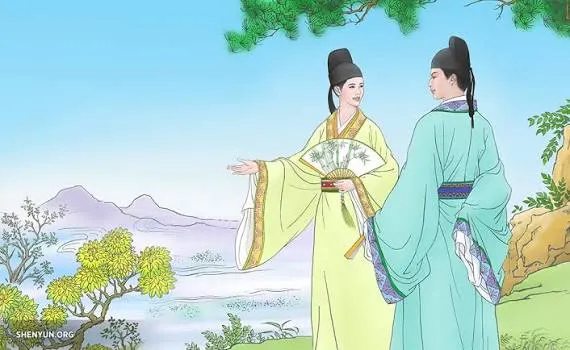
| Quick facts | The Butterfly Lovers |
|---|---|
| Chinese names | 梁祝 (Liáng Zhù); 梁山伯与祝英台 (Liáng Shānbó yǔ Zhù Yīngtái) |
| Type | Folk legend (民间传说), later a major opera and film subject |
| Main characters | Zhu Yingtai, Liang Shanbo, Zhu’s father, the Ma family suitor (Ma Wencai in later versions) |
| Traditional setting | Eastern Jin dynasty; Shangyu, Kuaiji, Hangzhou and Ningbo in Zhejiang |
| Earliest surviving record | A line from a lost Tang geography, quoted in a Ningbo gazetteer of 1169 |
| Signature ending | The grave opens and the lovers become butterflies (化蝶, huà dié) |
| Best-known modern forms | Yue opera, the 1959 Butterfly Lovers violin concerto, the 1963 film The Love Eterne |
| Heritage status | Listed in China’s first national intangible cultural heritage list (2006) |
The Butterfly Lovers Story in Brief
The version most readers know today was shaped by twentieth-century Yue opera (越剧, Yuèjù) and the films and music based on it. In outline, it runs like this:
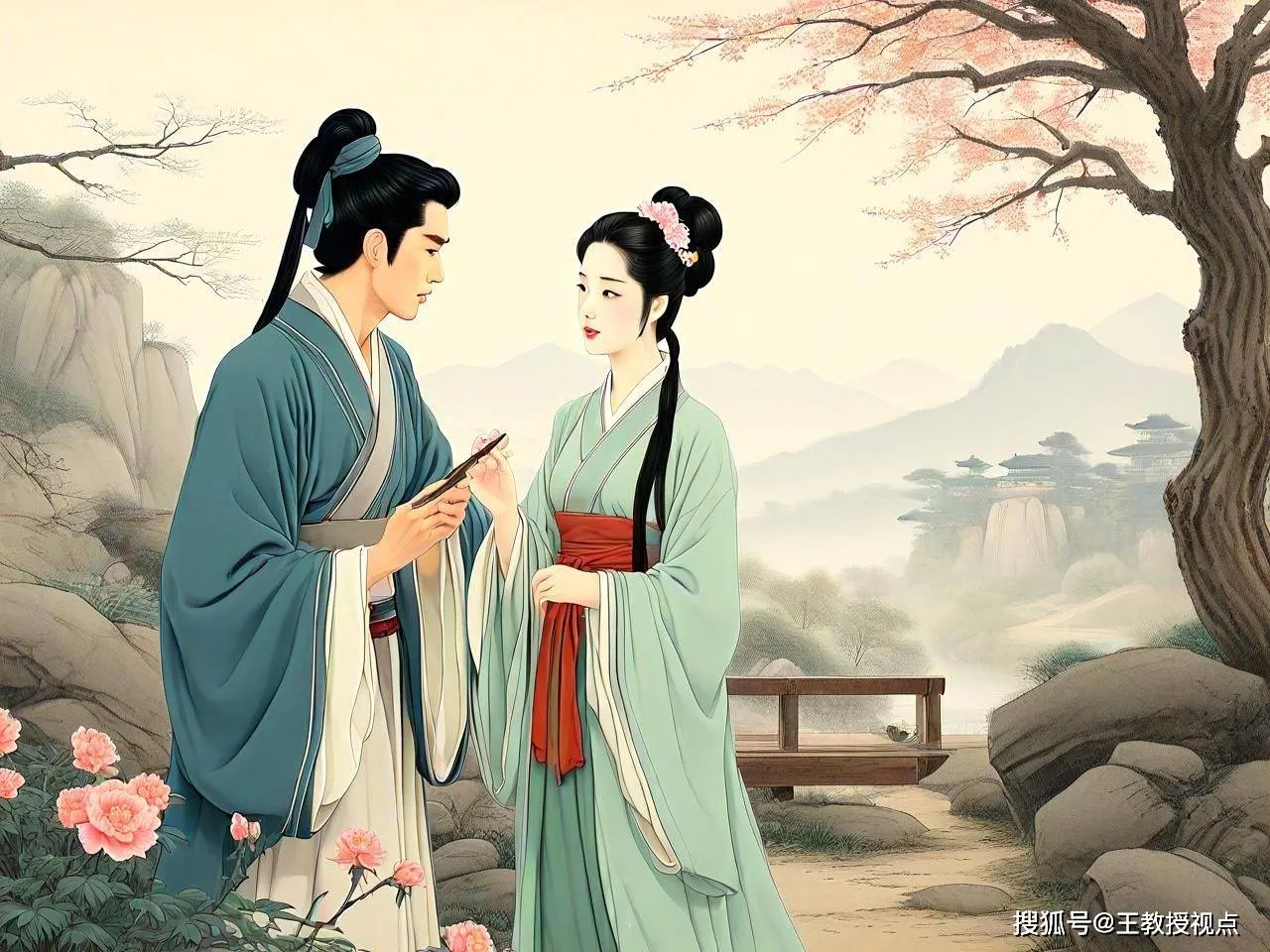
- The disguise. Zhu Yingtai (祝英台, Zhù Yīngtái), the daughter of a well-off family in Shangyu (上虞), persuades her parents to let her study away from home, dressed as a young man.
- Sworn brothers. On the road she meets Liang Shanbo (梁山伯, Liáng Shānbó), a scholar of modest means from Kuaiji (会稽). They swear brotherhood and study together for three years, usually placed in Hangzhou. Liang never suspects his companion is a woman.
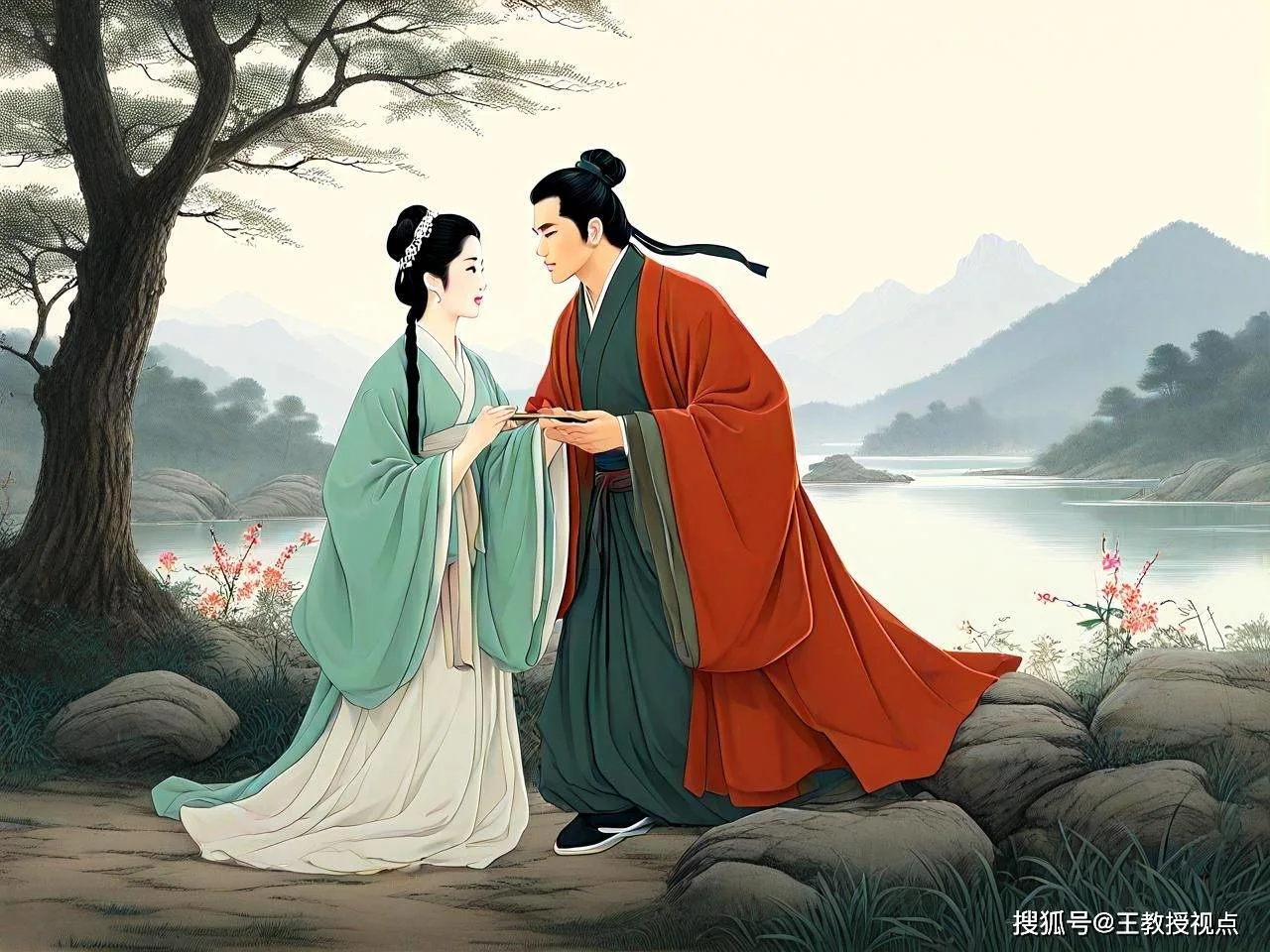
- The Eighteen-Mile Farewell (十八相送, Shíbā xiāngsòng). Called home by her family, Zhu walks part of the way with Liang and keeps dropping hints, comparing the two of them to pairs of birds and other couples they pass. Liang misses every one. Before they part, she offers to arrange his marriage to her “ninth sister,” who is in fact herself.
- The meeting at the tower (楼台会, Lóutái huì). When Liang finally visits, he finds Zhu in women’s clothing. It is too late: her father has betrothed her to the son of the wealthy Ma family, Ma Wencai (马文才, Mǎ Wéncái).
- The grave. Liang falls ill and dies. As Zhu’s bridal procession passes his tomb, a sudden storm stops it. She goes to the grave to mourn, the earth splits open, and she leaps inside.
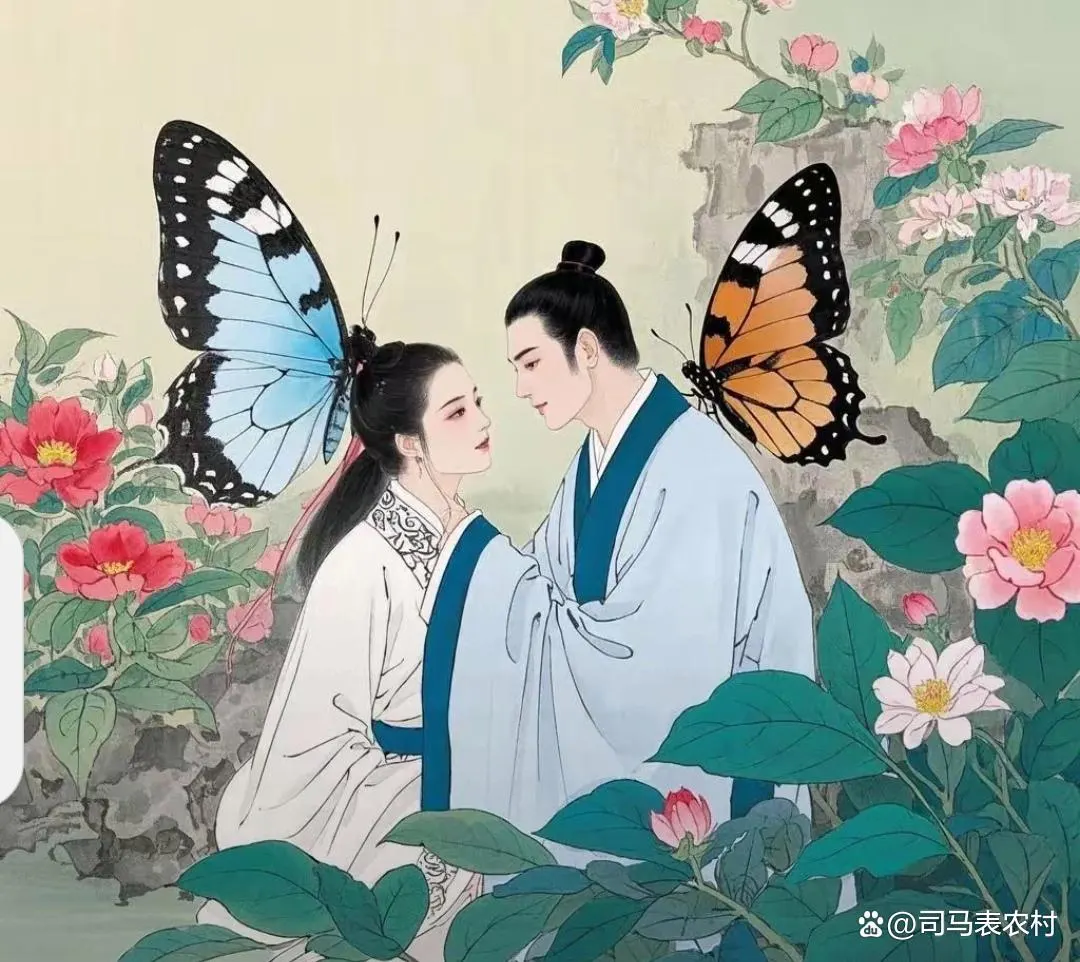
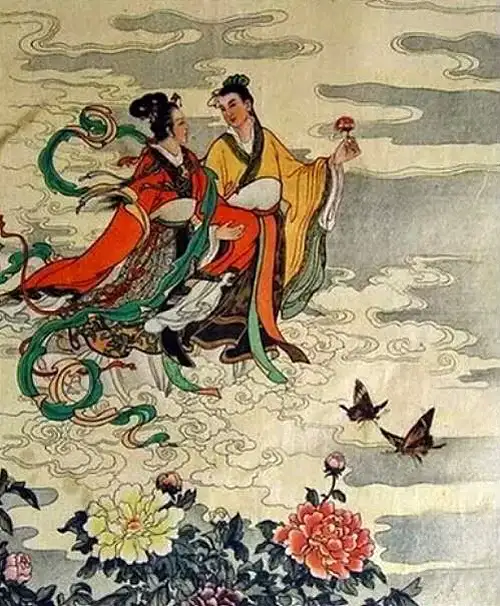
- The transformation. The grave closes, and a pair of butterflies flies out together, understood as the lovers united at last.
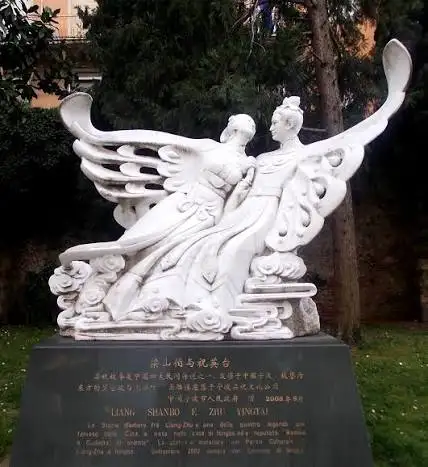
The details move from version to version. In some tellings Liang serves briefly as a county magistrate before he dies; in others he dies a poor student. Some retellings make Ma Wencai a bully at the academy, while older records mention only “the Ma family” without a personality at all. The core sequence, though, is stable: a disguised woman, an unknowing partner, a forced match, a death, and a grave that refuses to keep the lovers apart.
Main Characters
| Character | Chinese | Role in the story |
|---|---|---|
| Zhu Yingtai | 祝英台, Zhù Yīngtái | The heroine; drives the plot through her disguise, her hints and her final choice at the grave |
| Liang Shanbo | 梁山伯, Liáng Shānbó | Earnest, slow to understand, and honored in a local temple cult around Ningbo |
| Zhu’s father | 祝员外 (in many opera versions) | Represents parental authority over marriage; prefers wealth and status to Liang |
| Ma Wencai | 马文才, Mǎ Wéncái | The rival suitor; named in later popular versions, often just “the Ma family” in early records |
Where the Legend Comes From: The Early Records
No reliable historical evidence shows that Liang Shanbo and Zhu Yingtai were real people. What survives is a trail of local records, mostly connected with graves and temples, that becomes more detailed with each century.
The oldest reference is indirect. The Tang-dynasty geographer Liang Zaiyan (梁载言) wrote a gazetteer of the empire, the Shidao zhi (十道志), that no longer survives. A Ningbo-area gazetteer compiled by Zhang Jin (张津) in 1169, the Qiandao Siming tujing (乾道四明图经), quotes it as saying that the “righteous woman” Zhu Yingtai shares a grave with Liang Shanbo. The same gazetteer locates this Tomb of the Righteous Woman (义妇冢, Yìfù zhǒng) west of the county seat and cites an “old record” saying the two studied together for three years without Liang learning she was a woman. Because the Tang book is lost, its date for the story rests on this later quotation.
Later gazetteers show local writers arguing with the story. A Ningbo gazetteer of 1227 objected that Zhu should be called a maiden rather than a wife, since she never married Liang. One from 1320 described the account as hazy but kept it anyway. Meanwhile, a gazetteer from the Changzhou region dated 1268 recorded a “Zhu tomb” at Shanquan Mountain, in the area now associated with Yixing, and noted a popular belief that Yingtai had turned into a butterfly, a belief the compiler considered far-fetched. This is one of the earliest securely dated mentions of the butterfly motif.
| Date | Source | What it adds |
|---|---|---|
| Tang dynasty (book lost) | Liang Zaiyan, Shidao zhi, quoted in 1169 | Zhu Yingtai and Liang Shanbo share one grave |
| 1169 | Zhang Jin, Qiandao Siming tujing (Ningbo) | Tomb of the Righteous Woman; three years of study, Liang unaware she is a woman |
| 1227 | Baoqing Siming zhi (Ningbo) | Debate over calling Zhu a “wife” versus a “maiden” |
| 1268 | Xianchun Piling zhi (Changzhou) | Second tomb tradition; popular belief that Zhu became a butterfly |
| c. 1300 | Korean annotations to a Tang poetry anthology | The shared grave and the butterflies are already known in Korea |
| Ming dynasty | Chenghua-era Ningbo gazetteer | Zhu betrothed to the Ma family; a temple record honoring Liang (authorship disputed) |
| 18th century | Zhai Hao, Tongsu bian | Quotes a fuller narrative attributed to the Tang Xuanshi zhi, not found in surviving editions |
The last entry is often repeated online as the “Tang version.” The Qing scholar Zhai Hao (翟灏) quoted a passage, supposedly from Zhang Du’s ninth-century Xuanshi zhi (宣室志), in which Liang becomes magistrate of Yin County, dies, and is buried; Zhu’s boat is stopped by wind and waves at his grave, the earth opens, and the statesman Xie An later names the site the Tomb of the Righteous Woman. The passage does not appear in the surviving text of the Xuanshi zhi, so it is best treated as evidence of how the story was told by Qing times rather than as a secure Tang source.
How the Story Grew: Major Versions and Adaptations
From a grave note to a full romance
The earliest layer is a story about virtue and a tomb. The label “righteous woman” frames Zhu as a moral exemplar whose loyalty to Liang is honored after death, close to the way imperial culture praised faithful wives and widows. The love story, the comic misunderstandings and the named villain came later. The idea of lovers united after death was not new: in the fourth-century collection Soushen ji (搜神记), the separated graves of Han Ping (韩凭) and his wife grow trees whose branches intertwine. The Butterfly Lovers gave that older motif its most famous form.
Around Ningbo, Liang Shanbo also became the focus of a local temple cult. A Ming gazetteer cites a temple record attributed to a Northern Song prefect, dated 1107–1110, that honors him with the title Yizhong Wang (义忠王), roughly “Righteous and Loyal King.” Some modern researchers doubt the attribution because earlier gazetteers do not include it, but the temple itself remained active into the twentieth century. This shows how a figure from a folk legend could also be treated as a local protector, a process seen on a much larger scale in the cult of Mazu, the sea goddess who grew from a local woman’s cult. For the wider landscape of such figures, see the Chinese Gods directory.
Drama, ballads and competing hometowns
By the Song dynasty the names were familiar enough that poets wrote lyrics to a tune pattern called Zhu Yingtai Jin (祝英台近). The story was adapted for southern drama, Yuan variety plays and Ming chuanqi drama, and it circulated widely as sung ballads and storytelling texts. Wilt L. Idema’s English anthology translates four of these popular versions alongside related texts, and they differ markedly in tone, length and moral emphasis.
As the story spread, so did claims to it. China’s national heritage listing names Ningbo, Shangyu, Hangzhou, Yixing, Jining in Shandong and Runan in Henan as core areas where the legend has been told, and several of these places point to a tomb, a study hall or a temple. These competing sites are part of the legend’s history, not proof of a historical couple.
Yue opera, film and the violin concerto
In the early twentieth century, Chinese folklorists grouped the Butterfly Lovers with the Legend of the White Snake, Lady Meng Jiang and the Cowherd and the Weaver Girl as China’s Four Great Folktales (四大民间传说). Yue opera, from the Shaoxing region of Zhejiang, made it a signature piece, and a color film of the Yue opera version was released in 1954.
Two later works carried the story far beyond opera audiences. In 1958 two students at the Shanghai Conservatory of Music, He Zhanhao (何占豪) and Chen Gang (陈钢), wrote The Butterfly Lovers violin concerto, a single-movement work built on Yue opera melodies and techniques. It premiered in Shanghai on May 27, 1959, with 18-year-old Yu Lina (俞丽拿) as soloist, and it remains one of the most performed Chinese orchestral works. In 1963 the Shaw Brothers studio in Hong Kong released The Love Eterne, a Huangmei opera film directed by Li Han-hsiang with Ivy Ling Po playing Liang Shanbo, a woman playing a man in a story about a woman disguised as a man. The film broke box-office records in Taiwan and won six Golden Horse Awards, including Best Picture.
A legend that crossed borders
The Korean evidence from around 1300 shows the story traveling early. Today it is also told in Vietnam, where it became a popular subject for cải lương theater, and the national heritage listing records its spread to Japan, Myanmar, Singapore and Indonesia. In 2006 the legend was included in the first batch of China’s national intangible cultural heritage list under folk literature, with Ningbo as the applying region.
What the Butterfly Lovers Means
Education and a woman’s disguise
Zhu Yingtai can only study by pretending to be a man, and the story never treats her desire to learn as foolish. Her intelligence drives the plot: she sees what Liang cannot, plans the “ninth sister” ruse, and sets the terms of her final act. Modern audiences often read her as a woman claiming access to education and choice in a world that denied her both. Older versions place more weight on her loyalty, which is why the earliest records call her a “righteous woman.”
Arranged marriage and parental authority
The tragedy turns on a decision the lovers cannot control. Zhu’s father chooses the Ma family for its wealth and standing, and Liang’s late proposal carries no weight against an agreement between families. The Yue opera stage version and film of the 1950s appeared in the years after the 1950 Marriage Law outlawed forced marriage in the People’s Republic, and they were widely read as a critique of arranged marriage. That reading is real and influential, but it is a modern emphasis layered onto a much older story. The theme also sits in conversation with a gentler idea in Chinese folk belief, that marriage is fated, expressed in the figure of Yue Lao and the red thread of fate. In the Butterfly Lovers, the match that should have been fated is broken by human interests.
The butterflies
The transformation answers the story’s injustice without undoing it. Liang and Zhu still die, but the grave refuses the marriage the family arranged and gives the lovers the union they were denied. Butterflies suit that ending: they are light, paired and free to leave the ground. The image is a folk resolution, not a doctrine of the afterlife. The story does not describe a heaven, a judgment of the dead or a reincarnation system, and the earliest gazetteer writer who mentioned the butterfly openly doubted it.
Is the Butterfly Lovers “China’s Romeo and Juliet”?
English-language writing often calls the Butterfly Lovers “the Chinese Romeo and Juliet.” The comparison helps a new reader grasp the tragic shape of the story, but the two differ in important ways.
| Feature | The Butterfly Lovers | Romeo and Juliet |
|---|---|---|
| Origin | Anonymous folk legend, reshaped over many centuries | Shakespeare’s play (c. 1595), based on earlier Italian novellas |
| Obstacle | An arranged match with a wealthier family | A feud between two families |
| Central device | A woman’s disguise and a partner who misses the truth | Secret marriage and a failed plan |
| Ending | Supernatural union: the grave opens and the lovers become butterflies | Double suicide; the families reconcile |
| Afterlife | Local tombs, temples and heritage sites in several regions | A literary work with later tourist sites in Verona |
Related Chinese Legends
The Butterfly Lovers belongs to a small group of Chinese love legends that became national stories through opera and popular retelling. The closest companion is the White Snake legend of Bai Suzhen and Xu Xian, another of the Four Great Folktales, in which a forbidden love is also opposed by an outside authority. The story of Chang’e and the moon offers a different kind of separation, between a woman in the sky and a husband left on earth. You can find more narratives, from creation myths to festival tales, in the Legends & Stories collection.
Frequently Asked Questions
Is the Butterfly Lovers a true story?
There is no reliable evidence that Liang Shanbo and Zhu Yingtai were historical people. The earliest records are local gazetteer notes about a shared grave, and several towns in different provinces claim a tomb or study site. The story is best understood as a folk legend that grew around these local traditions.
Who is Ma Wencai in the Butterfly Lovers?
Ma Wencai is the wealthy suitor Zhu Yingtai’s father chooses for her. Early records refer only to “the Ma family,” while later popular versions and modern opera give him a full name and sometimes portray him as a bully or a villain.
What do the butterflies symbolize?
The pair of butterflies represents Liang and Zhu united after death, escaping the marriage that was forced on her. The motif is attested by 1268, when a Changzhou-area gazetteer recorded it as a popular belief, and it became the defining image of the legend.
What are China’s Four Great Folktales?
Twentieth-century Chinese folklorists commonly grouped four stories together: the Butterfly Lovers, the Legend of the White Snake, Lady Meng Jiang, and the Cowherd and the Weaver Girl. All four exist in many regional versions and were heavily shaped by opera.
What is the Butterfly Lovers violin concerto?
It is a single-movement violin concerto written in 1958 by He Zhanhao and Chen Gang, then students at the Shanghai Conservatory of Music. It draws on Yue opera melodies, follows the story from the lovers’ school days to the transformation, and premiered in Shanghai on May 27, 1959, with Yu Lina as soloist.
When is the Butterfly Lovers story set?
Most versions set it in the Eastern Jin dynasty (317–420) in what is now Zhejiang province. That setting comes from tradition; the earliest surviving written references date from much later, and the Tang-era mention survives only as a quotation in a gazetteer of 1169.
References and Further Reading
- Wilt L. Idema, ed. and trans. The Butterfly Lovers: The Legend of Liang Shanbo and Zhu Yingtai; Four Versions, with Related Texts. Indianapolis: Hackett Publishing, 2010. Library catalog record
- William Noseworthy, review of Idema, The Butterfly Lovers. Asian Cha, issue 14 (July 2011). https://www.asiancha.com/content/view/844/115/
- China Intangible Cultural Heritage Network. “梁祝传说 (Liang Zhu Legend),” national list item I-7, first batch (2006). https://www.ihchina.cn/project_details/12188/
- Ge Chang (个厂). “寻找祝英台” (Looking for Zhu Yingtai). The Paper, republished by China Writers Network, May 9, 2023. https://www.chinawriter.com.cn/n1/2023/0509/c442005-32681557.html
- University of Leeds, Chinese Theatre project. “Liang Shanbo and Zhu Yingtai.” https://chinesetheatre.leeds.ac.uk/plays/21
- Rachel Cheung. “Chinese composer recalls birth of The Butterfly Lovers violin concerto 60 years ago.” South China Morning Post. https://www.scmp.com/culture/music/article/2166740/chinese-composer-recalls-birth-butterfly-lovers-violin-concerto-60