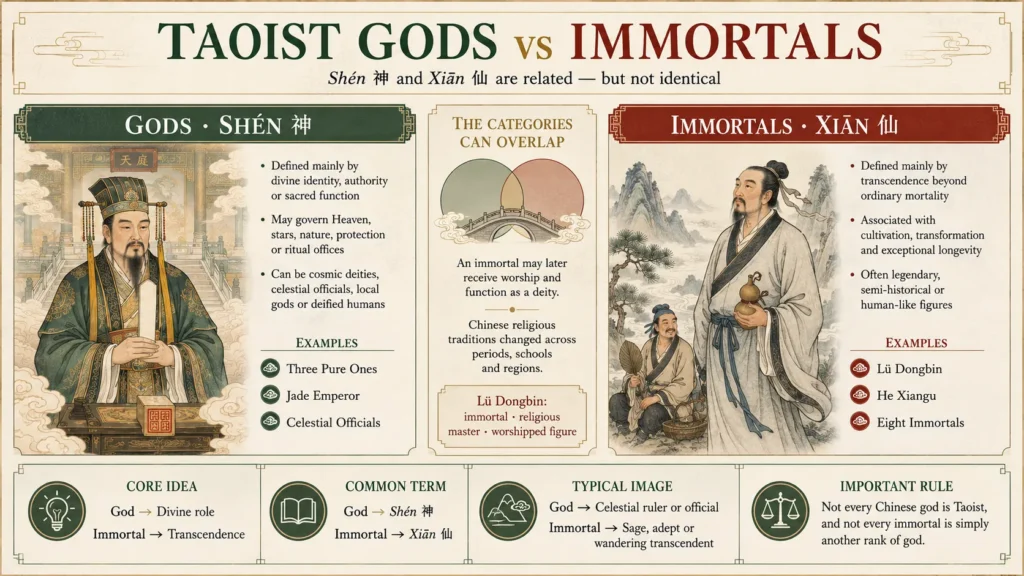
Difference Between Taoist Gods and Immortals
The difference between Taoist gods and immortals is mainly a difference of religious identity and function. A god or deity may be called shén 神 (shén), a broad Chinese term for gods, spirits, and numinous beings. An immortal is usually called xiān 仙 (xiān), meaning an immortal or transcendent being who has passed beyond ordinary human limitations. Gods often possess divine authority, ritual offices, or responsibility for parts of the cosmos, while immortals are especially associated with transcendence, longevity, and spiritual cultivation. The categories, however, can overlap.
Short answer: a Taoist god is generally a deity recognized through divine identity, cosmic authority, ritual function, or worship. A Taoist immortal, or xian, is primarily a transcendent being associated with overcoming ordinary mortality through cultivation, transformation, extraordinary longevity, or spiritual attainment. An immortal may later receive worship and function much like a deity, so the boundary is real but not absolute.
Taoist Gods vs Immortals at a Glance
| Category | God or Deity | Immortal |
|---|---|---|
| Common Chinese term | 神, shén | 仙, xiān |
| Main idea | Divine identity, authority, sacred function, or ritual office | Transcendence beyond ordinary human mortality |
| Typical origins | Cosmic deity, celestial power, natural force, divine official, local god, or deified person | Legendary, semi-historical, or human-like figure who attains a transcendent state |
| Typical role | Govern, protect, judge, regulate, bless, record, or administer | Cultivate, transcend, teach, wander, heal, demonstrate spiritual attainment |
| Typical examples | Three Pure Ones, Jade Emperor, Zhenwu and celestial officials | Lü Dongbin, He Xiangu, Li Tieguai and the Eight Immortals |
| Can receive worship? | Yes | Yes, in some traditions |
| Are the categories completely separate? | No. Later religious practice, temple cults, literature and popular religion can blur the distinction. | |
This distinction is more useful than treating every supernatural Chinese figure as simply a “god.” The broader Taoist deities and sacred beings tradition includes supreme deities, divine officials, immortals, perfected beings, protectors and figures shared with Chinese popular religion.
What Does Shen 神 Mean?
The Chinese word shén 神 has a wider range than the English word “god.” Depending on context, it may refer to a deity, spirit, numinous presence or sacred power. This is one reason English descriptions of Chinese religion can become confusing: translating every occurrence of shen as “god” may suggest a category more rigid than the Chinese religious landscape actually is.
Within Daoist religion, deities can have very different origins. Some express high cosmological or theological principles. Others appear as celestial officials, star deities, thunder powers, protectors or divine administrators. Still others developed from local cults or from humans who were eventually deified.
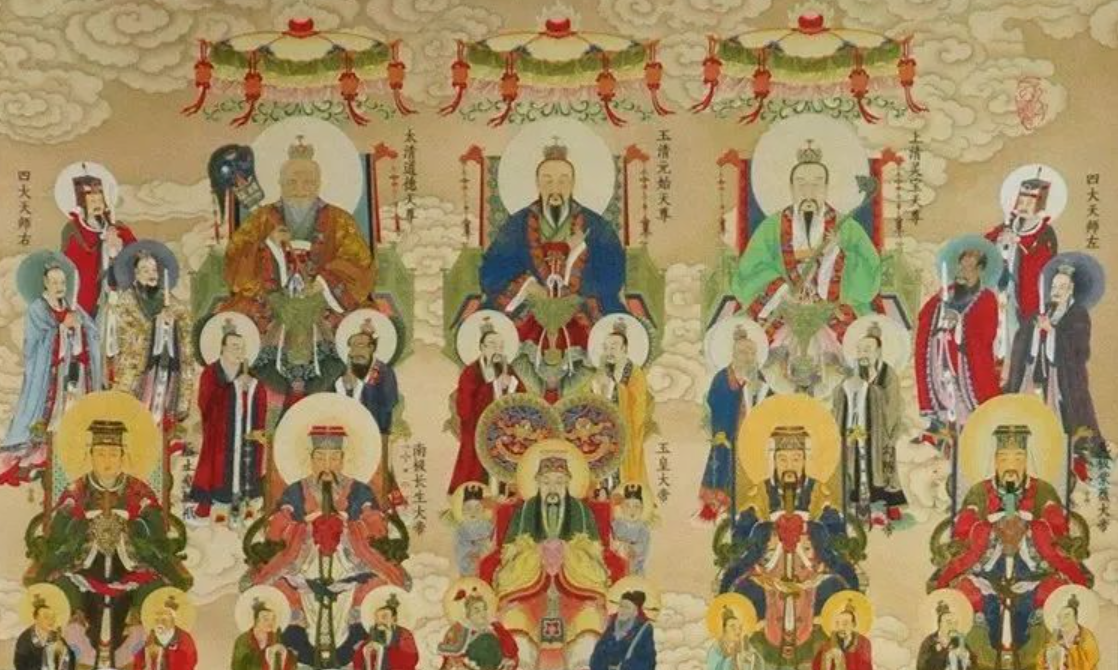
The highest deities offer a useful example. The Three Pure Ones, Sānqīng 三清, are supreme figures of formal Daoist theology and are associated with the highest sacred dimensions of the Dao. They are not simply legendary humans who mastered a longevity technique.
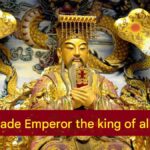
The Jade Emperor, Yùhuáng Dàdì 玉皇大帝, presents another model. In many religious and popular traditions he is imagined as the sovereign of a celestial administration. His authority resembles imperial rulership: Heaven contains officials, departments, reports and jurisdictions. For more context, see the guide to the Jade Emperor and his role in Heaven.
Even this bureaucracy should not be treated as one fixed organization chart. Different Daoist schools, scriptures, historical periods and local traditions may arrange sacred figures differently. The site’s guide to the Taoist gods hierarchy explains this variability in greater detail.
What Is a Xian 仙?
A xiān 仙 is usually translated as an “immortal,” although scholars also use “transcendent.” The second translation can be helpful because Daoist immortality does not always mean that an ordinary biological body simply continues forever without changing.
Daoist hagiographic traditions describe immortals as historical, semi-historical or legendary persons who have crossed beyond normal human limits. Their stories may involve extraordinary longevity, bodily transformation, healing, movement between earthly and celestial realms, encounters with divine teachers, or ascent to Heaven.
The idea of the xian is also older than some of the institutions now identified as organized religious Daoism. Robert Ford Campany’s work on Chinese transcendents describes traditions of pursuing transcendence that were already developing before institutional Daoist priesthoods and scriptures had taken their later forms.
By the early medieval period, the pursuit of immortality had become the subject of highly developed texts and practices. Ge Hong’s Baopuzi (抱朴子), written in the fourth century, discusses the possibility of becoming an immortal and records traditions of alchemy, longevity and transcendence. These were religious and historical ideas, not modern scientific claims.
The Eight Immortals Show the Difference Clearly
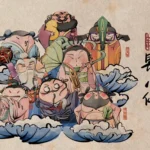
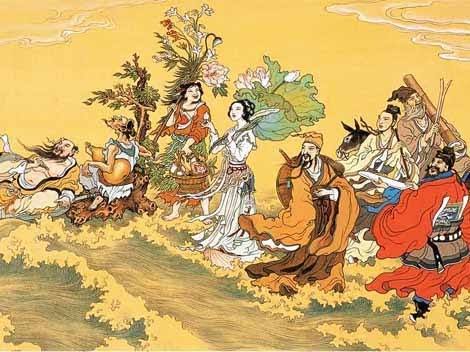
The most familiar examples of xian are the Eight Immortals, Bāxiān 八仙. Their commonly recognized group includes Lü Dongbin, Zhongli Quan, Li Tieguai, Zhang Guolao, He Xiangu, Han Xiangzi, Cao Guojiu and Lan Caihe.
Unlike supreme cosmic deities, these figures are remembered through stories of eccentric sages, wandering adepts, recluses and extraordinary people. Some have connections with historical or semi-historical individuals, while others are much harder to separate from legend.
By around the Song and early Yuan periods, the Eight Immortals had become an established group in Chinese religious and artistic culture. Museum collections show them carrying distinctive attributes and appearing on paintings, ceramics, carvings and other objects. Their popularity made immortality visible in a highly human form.
For their individual identities and symbols, see the complete guide to the Eight Immortals.
So Are the Eight Immortals Gods?
Calling them immortals is more precise. Their central identity is that of xian: beings associated with transcendence rather than supreme cosmic gods.
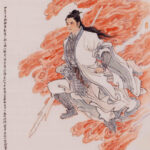
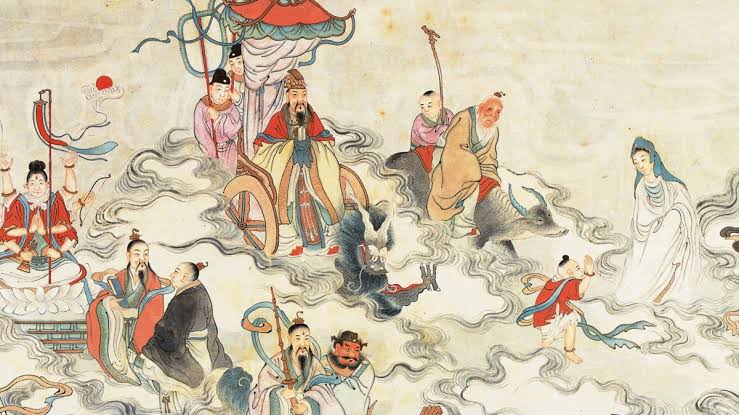
That does not mean they are excluded from religious worship. An immortal can acquire temples, devotees, ritual importance and divine functions. Lü Dongbin is perhaps the clearest example. He is simultaneously remembered as one of the Eight Immortals, a master associated with Daoist cultivation traditions and a figure who has received religious worship.
This is where a simple dictionary distinction begins to break down. Religious identity can change over centuries. A being classified as an immortal in hagiography may function as a deity in a temple cult. A legendary or historical person may later be incorporated into a divine hierarchy.
Can a Human Become a God or an Immortal?
Chinese religious traditions contain both possibilities, but they describe different processes.
Becoming an Immortal
Immortality traditions emphasize transformation. Different texts and schools describe different paths, including moral discipline, meditation, breath practices, ritual, external alchemy and later internal alchemy. There has never been one single method accepted by every Daoist tradition.
The important conceptual point is that the mortal person is transformed into a transcendent state. Readers interested in this tradition can continue with how immortality is understood in Taoism.
Becoming a Deity
Deification follows a different pattern. Chinese religious history contains historical officials, heroes, local protectors and other human figures whose cults developed after death. Their perceived spiritual efficacy, community devotion, religious incorporation or official recognition could eventually give them divine status.
There is therefore no universal rule that “gods were born divine while immortals were once human.” Some gods were understood as celestial or cosmic beings, while others had human biographies or were based on historical personalities.
Gods Often Have Offices; Immortals Represent Transcendence
One of the most useful distinctions for beginners is to ask what a sacred figure represents.
Many Daoist gods are imagined through function and jurisdiction. A deity may govern a celestial region, star, natural force or ritual department. Gods can protect communities, supervise records, control weather, punish disorder or administer aspects of human destiny.
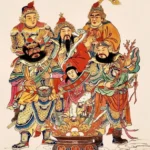
Daoist religious art frequently visualizes this sacred order in bureaucratic terms. The Metropolitan Museum of Art, for example, describes Daoist pantheons that include stars, officials, marshals and lords. Local deities could also be incorporated into this expanding religious framework.
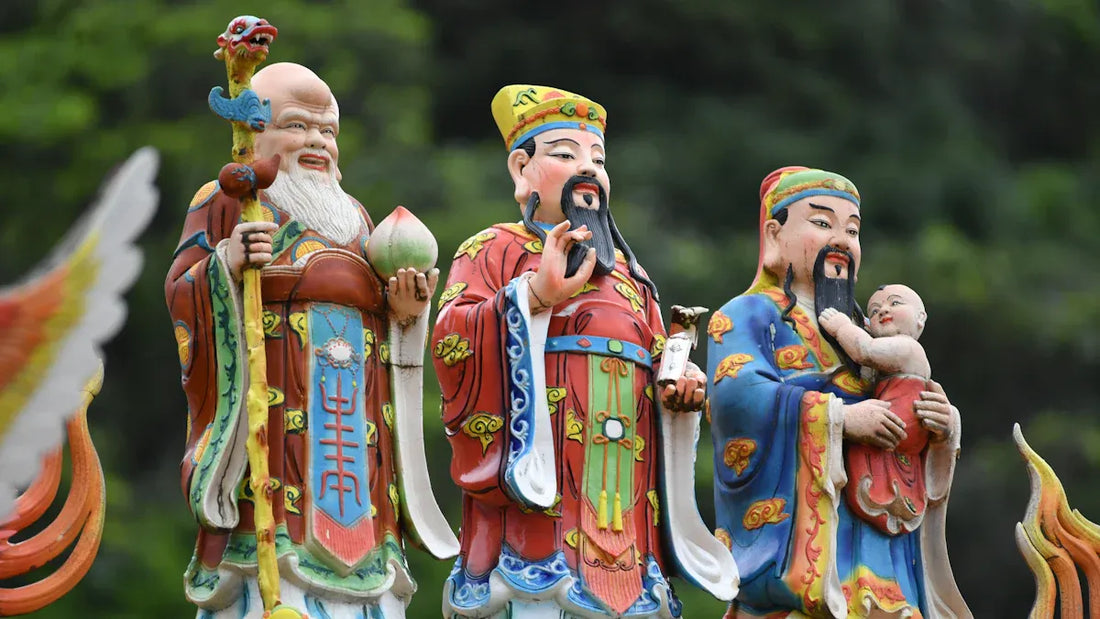
Immortals, by contrast, typically embody the possibility of transcendence. Their stories ask whether a human being can overcome ordinary limitations, transform the body and spirit, leave conventional society behind, or enter a sacred realm.
This distinction explains why an immortal may be shown wandering through mountains or clouds while a deity may be represented enthroned as a celestial official. These are tendencies, not mandatory visual rules.
What About Zhenren 真人, “Perfected Persons”?
Another term readers encounter is zhēnrén 真人, often translated as “Perfected Person,” “True Person” or “Realized Person.” It should not automatically be treated as a synonym for either shen or xian.
The term appears in different philosophical and religious contexts. In the Zhuangzi, the “True Man” expresses an ideal of realization and freedom from conventional attachments. In later Daoist religious traditions, titles involving zhenren could designate highly realized or sacred persons.
This is another reason a single English label such as “god” cannot describe every figure in Daoist religion accurately.
Why Gods and Immortals Overlap
The categories overlap because Daoism did not develop in isolation. Daoist traditions interacted continuously with Chinese popular religion, local cults, imperial institutions, Buddhism, literature and visual culture.
The Daoist pantheon itself expanded over time. Local gods could be incorporated into Daoist ritual systems. Legendary figures developed cults. Historical teachers acquired sacred identities. Immortals appeared not only in religious texts but also in drama, painting, porcelain, legends and temple worship.
Even Laozi illustrates how religious identities can change. The traditional sage associated with the Daodejing was gradually divinized in early religious Daoism and came to be worshipped as Lord Lao and, in later theology, associated with Daode Tianzun. The philosopher or sage of an early textual tradition and the deity of later religious tradition should therefore not simply be collapsed into a single historical biography.
Common Misconceptions
“All immortals are gods.”
Not exactly. Classical and medieval hagiographic traditions distinguish the attainment of immortal or transcendent status from simply becoming a god. Some immortals later receive worship and can function as divine figures, but their underlying identity remains connected with transcendence.
“All gods were always divine.”
No. Chinese religion includes cosmic deities as well as local gods and deified human figures. The origin of a deity must be examined individually.
“Every supernatural figure in a Taoist temple is a Taoist god.”
This is also too simple. Chinese temples and ritual traditions frequently share figures across Daoism, Buddhism and popular religion. Presence in a Daoist setting does not prove that a figure originated exclusively within Daoism.
“The Jade Emperor and the Eight Immortals are the same type of being.”
No. The Jade Emperor is primarily a heavenly sovereign and major deity. The Eight Immortals are primarily a group of legendary transcendents. Both belong to the wider Chinese sacred world, but their identities and religious functions are different.
Why the Difference Matters
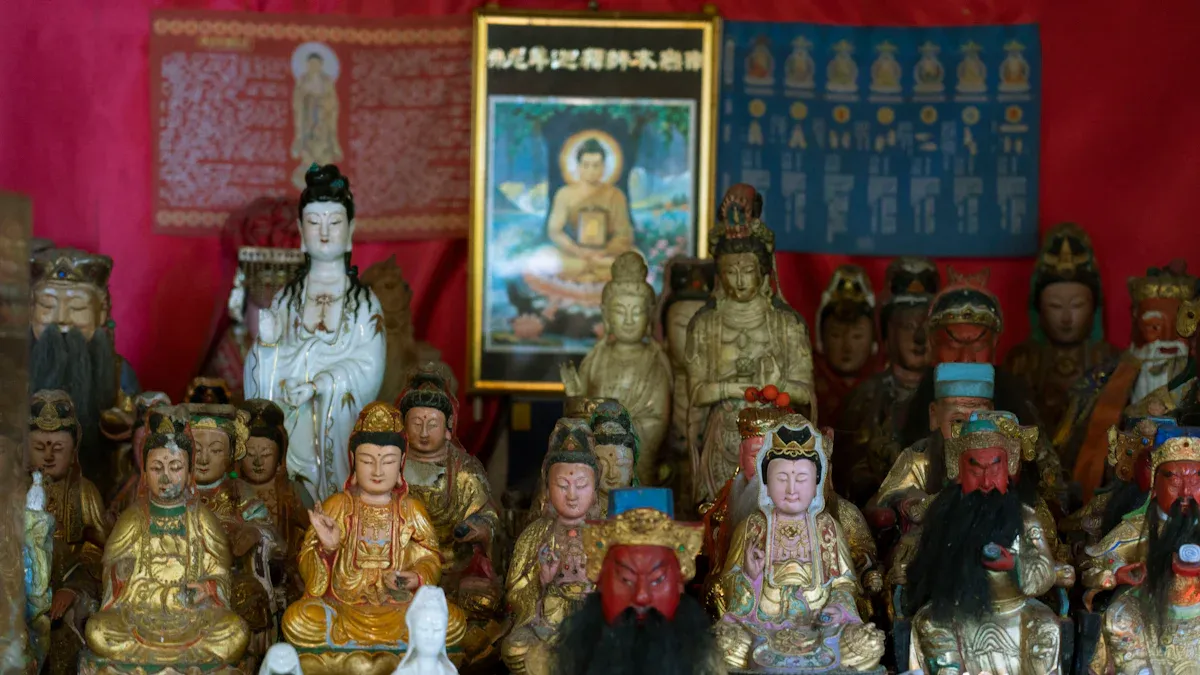
Understanding the difference between gods and immortals makes Chinese mythology and religion much easier to read. It explains why some figures govern Heaven while others wander through mountains, why some are approached as divine administrators while others embody the possibility of spiritual transformation, and why the same figure can sometimes occupy more than one category.
It also prevents a common problem in English-language mythology writing: treating Chinese religion as if it possessed one fixed pantheon comparable to a single family of mythological gods. Daoist traditions developed across many centuries, schools and regions, and their divine worlds changed with them.
The most reliable question is therefore not simply, “Is this figure a god?” Ask instead: What kind of being is this figure in this particular text, ritual, historical period or popular tradition?
FAQ
What is the main difference between Taoist gods and immortals?
A Taoist god is generally defined by divine identity, authority, worship or a sacred function. An immortal, or xian, is primarily defined by transcendence beyond normal mortality, often through cultivation or spiritual transformation. The categories can overlap in later religious practice.
Are the Eight Immortals gods?
They are more precisely called immortals or transcendents. However, individual members such as Lü Dongbin have also received temple worship and can function as divine figures in particular religious traditions.
Is the Jade Emperor an immortal?
The Jade Emperor is primarily classified as a major deity and heavenly ruler rather than as one of the human-like immortals. Later legends sometimes give him biographical stories involving spiritual cultivation, but these should not replace his principal religious identity as a celestial sovereign.
Can an immortal become a god?
The categories are not completely sealed off. A famous immortal may acquire a cult, receive worship and take on divine functions. Lü Dongbin is a strong example of how immortal traditions and deity worship can intersect.
Are Taoist immortals supposed to live forever?
Some traditions describe extremely long life or physical deathlessness, but “immortality” has had several meanings in Daoist history. It can also involve bodily transformation, ascent to Heaven, liberation from ordinary mortality or attainment of a transcendent state.
Are all Chinese gods Taoist gods?
No. Chinese sacred figures can come from ancient religion, Daoism, Buddhism, local cults, household religion, imperial worship, folklore and the deification of historical people. Many figures became shared across traditions.
References and Further Reading
- Stanford Encyclopedia of Philosophy — Religious Daoism — Detailed scholarly overview of Daoist history, pantheons, immortality, hagiography and the distinction between immortals and gods.
- Columbia University, Asia for Educators — Daoism — Overview of the diversity of Daoism, celestial gods and the pursuit of immortality.
- Robert Ford Campany, Making Transcendents — Oxford Academic — Scholarly discussion of the early Chinese quest for transcendence and the historical development of the xian tradition.
- Chinese Text Project — Baopuzi, “On Immortals” — Online edition of an important early medieval Chinese text discussing immortality and transcendents.
- The Metropolitan Museum of Art — Daoism and Daoist Art — Museum overview of Daoist religion, its expanding pantheon, divine bureaucracy and representations of immortals.
- The Metropolitan Museum of Art — Cup with Eight Daoist Immortals — Museum record discussing the Eight Immortals as symbols of the attainment of immortality and their traditional attributes.