Chinese Mythology · Legendary Rulers · Cultural Symbolism
Yan Emperor Yándì: Story, Meaning, Symbols, and Cultural Role
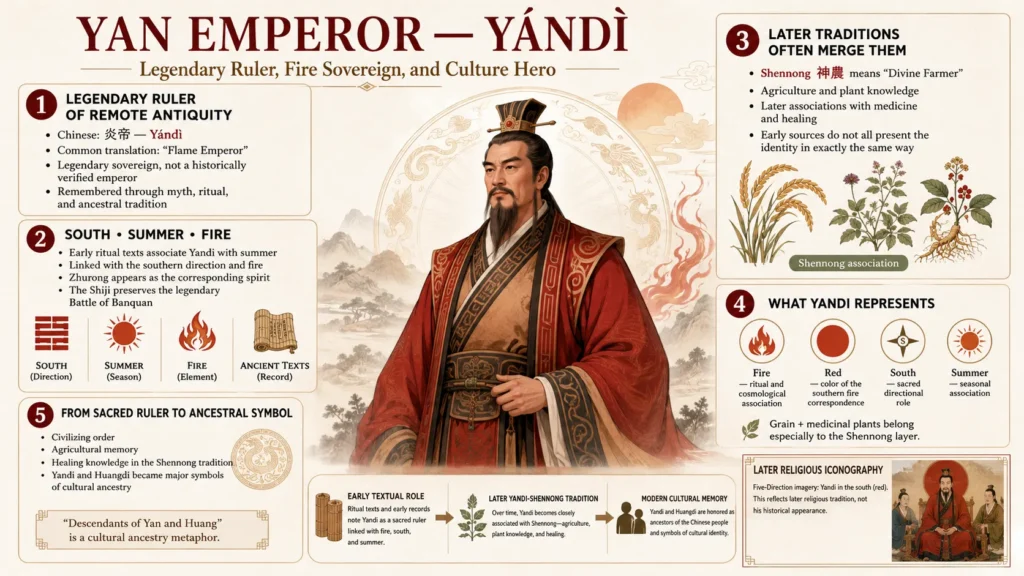
The Yan Emperor Yándì (炎帝, Yándì), commonly translated as the Yan Emperor or Flame Emperor, is a legendary sovereign and culture hero of remote Chinese antiquity. Early transmitted texts connect Yandi with the south, summer, fire, and ancient ritual cosmology, while the Records of the Grand Historian places a Yan Emperor in a legendary conflict with Xuanyuan, the future Yellow Emperor. Later traditions often identify Yandi with Shennong (神農, Shénnóng), the Divine Farmer, adding associations with agriculture, medicinal plants, and healing. These layers developed over time and should not be treated as one fixed historical biography.
Who Is the Yan Emperor?
Yandi is one of the major ancestral rulers remembered in Chinese mythic history. Calling him an “emperor” can be misleading if it suggests a ruler documented like an emperor of the Qin, Han, Tang, or Ming dynasties. The character 帝 (dì) had meanings connected with exalted rulership and divine sovereignty long before the later imperial title huangdi 皇帝 became standard.
Yandi is therefore best understood as a legendary sovereign, sacred ruler, and culture hero. His identity crosses several categories that modern English often separates: mythology, ancestral tradition, ritual cosmology, legendary history, and later religious worship. This is common among early figures discussed in broader collections of Chinese gods and culture heroes.
| Quick Fact | Yan Emperor |
|---|---|
| Chinese name | 炎帝 |
| Pinyin | Yándì |
| Common English names | Yan Emperor; Flame Emperor |
| Primary early associations | South, summer, fire, sacred rulership |
| Important legendary story | Conflict with Xuanyuan or Huangdi at Banquan |
| Later major identification | Shennong, the Divine Farmer |
| Later cultural associations | Agriculture, medicinal plants, healing, ancestral memory |
| Historical status | Legendary; not a securely documented prehistoric monarch |
What Does Yándì Mean?
The name 炎帝 combines yán 炎, meaning flame, blaze, or intense fire, with dì 帝, an ancient term for an exalted ruler or divine sovereign. “Flame Emperor” is therefore a useful literal translation, although “Yan Emperor” is also standard in English.
The name fits a much wider symbolic system. In the received Book of Rites (Liji) and the Lüshi Chunqiu, Yandi appears as the divine ruler associated with summer, alongside Zhurong as the corresponding spirit. Within later systems of cosmic correspondences, the south belongs to fire, summer, and red.
This is why Yandi’s fire symbolism should not automatically be imagined as a fantasy ability to throw flames or command magical weapons. His connection with fire is primarily cosmological, ritual, seasonal, and political.
Yandi in Early Textual Tradition
There is no single early book containing a complete “life of the Yan Emperor.” Instead, different texts preserve different roles.
Yandi as a ruler of summer and the south
Seasonal sections of the Lüshi Chunqiu and the received Book of Rites place Yandi within a system that coordinates seasons, directions, colors, sounds, tastes, ritual actions, and divine powers. In the summer sequence, Yandi is the ruling divine figure and Zhurong is the associated spirit.
This material is especially important because it shows that Yandi was more than a character in an adventure story. He could function as a component of a sacred model of the cosmos. Readers interested in how directional rulers developed into larger systems can compare this tradition with the Wufang Shangdi and Five Emperors.
The Battle of Banquan
Another influential tradition appears in Sima Qian’s Records of the Grand Historian (Shiji). Its opening account says that the descendants or ruling house of Shennong had declined during the age of Xuanyuan. It then introduces Yandi as a ruler whose aggression caused other lords to turn to Xuanyuan.
Xuanyuan eventually fights Yandi at the field of Banquan. After the legendary struggle, Xuanyuan emerges as the dominant ruler and later appears under the title Huangdi, the Yellow Emperor.
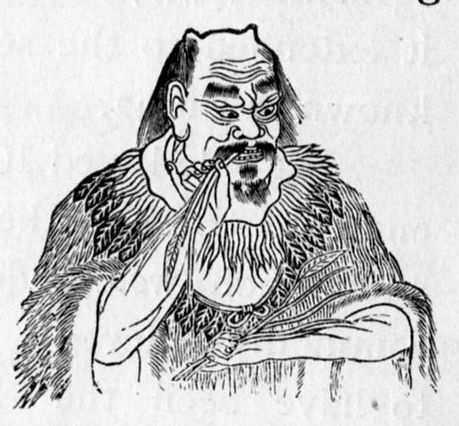
Are the Yan Emperor and Shennong the Same Figure?
They are often treated as the same figure in later tradition, but the identification should not be projected uniformly onto every early source.
Shennong 神農 means the “Divine Farmer” or “Divine Husbandman.” He is one of China’s most important agricultural culture heroes. Traditional accounts credit him with teaching cultivation and investigating the useful or harmful properties of plants.
Over time, Shennong and Yandi became so closely connected that the combined name Yandi Shennongshi 炎帝神農氏 became familiar. In directional and Five Phases traditions, Shennong could be identified with the southern Red or Flame Emperor.
Yet the textual history is more complicated. The Shiji passage describing Xuanyuan’s rise refers first to the decline of the Shennong lineage and then to Yandi. That wording does not provide a simple statement that “Shennong and Yandi are one person.” Later commentators, genealogies, religious traditions, and mythographers increasingly harmonized overlapping traditions.
| Tradition or Context | How Yandi Appears | How to Read It |
|---|---|---|
| Seasonal ritual cosmology | Divine ruler associated with summer, the south, and fire | An ordered cosmic role rather than a full biography |
| Records of the Grand Historian | Legendary ruler opposed by Xuanyuan at Banquan | Mythic antiquity organized into a historical sequence |
| Later Yandi-Shennong tradition | Identified with Shennong, the Divine Farmer | Adds agriculture, herbal knowledge, and healing associations |
| Five-Direction systems | Southern or Red Emperor associated with fire | Cosmological identification varies across texts and periods |
| Modern cultural memory | Ancestral and civilizing figure honored in commemorative rites | A living cultural interpretation, not proof of prehistoric biography |
Agriculture, Herbs, and Medicine
Many of the qualities English readers associate with the Yan Emperor actually come from the Shennong layer of the tradition.
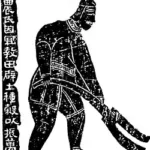
Shennong is traditionally remembered as a teacher of agriculture and as an investigator of plants. The famous image of him tasting herbs expresses an ideal of discovering which natural substances nourish, heal, harm, or poison the body.
The medical work known as the Shennong Bencao Jing, or Classic of Materia Medica of the Divine Farmer, was attributed to the mythical Shennong. That traditional attribution should not be confused with modern authorship. Scholarly bibliographical research treats the text as a work transmitted and compiled long after the age in which Shennong was imagined to have lived.
Shennong is not the only agricultural figure in Chinese tradition. For example, Hou Ji, the Lord of Millet, is particularly associated with grain cultivation and Zhou ancestry. Keeping these figures distinct helps avoid the misleading idea that Chinese mythology had only one universal “god of agriculture.”
Yan Emperor Symbols and Powers
Searches for “Yan Emperor symbols and powers” can make Yandi sound like a fantasy character with a fixed inventory of magical abilities. Traditional sources are better understood in terms of associations, functions, and ritual correspondences.
| Symbol or Association | Meaning | Historical Layer |
|---|---|---|
| Fire | Expressed in the name Yandi and in southern, seasonal cosmology | Early and later cosmological tradition |
| South | Sacred direction corresponding with summer and fire | Ritual and Five-Direction systems |
| Red | Color associated with fire and the southern divine ruler | Correlative cosmology and later religious art |
| Summer | Season governed by the fire correspondence | Seasonal ritual texts |
| Grain and farming | Civilizing knowledge and agricultural livelihood | Especially the Shennong identification |
| Medicinal plants | Knowledge of herbs, healing, and materia medica | Shennong and later medical tradition |
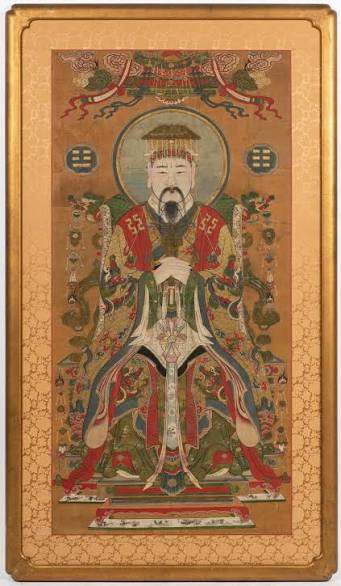
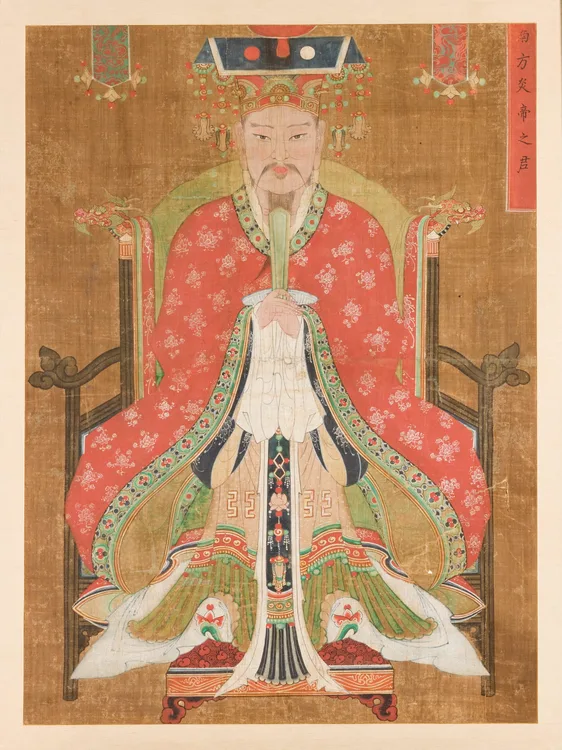
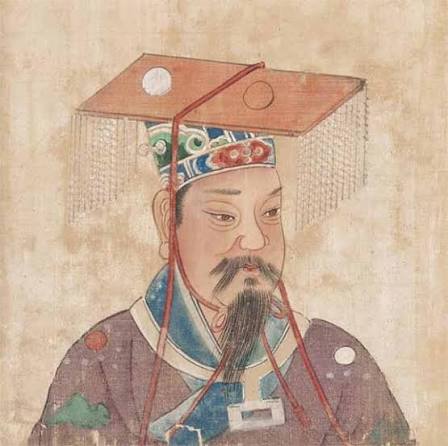
A useful example of later iconography survives in the Los Angeles County Museum of Art. An eighteenth-century Korean painting identifies its subject as the Yan Emperor of the South. He wears a red robe, sits formally on a throne, holds a ceremonial scepter, and has sun-and-moon imagery on his crown. The museum places the work within a five-direction divine system.
These details are valuable evidence for one later religious-art tradition, but they should not be treated as Yandi’s universal appearance in every period. A ceremonial scepter or specific crown is not automatically an ancient personal attribute of the legendary ruler.
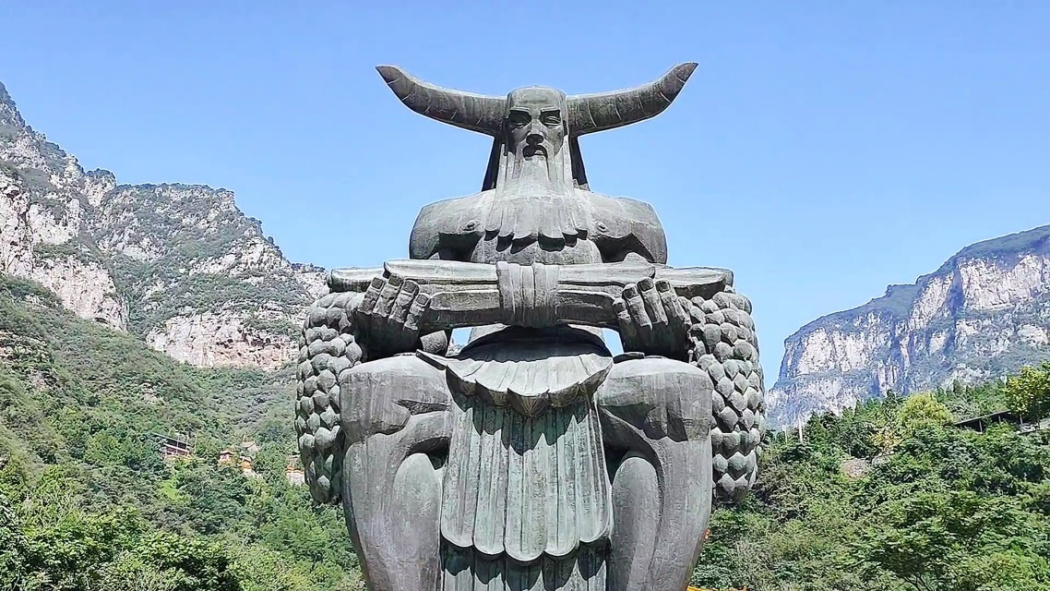
Is the Yan Emperor a Daoist God?
Calling Yandi simply “a Taoist god” is too narrow. His important textual and ritual associations developed from traditions older than the organized Daoist religious institutions that emerged centuries later.
Yandi was subsequently incorporated into wider cosmological and religious systems, including traditions that became important in Daoist contexts. Later art can therefore portray a divine southern emperor in a recognizably Daoist-associated cosmology without making Daoism the sole origin of Yandi.
This layered identity resembles that of other legendary rulers. Fuxi, for example, may appear as ancestral sovereign, culture hero, or sacred figure depending on the source. The separate guide to Fuxi and early Chinese culture-hero traditions shows why modern labels such as “god,” “emperor,” and “hero” cannot always be applied exclusively.
What Does the Yan Emperor Represent?
Yandi’s meaning changed as different traditions accumulated around him. At the broadest level, he represents several closely connected ideas.
- Fire and seasonal order: Yandi occupies the southern, fiery, summer position in traditional cosmological classification.
- Ancient rulership: he belongs to the remembered age of legendary sovereigns who organize the world before conventional dynastic history.
- Agricultural civilization: when identified with Shennong, he symbolizes cultivation, food production, and practical knowledge.
- Healing knowledge: the Shennong tradition connects him with the investigation of medicinal plants and the later heritage of Chinese materia medica.
- Ancestral memory: paired with Huangdi, he became an important symbol in narratives about Chinese cultural origins.
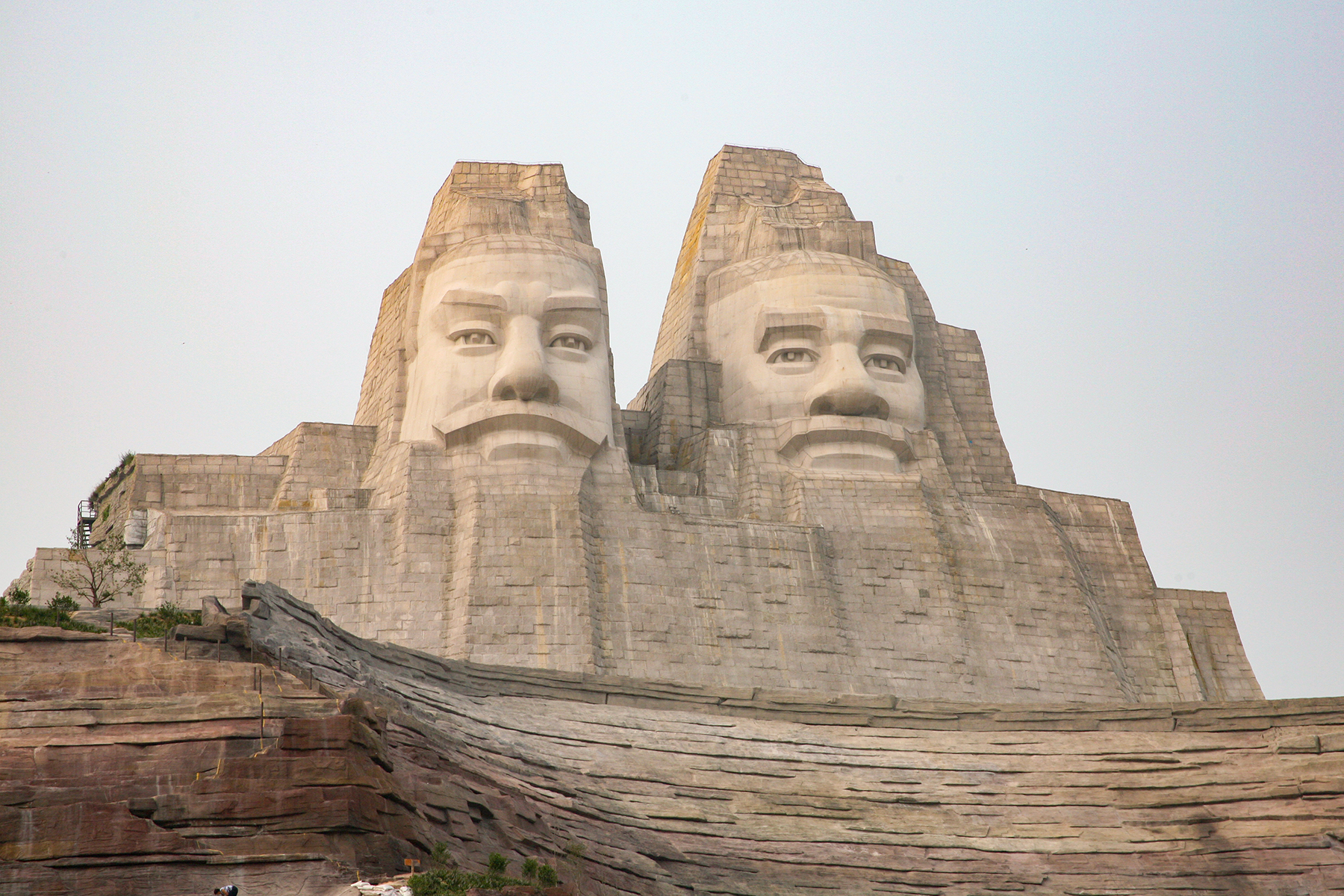
The familiar expression “descendants of Yan and Huang” (炎黄子孙, Yán Huáng zǐsūn) invokes Yandi and Huangdi as shared ancestors. In modern cultural and political language, this has functioned as a powerful metaphor for common origin and belonging. It should be understood as cultural and mythic ancestry rather than as a scientific statement that an entire modern population descends biologically from two individually verified rulers.
Yan Emperor Worship and Modern Cultural Memory
Yandi continues to be honored at temples, memorial sites, and cultural ceremonies, particularly in traditions that identify him with Shennong. Several regions maintain their own claims about places connected with his birth, activity, or burial. Such geographical traditions are important parts of local cultural memory but should not be used as simple archaeological proof of a prehistoric ruler’s biography.
Modern ceremonies also demonstrate how the figure continues to change. In 2026, for example, an officially reported memorial ceremony in Yanling County, Hunan, honored Emperor Yan as Shennong and as an ancestor of tea culture. The rite combined offerings and commemorative ritual with contemporary tea culture.
This is evidence of living modern commemoration. It does not establish that precisely the same ritual, title, or tea tradition existed in the earliest period in which Yandi appears in surviving texts.
Common Misconceptions About Yandi
“Yandi was a historically verified emperor who ruled China on exact dates.”
No secure historical evidence supports treating the legendary chronology as a modern political biography. Yandi belongs primarily to mythic antiquity, ritual tradition, and cultural memory.
“Every ancient source says Yandi was Shennong.”
No. Their later identification became extremely influential, but surviving textual traditions are not completely uniform. The distinction is important when explaining the development of the myth.
“Yandi’s fire association means he had supernatural fire attacks.”
Traditional fire symbolism is primarily cosmological and ritual. Modern fantasy-style powers should not be projected backward without textual evidence.
“Yandi personally wrote the Shennong Bencao Jing.”
The medical classic is traditionally attributed to Shennong, but scholarly research does not treat that legendary attribution as evidence that a prehistoric individual personally authored the received text.
Why the Yan Emperor Still Matters
Yandi is valuable precisely because his tradition is not simple. He can appear as a fiery southern sovereign, an opponent of the Yellow Emperor, a cosmic ruler, Shennong the agricultural culture hero, a patron-like figure of healing traditions, and an ancestral symbol of civilization.
Those identities did not necessarily originate together. Their gradual combination shows how Chinese mythology grew through ritual, historiography, cosmological theory, medicine, religious art, local tradition, and modern cultural memory.
Understanding the Yan Emperor therefore means resisting the temptation to turn every surviving story into a single timeless biography. Yandi’s importance lies less in discovering one definitive “real story” than in seeing how generations used an ancient sacred ruler to express ideas about fire, farming, healing, political order, ancestry, and civilization. For more traditional narratives, the site’s Chinese mythology legends and stories provide the wider mythic context.
Frequently Asked Questions
Who is the Yan Emperor in Chinese mythology?
The Yan Emperor, or Yandi 炎帝, is a legendary sovereign of remote Chinese antiquity associated with fire, the south, summer, and ancient rulership. Later traditions frequently identify him with Shennong, the Divine Farmer.
What does Yan Emperor mean?
Yandi combines 炎, meaning flame or blaze, with 帝, an ancient term for an exalted ruler or divine sovereign. “Flame Emperor” is therefore a useful literal English translation.
Are Yandi and Shennong the same person?
They are commonly identified with each other in later tradition, especially in cosmological, agricultural, and religious contexts. Earlier textual evidence is less uniform, so it is more accurate to describe their identity as a historical merging of traditions rather than an uncontested fact in every source.
What does the Yan Emperor represent?
Yandi represents fire, summer, the south, legendary rulership, and ancestral memory. Through his identification with Shennong, he also represents agriculture, plant knowledge, and healing.
What are the Yan Emperor’s symbols?
His strongest traditional associations are fire, red, the south, and summer. Grain and medicinal plants become especially relevant when Yandi is identified with Shennong.
Is the Yan Emperor a Daoist god?
Not simply. Yandi has important roots in early ritual, mythic, and cosmological traditions that predate organized Daoism. He was later incorporated into religious systems and iconography that also became important in Daoist contexts.
References and Further Reading
- Chinese Text Project, Records of the Grand Historian: Annals of the Five Emperors — Primary transmitted source for the decline of the Shennong lineage, Yandi, Xuanyuan, and the Battle of Banquan tradition.
- Chinese Text Project, Book of Rites: Monthly Ordinances (Yue Ling) — Primary source for Yandi’s seasonal and cosmological association with summer and Zhurong.
- Chinese Text Project, Lüshi Chunqiu: First Month of Summer — Early transmitted evidence placing Yandi within the summer ritual-correlative system.
- Los Angeles County Museum of Art, Portrait of Yan Emperor of the South — Museum documentation for an eighteenth-century Korean representation of the southern Yan Emperor and its Five-Direction iconography.
- Catherine Despeux, “Shennong bencao jing,” in Early Medieval Chinese Texts: A Bibliographical Guide — Scholarly guide describing the materia medica text as a work attributed to the mythical Shennong.
- Cambridge University Press, The Cambridge History of Science: China — Scholarly context for the association of the Red Emperor or Yandi, Shennong, medicine, and healing.
- Yinghong Cheng, “Is Peking Man Still Our Ancestor?” The Journal of Asian Studies — Academic discussion of modern ancestry language including the expression “descendants of Yan and Huang.”
- Hunan Provincial Government, “2026 Chinese Tea Ancestor Festival Memorial Ceremony Held in Yanling County” — Documentation of a modern ceremony honoring Emperor Yan-Shennong within contemporary tea culture.