Doumu Yuanjun: Ruler of the Northern Dipper
Doumu: The Celestial Matriarch of Chinese Mythology
Doumu Yuanjun: Goddess Behind the Big Dipper
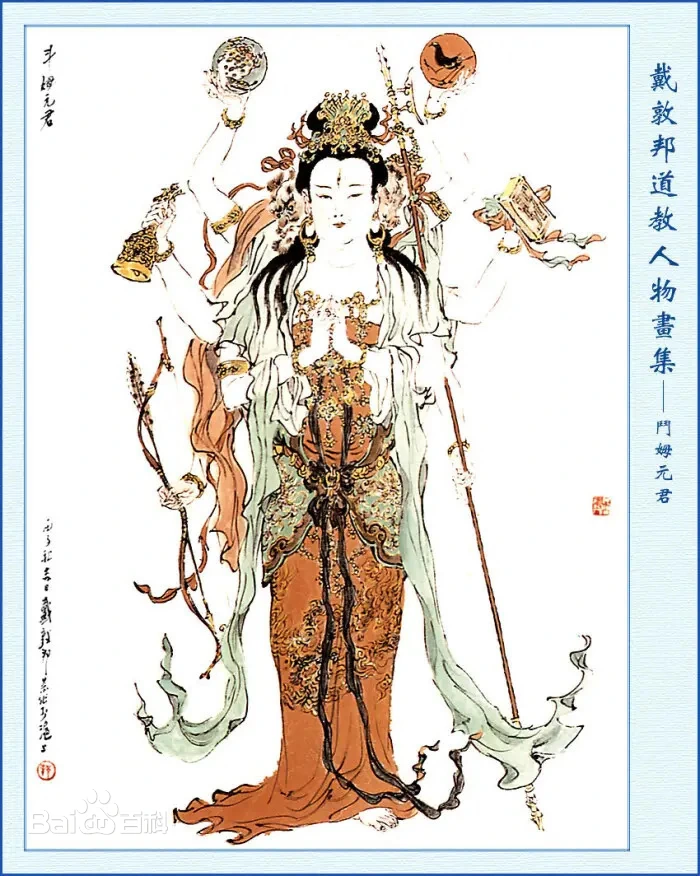
As the feminine counterpart to Tian (天)—the masculine principle within the traditional Chinese conception of celestial energy—Doumu (斗母) is revered as the divine progenitrix of the Big Dipper. In certain Daoist scriptures, she is even identified with the august goddess Xiwangmu (西王母), further underscoring her exalted status within the celestial hierarchy.
This goddess is known by a multitude of honorific titles, the most prevalent being Dǒumǔ (斗母), meaning “Mother of the Big Dipper.” In antiquity, the Big Dipper constellation was envisioned as a celestial chariot; accordingly, she is also venerated as Dǒumǔ Yuánjūn (斗母元君), or “Primordial Mother of the Chariot,” and Dòulǎo Yuánjūn (斗姥元君), meaning “Ancestral Matriarch of the Chariot.” She is at times addressed as Tiānhòu (天后), “Queen of Heaven,” or more tenderly as Tiānmǔ (天母), the “Heavenly Mother.”
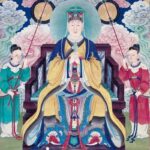
Iconographically, Doumu is depicted with a serene and compassionate countenance, accompanied by sixteen arms. Typically, two of her hands are joined in a gesture of prayer, while the remaining fourteen hold an array of sacred implements, each imbued with profound religious symbolism.
According to mythic cosmology, Doumu came into being at the moment of creation, when the universe was first shaped by Pangu (盤古). She is honored as the mother of the Jiǔhuángshén (九皇神), the “Nine God-Kings” of Heaven, who are believed to correspond to the seven visible stars—along with two unseen companions—encircling the Big Dipper in the night sky.
Although relatively few myths center explicitly upon Doumu, her theological significance is immense. As a primordial feminine deity, she embodies boundless compassion, mercy, and nurturing love. Certain traditions even suggest that she played a subtle yet pivotal role in the miraculous conception of Huangdi’s mother, Fubao, thus linking her to the very origins of Chinese civilization.
Doumu—also known as Doumu Yuanjun—derives her name from “Dou,” referring to the stars of the Northern Dipper, and “Mu,” meaning “mother,” signifying her role as the celestial mother of these astral powers. Over time, she has been adorned with an extensive array of exalted titles, such as Jiuling Taimiao Baiyu Guitai Yeguang Jinjing Zumu Yuanjun and Zhongtian Fanqi Doumu Yuanjun Ziguang Mingzhe Cihui Taisu Yuanhou Jinzhen Shengde Tianzun, reflecting her supreme spiritual authority and cosmic virtue.
Classical Daoist texts, including the Yuqing Wushang Lingbao Ziran Beidou Bensheng Zhenjing, recount that Doumu was once the beloved consort of King Zhouyu during the Longhan era, known as “Lady of Purple Radiance” (Ziguang Furen). She bore nine sons, the eldest being the August Heavenly Emperor (Tianhuang Dadi) and the Purple Tenuity Emperor (Ziwei Dadi), while the remaining seven sons are identified with the stars of the Big Dipper themselves.
Within the pantheon of Daoist goddesses, Doumu occupies an eminently exalted position. Her divine functions bear resemblance to those of a celestial healer: she governs medicine and healing, safeguards childbirth, dispels darkness and malevolent forces, and presides over fertility and the continuity of life.
Temples dedicated to Doumu are commonly found within Daoist complexes, where her image—often portrayed with multiple heads and arms—is enshrined. Devotees gather in these sanctuaries to perform rituals seeking longevity, health, and the blessing of descendants. Her sacred birthday is traditionally observed either on the twentieth day of the sixth lunar month or the ninth day of the ninth lunar month.
In broader religious syncretism, Doumu is also associated with the ancient Indian deity Marici, inheriting attributes such as the power to dispel calamities, remove obstacles, bestow blessings, and perceive hidden truths. Revered in Daoism as the “Mother of the Northern Dipper,” she is believed to wield boundless spiritual power, capable of influencing cosmic order, human destiny, and the harmony of the universe itself.
Over the course of history, Doumu’s image evolved through the confluence of Daoist and Buddhist traditions. From her early identification with the Purple Radiance Lady to her later synthesis with Marici, she emerged as a profoundly complex and richly symbolic deity, embodying both cosmological principles and the deep-rooted reverence for the feminine divine in Chinese spiritual thought.
Often depicted with three eyes, four heads, and eight arms on each side, Doumu presents an awe-inspiring yet benevolent visage. Classical scriptures describe her adorned in radiant garments, crowned with intricate coiffures, and enthroned upon a lotus seat, riding a chariot drawn by five dragons—an image that conveys both majesty and transcendence.
According to Daoist canon, Doumu presides over life itself: she governs birth, healing, and protection, harmonizes the cosmic forces of yin and yang, dispels misfortune, and restores balance to the natural order. She commands the celestial bureaucracy of stars, including the Northern and Southern Dippers, and responds to the prayers of devotees with grace and efficacy. Whether invoked for protection, prosperity, or spiritual elevation, her benevolence is believed to be boundless, her influence extending across heaven, earth, and all sentient beings.
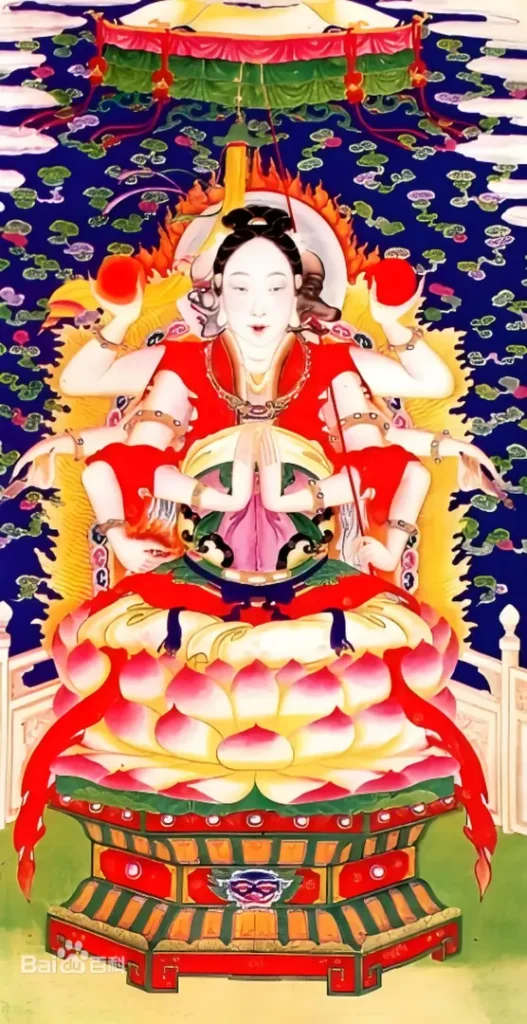
Origins and Evolution of Doumu’s Iconography
The figure of Doumu Yuanjun finds her earliest origins in the ancient veneration of the Northern Dipper, a celestial cult whose roots may be traced as far back as the Neolithic era. Archaeological and cultural evidence suggests that as early as ten millennia ago, proto-astral worship had already begun to take shape. By the Shang dynasty, oracle bone inscriptions explicitly record ritual offerings made to the Northern Dipper, attesting to its profound spiritual significance.
During the Zhou period, this stellar reverence evolved into a more systematic and coherent cosmological framework. By the early Warring States era, artifacts unearthed from the tomb of Marquis Yi of Zeng reveal a fully developed system of astral worship, in which the Northern Dipper occupied an unrivaled central position among the Twenty-Eight Lunar Mansions. Its prominence was so absolute that it informed early Chinese eschatological beliefs, including the notion that the souls of the deceased would ultimately return to the northern celestial realm.
Pre-Qin literary sources further hint at the embryonic form of Doumu’s mythology. In Tianwen (“Heavenly Questions”), attributed to Qu Yuan, a mysterious divine figure is described as bearing nine sons without a consort. Later commentators identified this enigmatic “Mother of Nine Sons” as a proto-form of Doumu. This archetype persisted within popular religion, where she was venerated as a fertility deity presiding over childbirth and progeny.
Transformation Through Dynastic Eras
By the Qin and Han dynasties, the cult of the Northern Dipper had become institutionalized. Historical records such as the Records of the Grand Historian (Shiji) note the existence of state-sponsored temples dedicated to celestial bodies, including both the Northern and Southern Dippers. Although astronomical precession gradually displaced the Big Dipper from its position as the pole star, it retained immense symbolic authority as the celestial chariot of the supreme deity Taiyi. In this capacity, it was imbued with apotropaic power, believed to suppress malevolent spirits and avert calamities.
During the Wei and Jin periods, the theological significance of the Dipper deepened. Texts such as Soushen Ji record the widespread belief that the Southern Dipper governed birth, while the Northern Dipper presided over death. Consequently, all prayers—whether for longevity, fortune, or protection—were directed toward the Northern Dipper, solidifying its central role in popular devotion.
By the Southern Dynasties, Daoist scholars such as Tao Hongjing began to systematize the celestial pantheon, assigning hierarchical ranks to deities. Within this framework, the Northern Dipper was formally deified and integrated into an increasingly sophisticated theological structure. The emergence of the “Nine Sovereigns” concept—comprising the seven stars of the Dipper alongside the Pole Star (Ziwei) and auxiliary celestial powers—marked a pivotal stage in the evolution of astral theology.
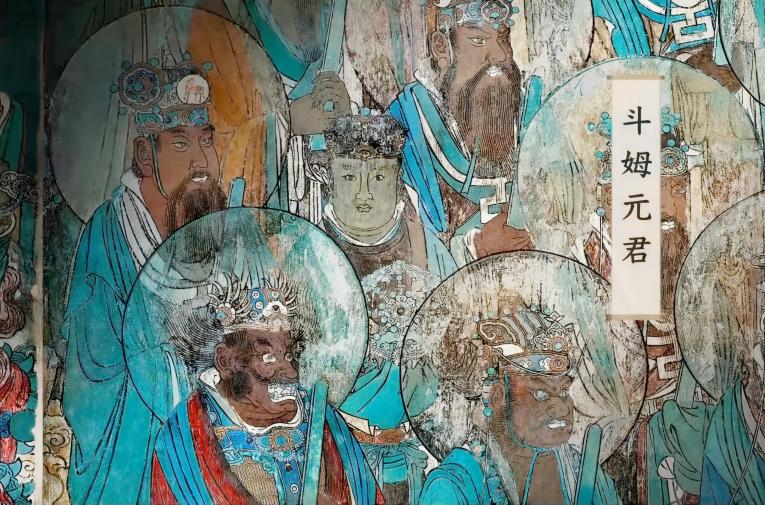
The Six Dynasties period witnessed further elaboration within the Shangqing Daoist tradition, which expanded the Dipper into a complex system of nine stellar deities. This development introduced a rich array of divine personifications and ritual practices, laying the doctrinal foundation for later Daoist cosmology and internal alchemy.
Maturation of Doumu’s Divine Identity
By the Sui and Tang dynasties, the worship of the Northern Dipper had matured into a fully articulated religious system, complete with canonical scriptures and elaborate liturgical rites. The Dipper was widely believed to govern human destiny—bestowing longevity, fortune, and protection—while rituals dedicated to it were thought to dispel misfortune and extend one’s lifespan.
It was during the Song dynasty that the theological framework surrounding the “Nine Sovereigns of the Dipper” reached its most complete form. Each star was endowed with a distinct divine office, transforming the Dipper from a natural celestial phenomenon into a fully anthropomorphized pantheon. This transition created the conceptual space for the emergence of Doumu as their celestial mother, a unifying maternal deity whose existence resolved the absence of genealogical origin within the system.
Daoist scriptures from this period, such as the Beidou Bensheng Zhenjing, narrate the myth of Lady of Purple Radiance (Ziguang Furen), who miraculously gave birth to nine divine sons—two supreme celestial emperors and the seven stars of the Northern Dipper. In this narrative, Doumu is understood not merely as a historical figure but as a primordial manifestation of cosmic energy, the generative force behind the stars themselves.
Further elaboration appears in the Heart Scripture of Doumu, which presents her as a transcendent savior who harmonizes cosmic forces, heals illness, dispels calamities, and restores balance to the universe. Here, Doumu emerges fully formed as a supreme Daoist goddess—compassionate, omnipotent, and deeply integrated into the metaphysical structure of existence.
Syncretism and Expansion
By the late Yuan dynasty, Doumu’s identity underwent a significant transformation through syncretism with the Buddhist deity Marici. This fusion enriched her iconography and expanded her spiritual functions, portraying her as a radiant, multi-armed goddess wielding celestial weapons and riding a divine chariot. This period marks the convergence of Daoist and Esoteric Buddhist traditions, facilitating the widespread popularization of her cult.
During the Ming dynasty, her image evolved yet further into that of a supreme cosmic mother—resplendent, awe-inspiring, and omnipresent. Scriptures from this era describe her as a luminous and transcendent being whose power extends across the three realms, capable of responding to the cries of all sentient beings and delivering them from suffering.
From the Ming and Qing periods onward, the worship of Doumu flourished both within China and among overseas Chinese communities. Her cult became closely intertwined with that of the Nine Sovereigns, celebrated in elaborate festivals marked by ritual fasting, offerings, theatrical performances, and devotional ceremonies. These traditions spread throughout Southeast Asia, where they remain vibrant expressions of Chinese diasporic spirituality.
Mythic Narratives and Religious Significance
Among the most enduring legends is the tale of the Nine Sons, in which Lady of Purple Radiance gives birth to nine lotus-born children who later become the celestial rulers of the cosmos. This myth not only establishes Doumu’s मातृarchal authority but also symbolically links her to the cyclical order of the heavens.
Other narratives emphasize her divine intervention in the human realm, portraying her as a compassionate protector who rescues devotees from disaster in response to sincere faith. Such stories reinforce her role as a living presence within popular religion, bridging the celestial and the mundane.
Ultimately, Doumu Yuanjun represents the culmination of centuries of religious development—from primitive star worship to a sophisticated theological system integrating cosmology, ritual practice, and metaphysical speculation. As the mother of the Nine Sovereigns and the embodiment of primordial yin energy, she occupies a central and indispensable position within Daoist thought. Her worship reflects not only the evolution of Chinese religious consciousness but also a profound reverence for the generative and nurturing power of the feminine divine.