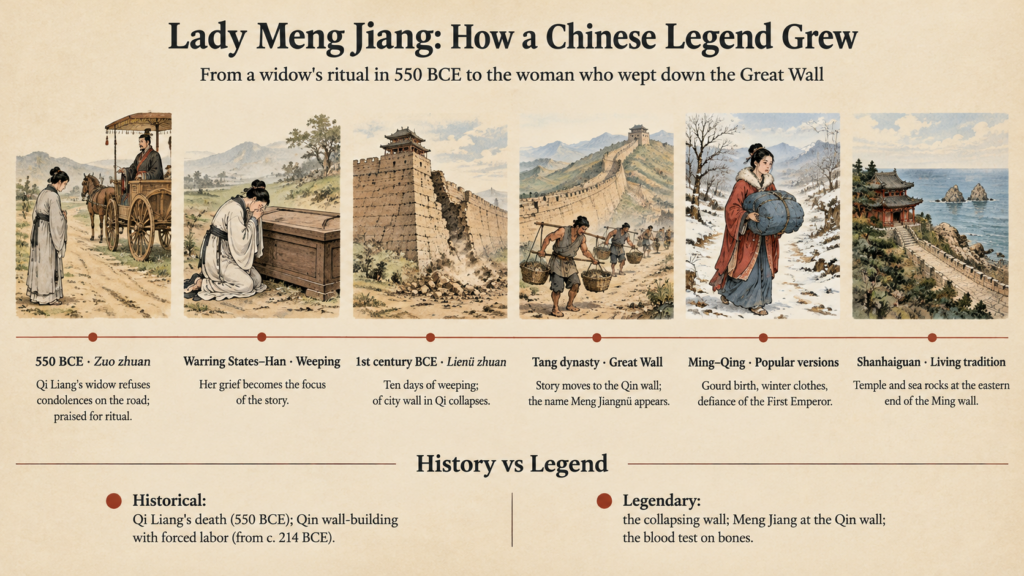
Lady Meng Jiang (孟姜女, Mèng Jiāng Nǚ), often called Meng Jiangnü, is the heroine of one of China’s best-known folk legends. In the familiar version, her husband is conscripted to build the Great Wall under the First Emperor of Qin and dies at the work site. When she arrives with winter clothes and learns of his death, her weeping brings down a section of the wall and exposes his bones. She is a legendary figure, not a documented historical person and not a goddess. The story grew over more than two thousand years from a short episode in the Zuo zhuan, dated to 550 BCE, about the widow of a Qi officer named Qi Liang, who was praised for observing ritual rather than for toppling walls.
| Chinese name | 孟姜女 (Mèng Jiāng Nǚ); also written Meng Jiangnü |
|---|---|
| What she is | Heroine of a folk legend; one of the modern “Four Great Folk Legends” |
| Earliest root | Anecdote of Qi Liang’s widow in the Zuo zhuan (550 BCE) |
| Wall-collapse miracle | First clearly told in the Han, in Liu Xiang’s Biographies of Exemplary Women |
| Name and Great Wall setting | Established in Tang-era texts, including Dunhuang manuscripts |
| Main associated places | Shanhaiguan (Hebei), Zibo (Shandong), Jinshi (Hunan) |
| Heritage status | Listed as national intangible cultural heritage in China (2006, extended 2008) |
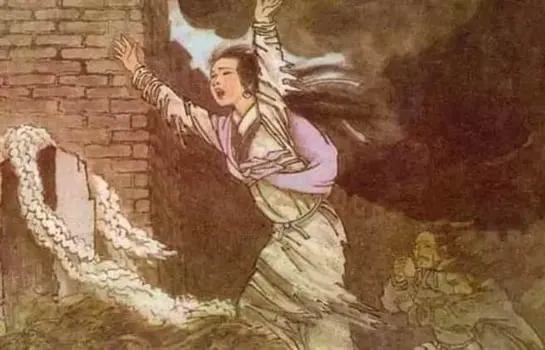
Who Is Lady Meng Jiang?
Lady Meng Jiang is the central character of a folk legend that is now usually grouped with the Cowherd and the Weaver Girl, the Legend of the White Snake, and the Butterfly Lovers (Liang Shanbo and Zhu Yingtai) as China’s “Four Great Folk Legends” (四大民间传说). That grouping is a modern convention, not an ancient canon, but it reflects how widely the four stories were told, sung, and staged in late imperial and modern China.
Her name combines two old naming elements with 女 (nǚ, “woman” or “daughter”). In Zhou-period usage, 孟 (mèng) marked the eldest child among siblings, and 姜 (Jiāng) was the clan name of the ruling house of Qi, in present-day Shandong. “Meng Jiang” was therefore a natural way to refer to an eldest daughter of the Jiang clan, and the Book of Songs (诗经, Shījīng) already uses “the beautiful Meng Jiang” as a stock phrase for an attractive noblewoman. Meng was not originally her surname. Later storytellers, who no longer read the name this way, explained it with a new tale about two neighboring families, the Mengs and the Jiangs.
In the earliest sources her husband is Qi Liang (杞梁, Qǐ Liáng), an officer of the state of Qi. Later versions rename him Fan Xiliang (范喜良), Wan Xiliang (万喜良), or Fan Qiliang (范杞良), names that still echo the original “Qi Liang.”
She is best understood as a legendary heroine. No record from the Qin period mentions her, and although several places maintain shrines in her honor, she never became a major deity with a defined role in Daoist or popular religious hierarchies.
The Best-Known Version of the Story
There is no single authoritative text. The outline below follows the form that dominated Ming and Qing ballads, precious scrolls (宝卷, bǎojuàn), and regional opera, and that most modern retellings repeat. Details vary from region to region and from one genre to another.
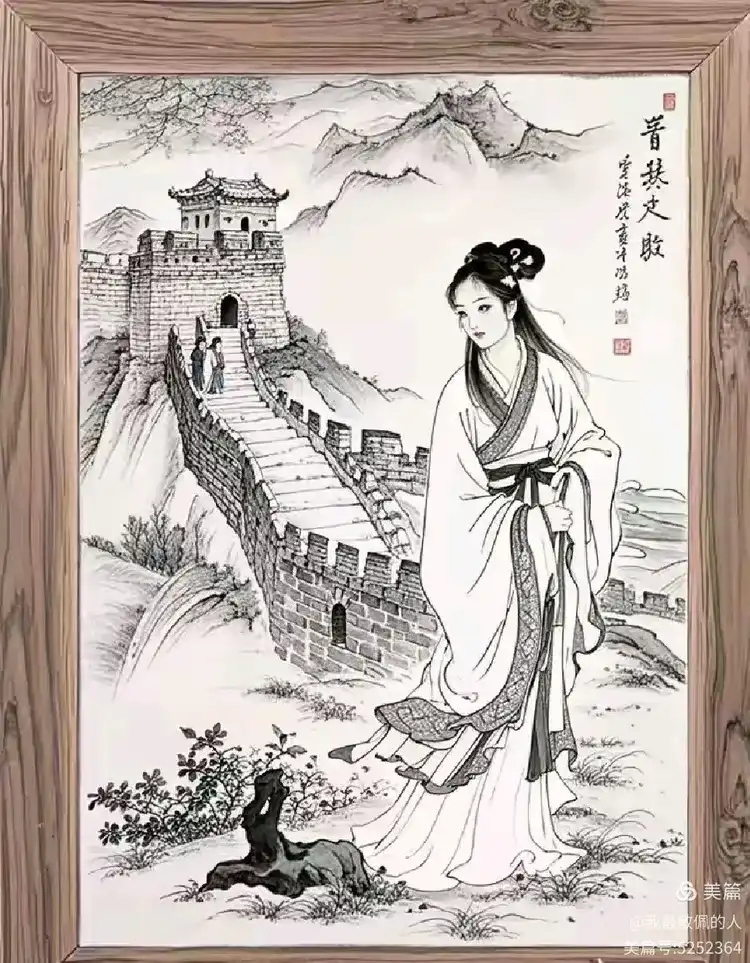
- A daughter from a gourd. An elderly Meng couple plants a gourd whose vine climbs over the wall into the yard of their neighbors, the Jiangs. When the gourd ripens, a baby girl is found inside. The two families agree to raise her together, and she is named for both.
- A fugitive in the garden. Years later, a young man fleeing conscription for the Great Wall hides in the family garden. In several versions he catches sight of Meng Jiang while she is bathing, and because a stranger has seen her, the families decide she must marry him.
- Conscription. Shortly after the wedding, sometimes on the wedding day itself, officials seize the husband and send him north to labor on the wall of the First Emperor, Qin Shi Huang (秦始皇, Qín Shǐhuáng).
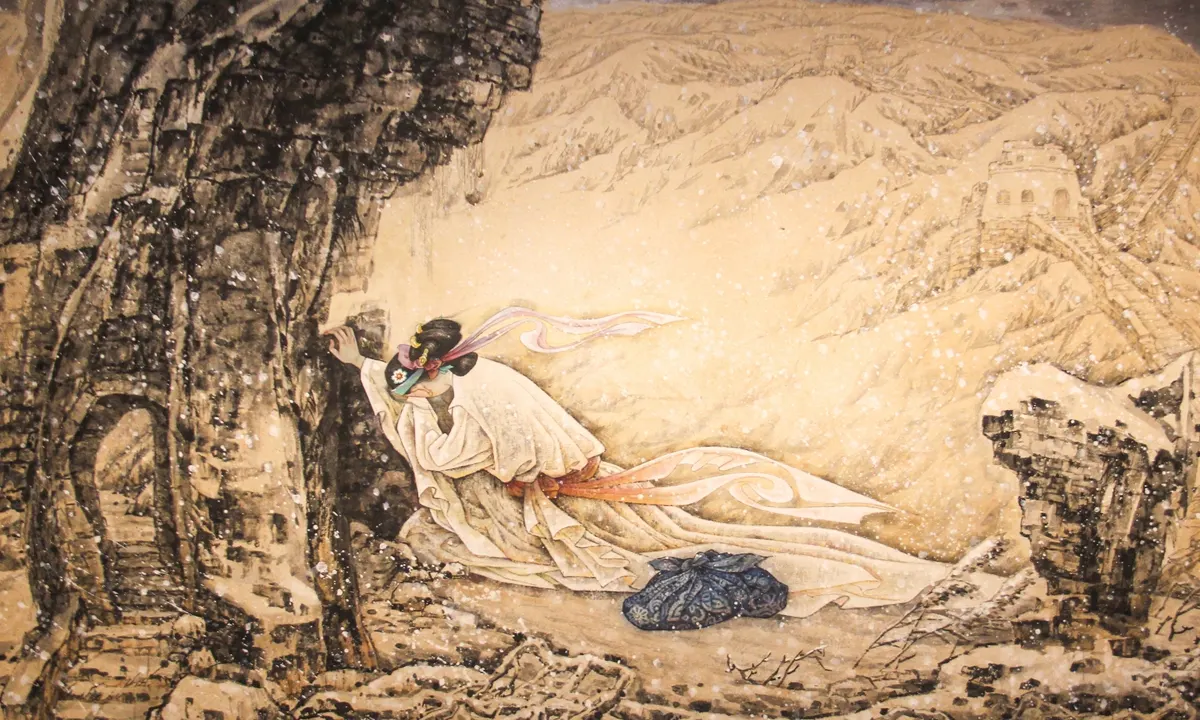
- Winter clothes. As winter approaches and no news arrives, Meng Jiang sews padded clothing and sets out alone on the long road north to deliver it.
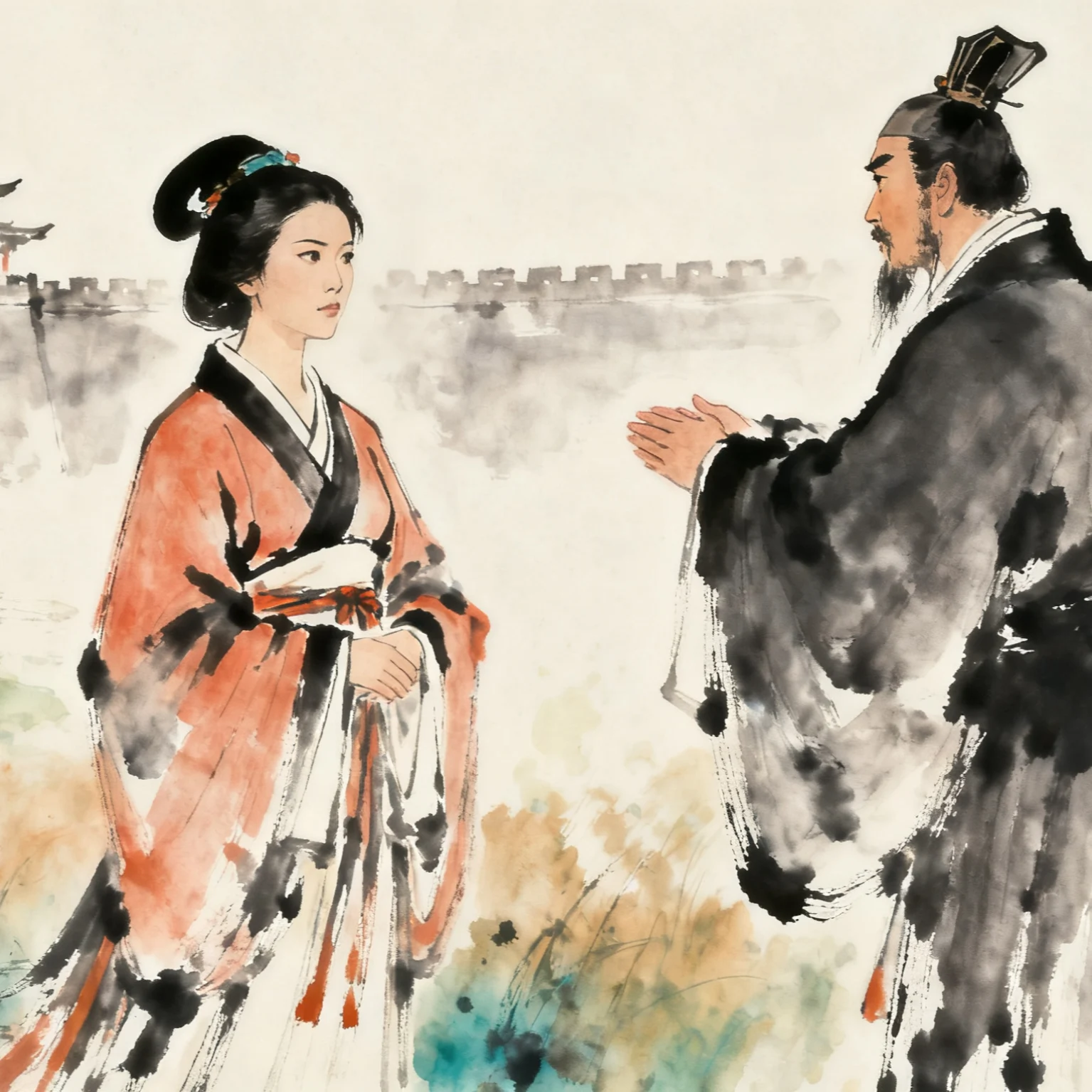
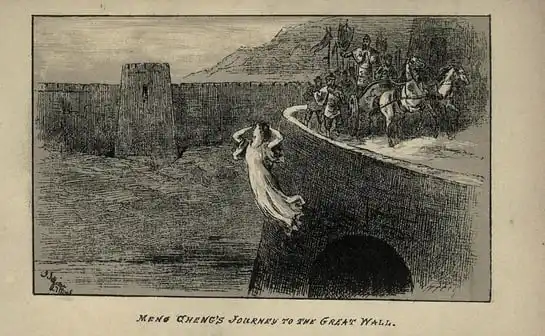
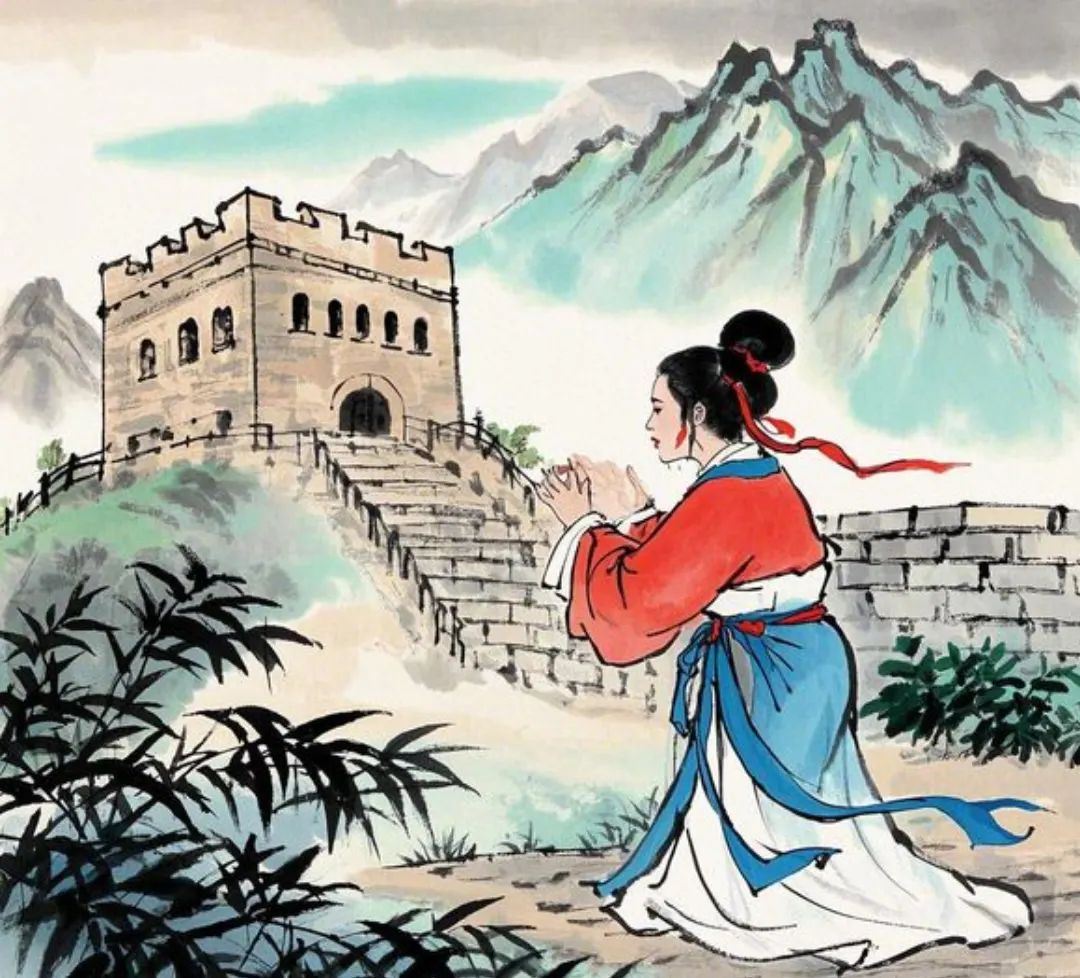
- The weeping. At the wall she learns that her husband has died and that his body was buried in or beneath the structure. She weeps so bitterly that a long stretch of the wall collapses, exposing many skeletons.
- The blood test. Unable to tell which bones are his, she pricks her finger and lets her blood fall on them. It soaks only into her husband’s bones, and she gathers them for burial.
- Facing the emperor. The First Emperor, angered by the collapse but struck by her beauty, wants to make her a consort. She agrees only on conditions, which usually include an honorable funeral for her husband with the emperor taking part in the mourning. Once the conditions are met, she throws herself into the sea; in some versions it is a river.
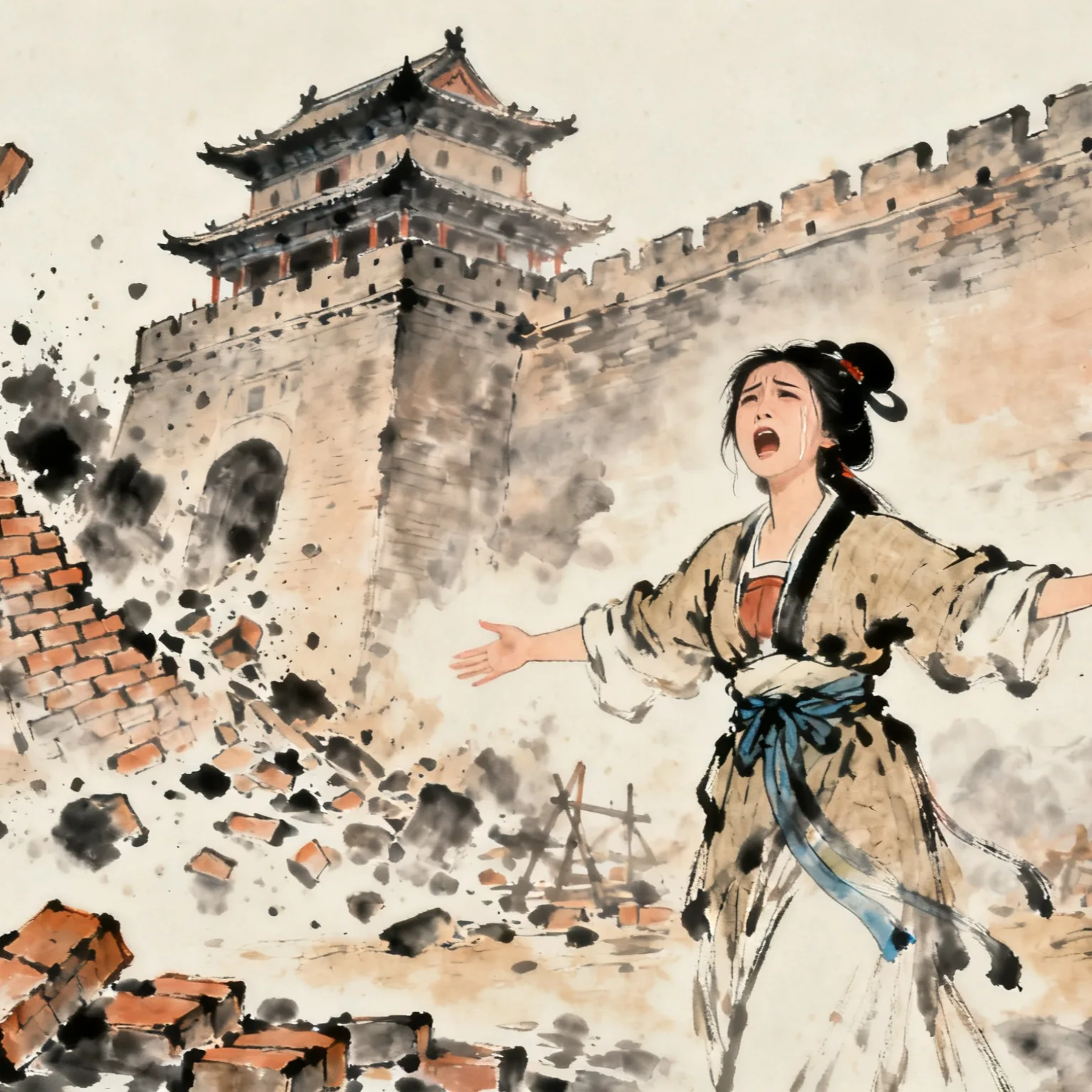
The sea ending reflects the story’s later attachment to Shanhaiguan, where the Ming Great Wall reaches the Bohai Sea. Earlier versions end quite differently.
How the Legend Developed Over Two Thousand Years
The legend did not begin at the Great Wall. Its earliest layer is a brief historical anecdote about ritual conduct. The miraculous collapse, the name Meng Jiang, the Qin setting, and the First Emperor were added over many centuries.
| Period | Key source or setting | What the heroine is called | Main development |
|---|---|---|---|
| Spring and Autumn (550 BCE) | Zuo zhuan | Qi Liang’s wife | Refuses condolences on the road; praised for ritual propriety |
| Warring States to early Han | Book of Rites; Mencius | Qi Liang’s wife | Her bitter weeping becomes the focus; said to have changed local customs |
| Western Han (1st century BCE) | Liu Xiang, Biographies of Exemplary Women | Qi Liang’s wife | Weeps at a city wall for ten days until it collapses; drowns herself in the Zi River |
| Eastern Han (1st century CE) | Wang Chong, Lunheng | Qi Liang’s wife | The collapse is dismissed as an exaggeration |
| Tang (618–907) | Anthologies, poems, Dunhuang manuscripts | Meng Zhongzi; Meng Jiangnü | Setting moves to the Qin Great Wall; husband becomes a laborer; blood test on bones |
| Song to Ming | Local shrines; Shanhaiguan | Meng Jiangnü | Commemorative sites appear; story tied to the Ming wall and the sea |
| Ming and Qing | Ballads, precious scrolls, opera | Meng Jiangnü | Gourd birth, winter clothes, new husband names, defiance of Qin Shi Huang |
| 1920s | Gu Jiegang and the folklore movement | Meng Jiangnü | Becomes a model case for the modern study of folk literature |
The Zuo zhuan: a widow who knew the rites
The root of the story is an entry in the Zuo zhuan (左传, Zuǒ zhuàn) for the twenty-third year of Duke Xiang of Lu, which corresponds to 550 BCE. Duke Zhuang of Qi raided the small state of Ju (莒, Jǔ), and the Qi officer Qi Liang was killed in the fighting. On his way home, the duke met Qi Liang’s widow outside the city and sent an attendant to offer condolences. She declined. If her husband had done wrong, she said, condolences were not owed; if he had not, his family had a home where they should be properly received, and she could not accept them in the open countryside. The duke then visited her house and paid his respects there.
In this account she has no name, performs no miracle, and no wall falls. Her virtue is knowing and upholding ritual (礼, lǐ), even when correcting a ruler.
From ritual to weeping
Later texts shift the emphasis to grief. The Book of Rites (礼记, Lǐjì) says that she met her husband’s coffin on the road and wept with deep sorrow. The Mencius (孟子, Mèngzǐ) remarks that the wives of Hua Zhou and Qi Liang mourned their husbands so movingly that they changed the customs of their state. From this point, the weeping rather than the ritual refusal became the part of the story people remembered.
The Han dynasty: the wall falls
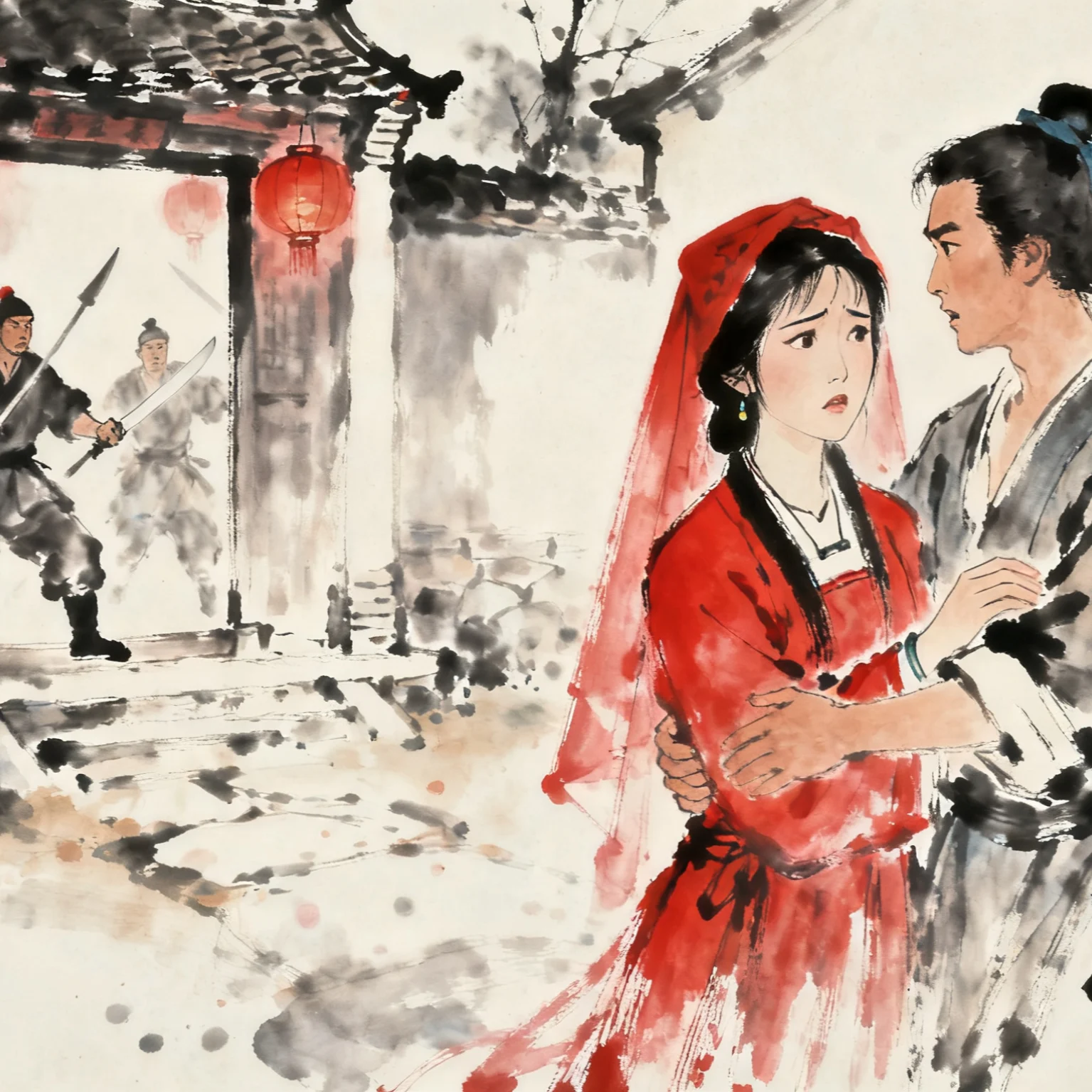
The decisive miracle appears in the Han. In Biographies of Exemplary Women (列女传, Liènǚ zhuàn), compiled by the scholar Liu Xiang (刘向, Liú Xiàng, 77–6 BCE), Qi Liang’s widow has no children and no relatives left to turn to. She lays her husband’s body at the foot of a city wall and weeps for ten days until the wall gives way (十日而城为之崩). After the burial, she drowns herself in the Zi River (淄水, Zī Shuǐ). The wall in this version is a city wall in Qi, not a frontier fortification. Liu Xiang included her among women of chastity and devotion, which made her a moral model for later readers.
Not everyone accepted the miracle. The Eastern Han thinker Wang Chong (王充, Wáng Chōng) took up the story in his Lunheng (论衡, Lùnhéng). He accepted that she might have wept facing a wall but argued that earth has no feelings and cannot be moved by grief, so the collapse must be an exaggeration.
The Tang dynasty: the Great Wall and a new name
By the Tang, the story had been moved about three centuries later in time, into the Qin dynasty, and the husband had become a conscript laborer on the First Emperor’s wall. A text quoted in a Tang-period anthology names the heroine Meng Zhongzi (孟仲姿) and has Qi Liang flee wall labor, hide in her family’s garden, and marry her after she is seen. The same tradition introduces the test of dripping blood on bones. The monk-poet Guanxiu (贯休, Guànxiū, 832–912) wrote a poem on Qi Liang’s wife that blames Qin’s tyranny and places her grief at the Great Wall.
Manuscripts recovered from the Dunhuang library cave preserve Tang-period songs and a fragment of a transformation text (变文, biànwén) about her. Bianwen was a prosimetric storytelling form closely linked to Buddhist preaching and performance, one example of how Buddhist storytelling shaped Chinese narrative traditions. The name Meng Jiangnü becomes established in this period. One Dunhuang ballad, translated into English by Arthur Waley, has the dead husband’s wandering soul speak to his wife.
Song to Qing: shrines, ballads, and the First Emperor
From the Song onward, local shrines to her appear, and by the Ming the story had become attached to Shanhaiguan, the fortified pass where the rebuilt Ming wall met the sea. Ming and Qing storytellers added the gourd birth, the winter clothes, the husband’s new names, and the climactic confrontation with Qin Shi Huang. The Harvard scholar Wilt Idema, whose translations of ten late-imperial versions are the standard English collection, counts it among the most widespread legends of Ming and Qing China. Different genres developed different episodes: some dwell on the marriage, others on her relations with her in-laws, the journey, the lament at the wall, or her defiance of the emperor.
Historical Background: What Is History and What Is Legend?
The legend mixes a few historical anchors with many later inventions. Sorting them helps explain why the story feels historical even though its heroine is not.
| Element | Status | Notes |
|---|---|---|
| Qi’s raid on Ju and Qi Liang’s death | Recorded history | Reported in the Zuo zhuan for 550 BCE |
| The widow’s refusal of roadside condolences | Recorded anecdote | The widow is unnamed and performs no miracle |
| A wall collapsing from her tears | Legend | Told in Han texts; doubted by Wang Chong in the 1st century CE |
| Qin Great Wall built with forced labor | History | Qin linked and extended earlier walls from about 214 BCE |
| Meng Jiang at the Qin wall | Legend | First appears in Tang-era sources, many centuries after the Qin |
| The wall at Shanhaiguan | Late association | The Ming pass at Shanhaiguan dates to 1381 |
| Meng Jiangnü Temple near Shanhaiguan | Real site | Said to have earlier origins; present buildings reflect Ming rebuilding |
The historical setting is real. After unifying China in 221 BCE, the Qin sent the general Meng Tian (蒙恬, Méng Tián) north against the Xiongnu, and from about 214 BCE soldiers, convicts, and conscripted commoners linked and extended the existing walls of the former states of Qin, Zhao, and Yan into a long northern barrier. The human cost of the project stayed in memory long after the dynasty fell. That memory is the soil in which the legend grew, but no Qin or Han record names a woman whose tears brought down the wall.
The geography also shifted over time. The Great Wall most visitors see today, including the Shanhaiguan pass, is a Ming structure built more than fifteen centuries after the Qin. Placing Meng Jiang at Shanhaiguan reflects Ming geography rather than Qin history. Note too that the general Meng Tian’s surname (蒙) is a different character from the Meng (孟) in Meng Jiang; the two are unrelated.
Why Did the Story Move to the Great Wall?
Scholars generally read the Tang relocation as an old tale of a grieving widow meeting newer concerns. Tang armies garrisoned distant frontiers, and poetry of the period returned often to wives left at home, to clothing sewn and sent to soldiers in the cold, and to men who never came back. Even earlier, the poet Chen Lin (陈琳, Chén Lín, d. 217) had pictured the Qin wall as a place where laborers’ bones lay heaped together in his ballad 饮马长城窟行, “Watering Horses at a Spring by the Great Wall.” The First Emperor, long remembered in Confucian historiography as a harsh ruler, made an effective antagonist.
The move changed what the story was about. A widow who once corrected a duke’s lapse in etiquette became an ordinary woman whose grief exposed the cost of imperial building projects. That critical edge helps explain the legend’s lasting appeal to audiences who knew conscription and corvée labor from their own lives.
Themes and Meanings
Fidelity and ritual propriety
From the Zuo zhuan to the Biographies of Exemplary Women, the heroine was presented as a model of correct conduct and loyalty to her husband. In late imperial China, when chaste widows were officially honored, this reading was easy to emphasize, and some versions stress her purity as much as her love.
Grief as a moral force
The collapse of the wall dramatizes an old idea that sincere feeling can move the world around it. Wang Chong’s objection shows that educated readers argued about this even in the Han, but for storytellers and audiences the image of tears defeating stone carried the story’s emotional weight.
Ordinary people and state power
In the Qin-era versions, the antagonist is not a monster but the state itself: its labor drafts, its officials, and finally the emperor. Meng Jiang wins no war, yet she exposes the dead, forces the emperor to mourn a laborer, and refuses to become his consort. Many modern retellings read her as a voice of protest, while older versions often frame her defiance within loyalty to her husband.
Caring for the dead
Much of the late story concerns bones, burial, and the fate of souls: finding the right remains, carrying them home, and securing proper rites. Scholars such as Wu Zhen have argued that performances of the tale could serve ritual purposes connected with appeasing and releasing the souls of the dead, which helps explain why it spread so widely beyond purely literary settings.
Places, Performance, and Living Tradition
The best-known site is the Meng Jiangnü Temple (孟姜女庙), also called the Zhennü Shrine (贞女祠, “Shrine of the Faithful Woman”), on Phoenix Hill about 6 kilometers east of the old town of Shanhaiguan in Qinhuangdao, Hebei. Local tradition traces its origins to the Song dynasty or earlier, while the present buildings reflect Ming reconstruction, commonly dated to 1594. Nearby landmarks tied to the story include a “Looking-for-Husband Rock” (望夫石, wàngfū shí) and two reefs offshore that local tradition calls Meng Jiang’s tomb.
Shanhaiguan is not the only claimant. When China announced its first national list of intangible cultural heritage in 2006, the Meng Jiangnü legend was listed under folk literature with Zibo in Shandong, in the old territory of Qi, as the nominating region. A 2008 extension added Qinhuangdao in Hebei and Jinshi in Hunan. Several places claiming the same heroine is typical of a legend that traveled through many regional versions.
The story has been told in nearly every popular form: narrative ballads, precious scrolls, drum songs, regional opera, folk songs that follow her through the twelve months of the year, and in the modern period picture books, film, and television. Each form tends to linger on different scenes, so the “same” story can feel very different from one performance tradition to the next.
Gu Jiegang and the Modern Study of the Legend
In November 1924, the historian Gu Jiegang (顾颉刚, Gù Jiégāng, 1893–1980) published “The Transformation of the Meng Jiangnü Story” (孟姜女故事的转变) in the Folksong Weekly (歌谣周刊) of Peking University. Instead of searching for one true version, he traced how the story changed from period to period and region to region, showing that each era reshaped it to fit its own concerns. The essay, together with the collections of songs and studies he edited in the following years, became a founding case for folklore studies in China.
Later scholars have looked at that movement itself. Haiyan Lee, for example, has examined how May Fourth intellectuals read Meng Jiangnü as an authentic voice of ordinary people, and how that reading also reflected their own ideas about feeling, gender, and the nation.
Common Misunderstandings
- “Lady Meng Jiang was a real woman of the Qin dynasty.” The earliest historical layer concerns an unnamed widow of the state of Qi in 550 BCE. The Qin setting appears only in Tang-era sources.
- “Meng is her surname.” Originally “Meng Jiang” combined a birth-order term and the clan name of Qi’s ruling house. The two-family gourd story is a later explanation.
- “The legend has always been about the Great Wall.” In Han sources the wall is a city wall in Qi. The frontier wall enters the story centuries later.
- “She is a Chinese goddess.” She is honored at shrines as a model of fidelity, but she is not a major deity in the way that Mazu, the sea goddess who developed from a historical woman, became the focus of a widespread temple cult.
- “Meng Jiang and Meng Po are the same figure.” Meng Po is the underworld figure who serves the broth of forgetting. A few popular retellings link the two, but this is not a standard identification and the traditions are distinct.
- “There is one original version.” Scholars since Gu Jiegang have treated the legend as a chain of versions, each answering the needs of its own time.
Related Legends and Figures
Meng Jiang’s story belongs with other narratives that changed shape as they passed through texts, festivals, and performance. The story of Chang’e and the moon also exists in several incompatible versions, each shaped by a different period. For marriage and devotion in Chinese tradition from another angle, see Yue Lao and the red thread of fate. More myths and folk narratives are gathered in the Legends & Stories collection.
The other three of the “Four Great Folk Legends” are the Cowherd and the Weaver Girl, the Legend of the White Snake, and the Butterfly Lovers. Together with Meng Jiang, they are among the most adapted stories in Chinese popular culture.
Frequently Asked Questions
Was Lady Meng Jiang a real person?
Not in the form most people know. The Zuo zhuan records an unnamed widow of the Qi officer Qi Liang in 550 BCE, who may well have existed. The name Meng Jiangnü, the Qin setting, and the Great Wall were added many centuries later.
Did a woman’s tears really knock down part of the Great Wall?
No. The collapse is a legendary motif first told in Han texts about a city wall in Qi. The Han thinker Wang Chong already argued that weeping could not bring down a wall.
Which part of the Great Wall collapsed in the legend?
No real section is involved. Late versions place the event near Shanhaiguan in Hebei, but the wall there is a Ming structure, and earlier versions point to a city wall in the old state of Qi in Shandong.
What is the moral of the Meng Jiang story?
It depends on the version. Early sources praise ritual correctness and wifely loyalty. Later versions add a sharp critique of forced labor and imperial power, along with concern for proper burial of the dead.
Is Lady Meng Jiang worshipped?
She is commemorated at shrines such as the Meng Jiangnü Temple near Shanhaiguan, but she did not become a major deity. Her case differs from deified historical figures such as Guan Yu, the general who became a god of loyalty and war.
What are the Four Great Folk Legends of China?
They are usually listed as Lady Meng Jiang, the Cowherd and the Weaver Girl, the Legend of the White Snake, and the Butterfly Lovers. The grouping is a modern classification, not an ancient one.
References and Further Reading
- Idema, Wilt L., trans. Meng Jiangnü Brings Down the Great Wall: Ten Versions of a Chinese Legend. With an essay by Haiyan Lee. Seattle: University of Washington Press, 2008. Project MUSE
- Lee, Haiyan. “Tears That Crumbled the Great Wall: The Archaeology of Feeling in the May Fourth Folklore Movement.” The Journal of Asian Studies (February 2005): 35–65. https://doi.org/10.1017/S0021911805000057
- Wu Zhen. “The Tale of Meng Jiangnü: Its Salvation Theme and Ritual Function.” Memoirs of the Research Department of the Toyo Bunko 69. PDF
- Liu Xiang. Lienü zhuan (Biographies of Exemplary Women). Chinese Text Project. https://ctext.org/lie-nv-zhuan
- Mencius, “Gaozi II.” Chinese Text Project. https://ctext.org/mengzi/gaozi-ii
- Wang Chong. Lunheng, “Gan Xu.” Chinese Text Project. https://ctext.org/lunheng/gan-xu
- China Intangible Cultural Heritage Network. “孟姜女传说” (Legend of Meng Jiangnü), national list project entry. https://www.ihchina.cn/project_details/12192.html
- Encyclopaedia Britannica. “Great Wall of China.” https://www.britannica.com/topic/Great-Wall-of-China