The Fenghuang (凤凰, Fènghuáng) is the bird usually called the Chinese phoenix in English. Its meaning is moral and political rather than magical. The earliest descriptions present a five-colored bird whose appearance signals peace under Heaven and a virtuous ruler on the throne. Later it also became a symbol of the empress, of a happy marriage when paired with the dragon, and of beauty, talent and high rank.
The Fenghuang does not burn and rise from its own ashes. That story belongs to the Western phoenix. The English translation is convenient, but it brings associations that Chinese sources do not support.
Fenghuang vs Western Phoenix at a Glance
| Feature | Fenghuang (Chinese phoenix) | Western phoenix |
|---|---|---|
| Cultural background | Early Chinese texts, Confucian moral thought, court art | Egyptian and Greco-Roman sun-bird lore, later Christian symbolism |
| Core meaning | Virtue, peace, good government, harmony | Death and renewal, immortality, resurrection |
| Fire and ashes | No rebirth story; some Han texts link it to the element of fire | The best-known versions have it burning and rising again |
| How many? | Originally a male feng and a female huang; also flocks of lesser birds follow it | Usually one unique bird at a time |
| Later symbolism | The empress, marriage (with the dragon), refined talent | Resilience, starting over, Christ’s resurrection in medieval art |
How to Say Phoenix in Chinese
The standard word for phoenix in Chinese is 凤凰 (traditional 鳳凰), pronounced fènghuáng: fèng with a falling fourth tone and huáng with a rising second tone. In everyday speech the single character 凤 is often enough, especially in compounds and names.
| Characters | Pinyin | Meaning |
|---|---|---|
| 凤凰 / 鳳凰 | fènghuáng | The phoenix bird; the standard full name |
| 凤 / 鳳 | fèng | Originally the male bird; now the usual short form for “phoenix” |
| 凰 | huáng | Originally the female bird; rarely used on its own |
| 凤皇 | fènghuáng | The older spelling found in many early texts, with 皇 (“august, sovereign”) in place of 凰 |
“Phoenix” in Chinese names
凤 is a common character in Chinese given names, where it carries wishes for beauty, distinction and good fortune. Familiar examples include 凤仪 (Fèngyí), which echoes the classical phrase about phoenixes arriving with stately bearing, and 丹凤 (Dānfèng), “cinnabar phoenix.” The character has been used more often in women’s names, a pattern reflected in the modern saying 望子成龙,望女成凤: parents hope a son becomes a dragon and a daughter becomes a phoenix. It was never exclusively feminine, though. The Three Kingdoms strategist Pang Tong was famously nicknamed 凤雏 (Fèngchú), “Young Phoenix.”
If you want to render the English name Phoenix in Chinese, there is no single fixed form. A meaning-based choice usually uses 凤. A sound-based transliteration such as 菲尼克斯 (Fēiníkèsī) is used for the city of Phoenix, Arizona.
The Fenghuang in Early Chinese Texts
Classic of Mountains and Seas (Shanhaijing)
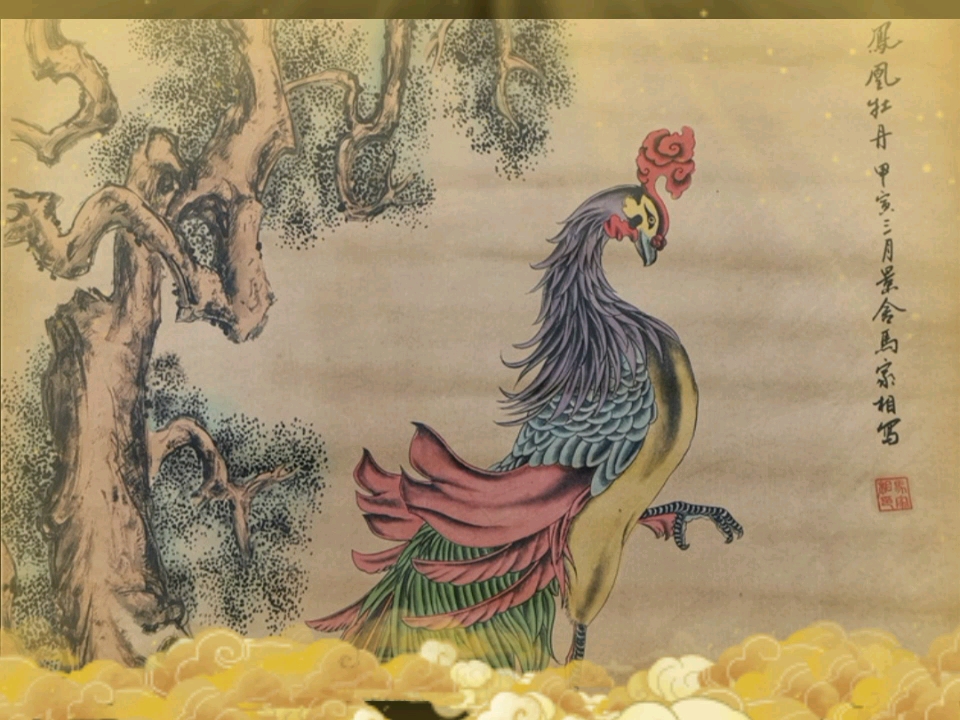
The Shanhaijing (山海经) is a layered compilation of mythic geography whose received form took shape by the early Han dynasty. In its account of the southern mountains, a bird living on Mount Danxue (丹穴山, “Cinnabar Cave Mountain”) looks like a rooster, has five-colored patterned plumage, and is called the fenghuang. The markings on its body spell out virtues:
首文曰德,翼文曰义,背文曰礼,膺文曰仁,腹文曰信。
The pattern on its head reads “virtue,” on its wings “righteousness,” on its back “propriety,” on its breast “benevolence,” and on its belly “trustworthiness.”
The passage adds that the bird eats and drinks naturally, sings and dances of its own accord, and that when it appears, the world is at peace.
Shuowen Jiezi
The Han dictionary Shuowen Jiezi (说文解字, c. 100 CE) defines 凤 as a “divine bird.” It quotes Tianlao, a minister of the Yellow Emperor in legend, who describes a composite creature. It has the front of a wild goose and the hindquarters of a lin, a snake’s neck and a fish’s tail, dragon-like patterning, a swallow’s chin and a rooster’s beak, with all five colors present. The bird comes from the “land of gentlemen” in the east, flies beyond the four seas, and its appearance brings great peace. Even this description survives in variant copies: the Qing scholar Duan Yucai noted versions with a deer’s hindquarters and a tortoise’s back.
The dictionary also explains that when the phoenix flies, birds follow it by the tens of thousands. For that reason, an ancient form of the character came to be used for 朋, “companion” or “group.”
Male Feng, Female Huang: How Two Birds Became One
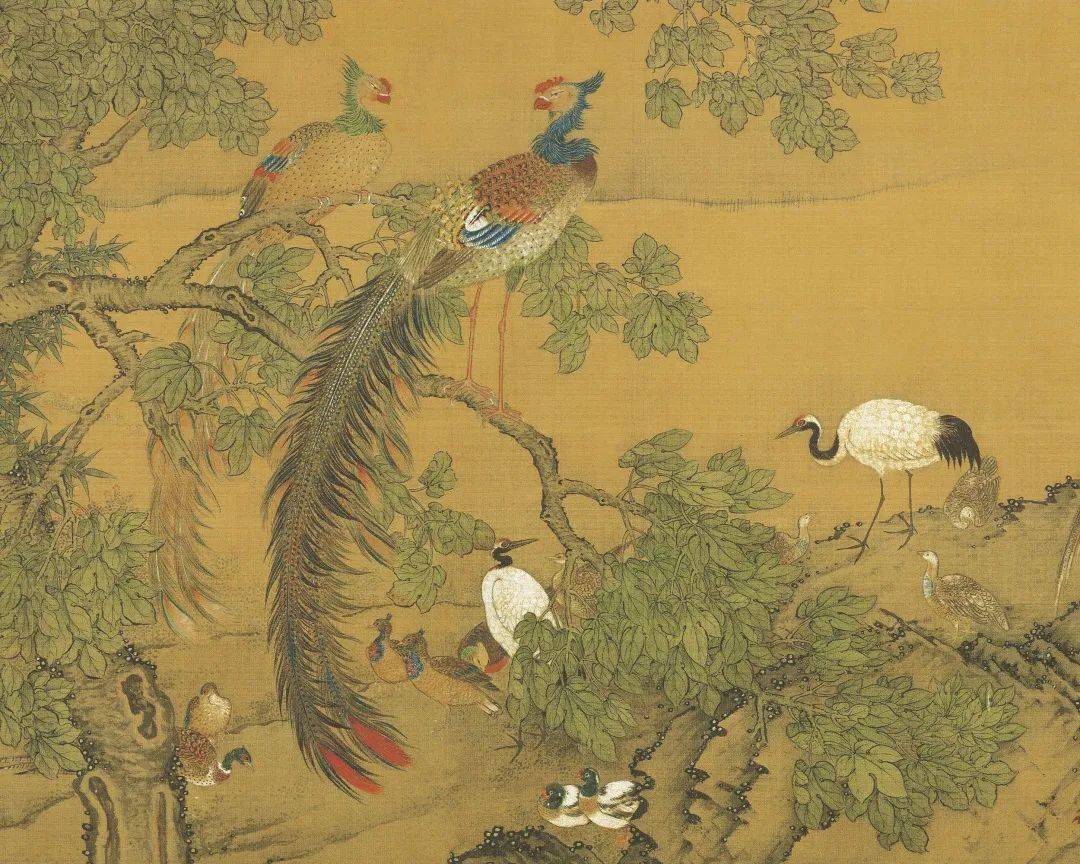
The early dictionary Erya (尔雅) glosses the bird as 鶠,凤,其雌皇: the feng, whose female is the huang. The Han-era Mao commentary on the Classic of Poetry says the same thing more directly: “the male is called feng, the female huang.” A qin song attributed to the Han poet Sima Xiangru built a famous image of courtship on this pairing, with the feng searching for its huang.
Over time, fenghuang became the name of a single kind of sacred bird rather than a strict male-and-female pair. In later court art, where the dragon stood for the emperor, the Fenghuang came to be read as feminine. So the answer to “is the Fenghuang male or female?” depends on the period and the context.
Confucius and the Phoenix That Did Not Come
The Fenghuang’s link to good government is clearest in Confucian texts. In the Shangshu (Book of Documents), when the Shao music of the sage-king Shun is performed nine times, phoenixes arrive “with dignified bearing” (凤皇来仪), a sign that the court is in perfect order.
Confucius used the same symbol in reverse. In Analects 9.9 (论语·子罕) he laments:
子曰:凤鸟不至,河不出图,吾已矣夫!
The Master said: “The phoenix does not come, the River yields no chart. It is all over with me!”
The phoenix and the River Chart were omens expected under a sage ruler. Their absence told Confucius that no such ruler existed to put his teachings into practice. The bird here is not a creature to be hunted or summoned. It is a moral barometer: it appears when virtue governs and stays away when it does not.
Fenghuang Abilities and Attributes: What the Sources Say
The Fenghuang has no combat powers in classical texts. What Chinese sources describe are behaviors and signs, each tied to its moral meaning:
- It appears only in times of peace. The Shanhaijing, the Shuowen and the Analects all treat its arrival as evidence of good rule.
- It perches only on the wutong tree and eats only bamboo seeds. A commentary on the Classic of Poetry, quoted in the Tang encyclopedia Chuxue ji, says the phoenix “will not roost except on the wutong, will not eat except bamboo seeds.” The ode Juan’e (卷阿) already pairs a calling phoenix on a high ridge with wutong trees growing on the sunny slope. Zhuangzi tells a similar story of the yuanchu, a phoenix-type bird, which rests only on the wutong, eats only bamboo fruit and drinks only from sweet springs.
- It sings and dances of its own accord and responds to music, as the Shanhaijing and Shangshu describe.
- Other birds follow it. This idea lies behind the art motif of a hundred birds paying homage to the phoenix, read as a virtuous ruler welcomed by loyal followers.
- Its body displays the virtues through its five colors and patterned markings.
- It is linked to fire as an element. Some Han-era apocryphal texts call the feng the “essence of fire” (火精), born at Cinnabar Cave. This is cosmological symbolism tied to fire and the south, not a story of self-immolation.
Not in the sources: rising from ashes, fire breathing, healing tears, resurrecting the dead, or combat powers. These come from the Western phoenix tradition or from modern fantasy, novels and games.
What the Fenghuang Symbolizes
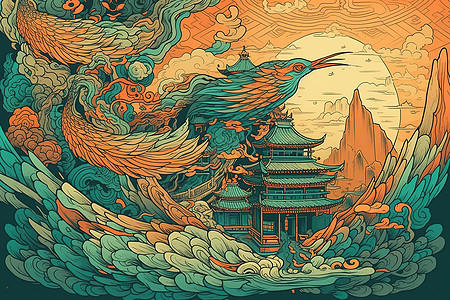
Virtue and good government
This is the oldest and most consistent meaning. The Metropolitan Museum of Art describes the fenghuang as a distinct mythical species rather than a Western phoenix, said to appear only in times of peace and prosperity. That is why it appears so often in work made for imperial courts.
The empress and imperial women
By the later imperial period, the Fenghuang had become an emblem of the empress and other high-ranking women. The clearest example is the Ming phoenix crown (凤冠, fèngguān). The crown of Empress Xiaoduan, wife of the Wanli Emperor, was excavated from the Dingling tomb near Beijing and is now in the National Museum of China. It is covered with dragon and phoenix ornaments.
Dragon and phoenix: marriage and balance
Paired with the dragon, the Fenghuang expresses complementary partnership. The phrase 龙凤呈祥 (lóngfèng chéngxiáng), “dragon and phoenix bring good fortune,” appears on wedding textiles, invitations and decoration. Court tapestries combined the two creatures with peonies, a flower of wealth and rank. For the dragon’s own long history of rain, water and political power, see the guide to Chinese dragon meaning and symbolism.
Rare talent
The idiom 凤毛麟角 (fèngmáo línjiǎo), “phoenix feathers and qilin horns,” describes something extremely rare and precious, usually a person of exceptional ability. It places the Fenghuang beside the qilin, another auspicious creature that appears only under virtuous rule.
Common Misunderstandings
“The Chinese phoenix is reborn from fire”
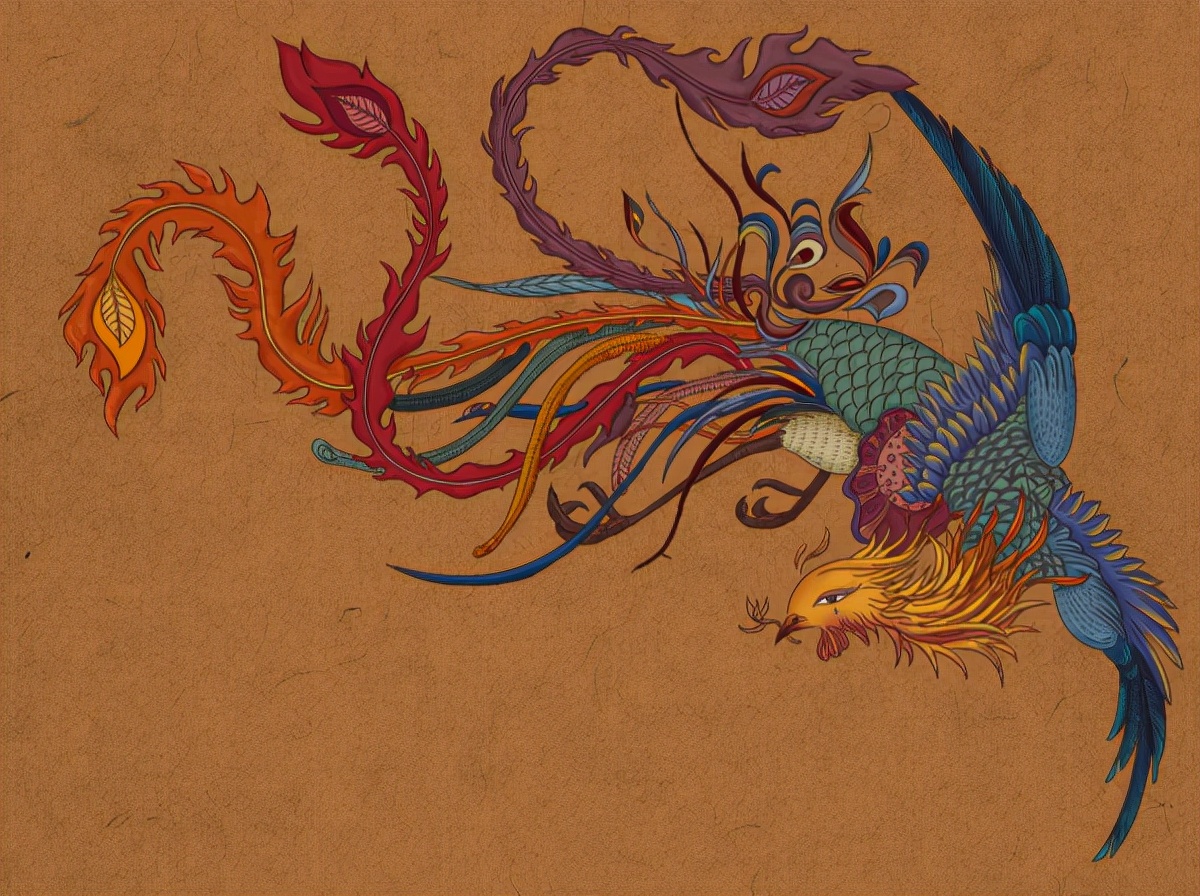
This idea comes from the Western phoenix. In Egyptian and classical lore, the phoenix was a sun-bird. In the most familiar later versions, it burns on a nest of spices and a new bird emerges from the ashes. Nothing like this appears in the early Chinese descriptions of the Fenghuang. The same kind of translation problem affects dragons, as explained in Chinese dragon vs Western dragon.
“The Fenghuang is the Vermilion Bird”
The Vermilion Bird (朱雀, Zhūquè) is one of the Four Symbols of the sky and guards the south. The two birds can look similar in later art, but the Vermilion Bird is a directional and astronomical emblem, while the Fenghuang is an omen of virtue and peace.
“The Fenghuang is a god”
It is better understood as an auspicious creature and symbol than as a deity with its own temples and worship. Like the Chinese guardian lion, it is valued for what its image signals and protects, not as an object of prayer.
For more legendary beasts and auspicious animals, browse the Chinese mythical creatures directory.
Frequently Asked Questions
What does Fenghuang mean?
Fenghuang (凤凰) combines feng, originally the male bird, and huang, originally the female. As a symbol it stands for virtue, peace and good government, and later for the empress, marriage and rare talent.
How do you say phoenix in Chinese?
Phoenix is 凤凰 (traditional 鳳凰), pronounced fènghuáng. The single character 凤 (fèng) is also widely used, especially in names and compound words.
Is the Fenghuang male or female?
Early dictionaries and commentaries identify feng as male and huang as female. Later the compound named one bird, and when paired with the imperial dragon it was usually treated as feminine.
What are the Fenghuang’s abilities?
Classical sources do not give it combat powers. It appears only in peaceful, well-governed times, perches only on the wutong tree, eats only bamboo seeds, sings and dances by itself, and leads other birds.
Does the Chinese phoenix rise from its ashes?
No. Rebirth from fire belongs to the Western phoenix. Modern fiction sometimes mixes the two traditions, but early Chinese texts never describe the Fenghuang dying and returning.
What does a dragon and phoenix together mean?
The pairing can represent the emperor and empress or, more commonly today, a harmonious marriage. The wedding blessing 龙凤呈祥 means the dragon and phoenix bring good fortune together.
References and Further Reading
- Chinese Text Project, Shanhaijing: Southern Mountain Classic (南山经)
- Zdic, entry for 鳳, quoting the Shuowen Jiezi, Duan Yucai’s commentary, the Erya and the Kangxi Dictionary
- Chinese Text Project, Analects, Book 9: Zi Han (子罕)
- Chinese Text Project, Shangshu: Yi and Ji (益稷)
- Chinese Text Project, Classic of Poetry: Juan A (卷阿)
- Chinese Text Project, Zhuangzi: The Floods of Autumn (秋水)
- Xu Jian, Chuxue ji (初学记), Volume 30, Birds: Phoenix (Wikisource)
- The Metropolitan Museum of Art, “Panel with five phoenixes in a garden”
- The Metropolitan Museum of Art, “Panel with dragon, phoenix, and peonies”
- China Culture, “Phoenix crown of Ming Dynasty Empress Xiaoduan”
- Encyclopaedia Britannica, “Phoenix (mythological bird)”