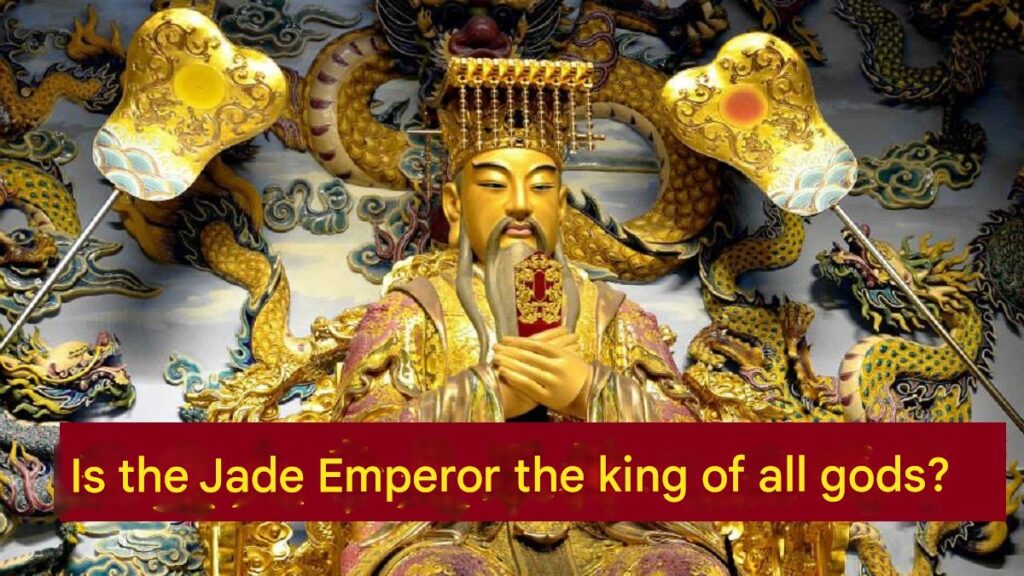
If you have ever wondered who is the Jade Emperor, the short answer is this: he is the heavenly ruler who came to stand at the center of Chinese folk religion and Taoist imagination. In popular belief, he governs Heaven, oversees gods and spirits, and represents the moral order above the human world.
But like many figures in Chinese mythology, the Jade Emperor is not easy to explain in just one sentence.
He is at once a religious deity, a mythic ruler, a cultural symbol, and a character shaped by centuries of storytelling. In some traditions, he is the supreme sovereign of Heaven. In others, he is linked to older ideas of Shangdi or Haotian, the ancient high god of the sky. Later Taoist belief gave him a more personal form, a celestial court, grand titles, and even a family. Folk legends then added even more texture, including the famous claim that he once lived on earth and may have been surnamed Zhang.
That layered history is exactly what makes him so fascinating.
Who Is the Jade Emperor in Chinese Mythology?
The Jade Emperor, known in Chinese as Yuhuang Dadi or Yuhuang Shangdi, is widely understood as the supreme ruler of Heaven in Chinese mythology. In popular religion, he presides over the celestial bureaucracy much as an emperor ruled imperial China. Gods, immortals, heavenly officials, and spirits all fall within his domain.
This is one reason he feels immediately recognizable even to modern readers. The heavenly world around him is not imagined as a vague paradise, but as a highly organized court. There are ranks, offices, punishments, rewards, reports, and ceremonies. Heaven mirrors the structure of the human empire below.
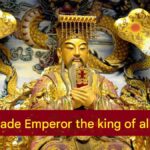
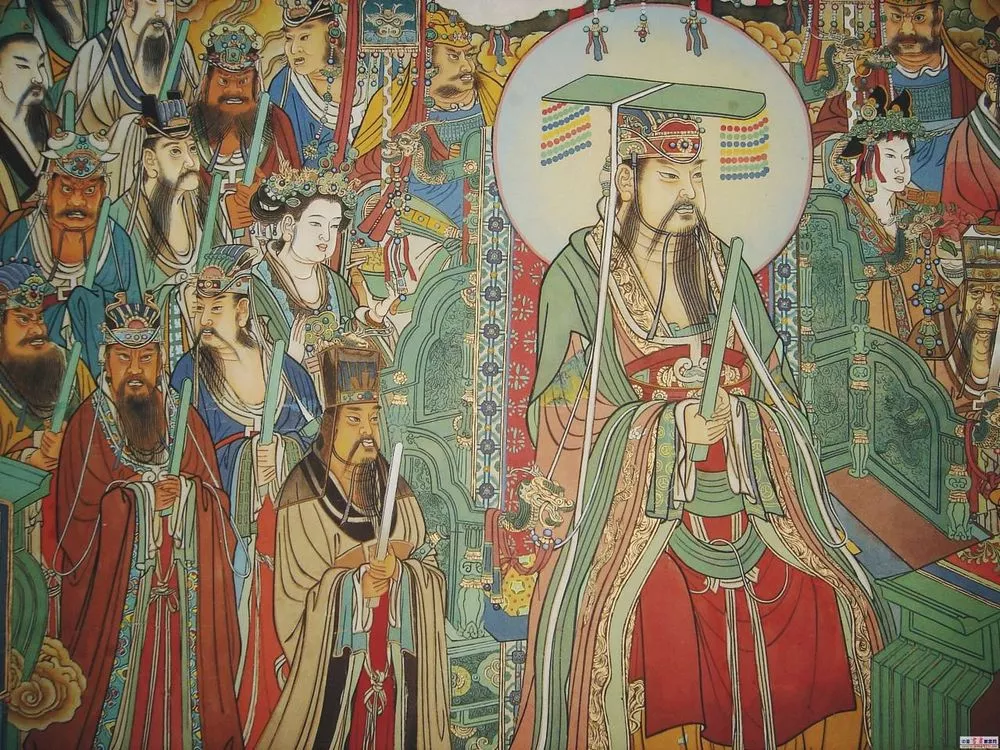
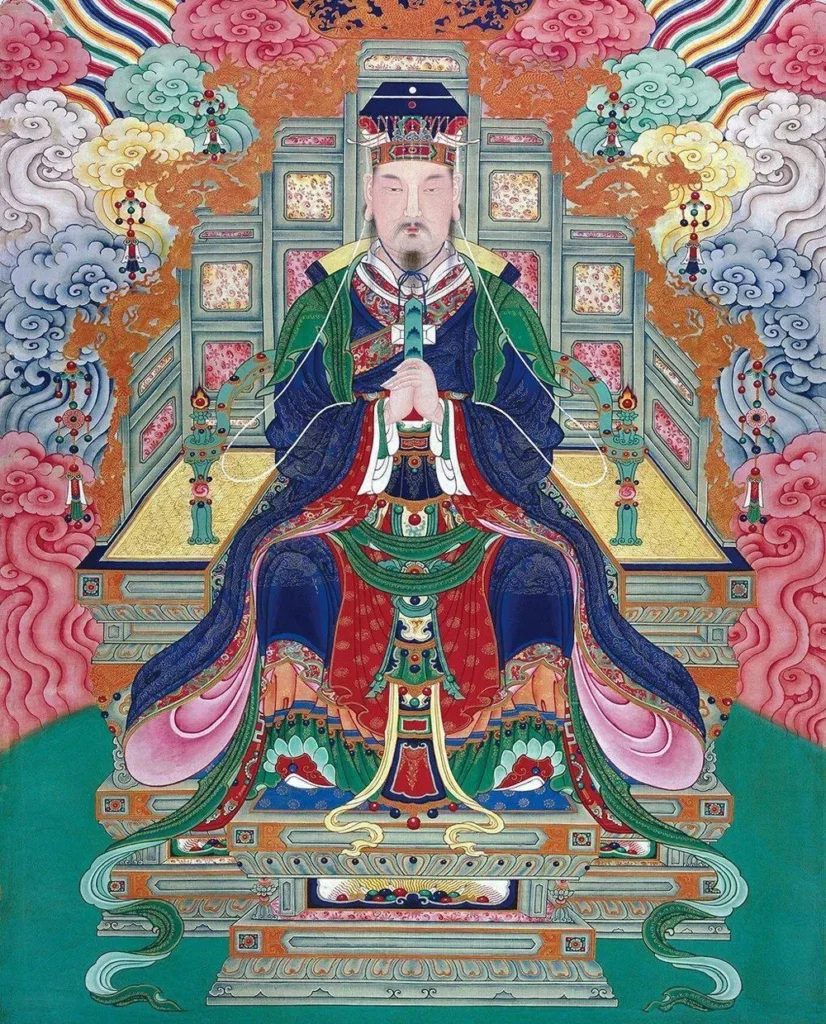
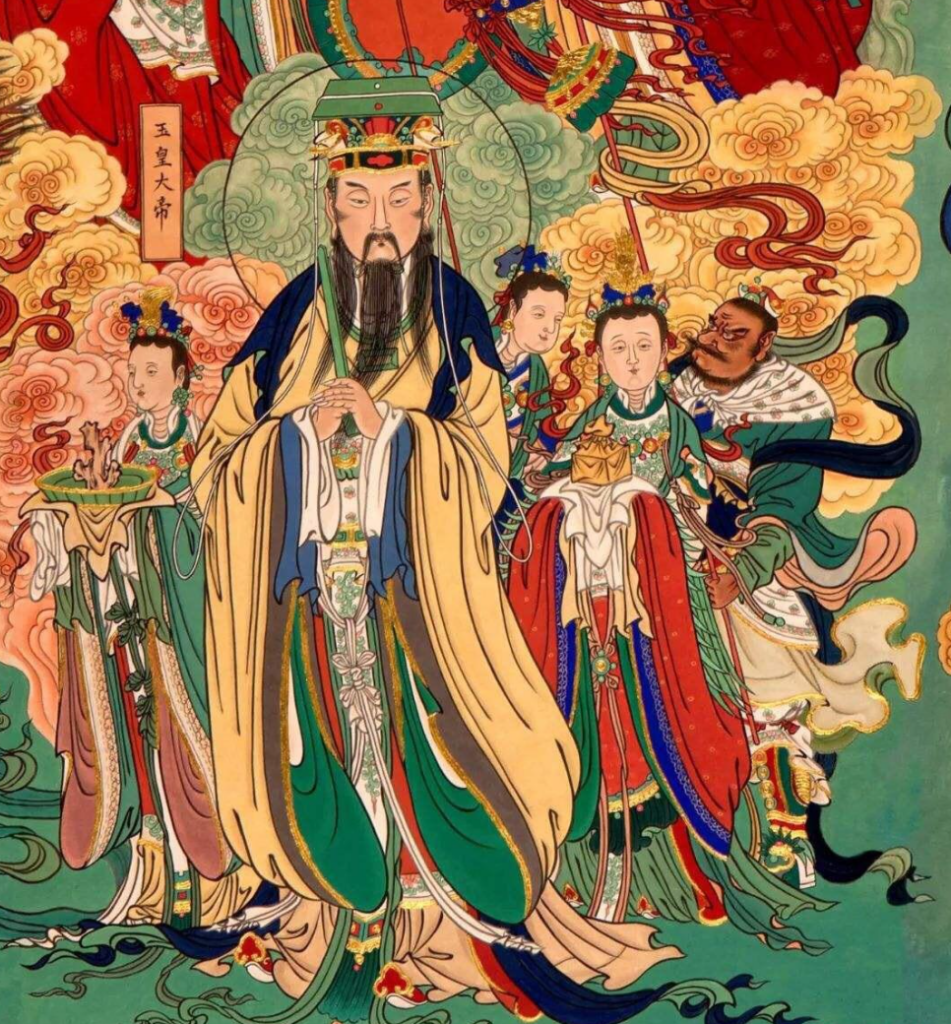
In art, the Jade Emperor is usually shown seated on a throne, wearing imperial robes, with the composed expression of a ruler who governs by authority rather than brute force. He is not simply a sky god in the abstract. He is a monarch of the cosmos.
In Taoist tradition, he came to embody the idea that Heaven is not chaotic or distant, but ordered, watchful, and morally significant.
From Ancient Heaven Worship to the Jade Emperor
To understand who the Jade Emperor is, it helps to go back before he had that name.
Long before the Jade Emperor emerged as a fully developed deity, ancient China already had a long tradition of reverence for Heaven. Early people feared thunder, lightning, floods, droughts, and earthquakes, and naturally imagined that some higher power stood behind these forces. In early texts, this power was often described as Heaven, Shangdi, or Haotian Shangdi.
At that stage, the high god of Heaven was more abstract than personal. He was a cosmic authority rather than the vividly imagined ruler later generations would picture in the Heavenly Palace.
Over time, especially as religious thought evolved and society itself became more structured, that high celestial authority took on a more human-like form. Taoism played a major role in this transformation. It gave Heaven a court, a hierarchy, and a sovereign who ruled from above. That sovereign became the Jade Emperor.
In other words, the Jade Emperor did not appear out of nowhere. He grew out of much older Chinese ideas about Heaven, divine order, and supreme rulership.
Why Is He Called the Jade Emperor?
The name itself carries meaning.
In Chinese culture, jade has long symbolized purity, nobility, sacred value, and supreme refinement. Emperor signals political and cosmic sovereignty. Put together, the title suggests not only royal status, but the highest possible dignity.
His full ceremonial titles can be extraordinarily long, reflecting the old religious habit of honoring great deities with layered names. One common extended form is often translated along the lines of “The August Jade Emperor on High”, though in everyday use people simply say Jade Emperor.
He is also known in popular devotion as Tiangong, often rendered as “Heavenly Grandfather” or “Lord Heaven,” a name that feels warmer and closer to ordinary worship.
That mix of grandeur and familiarity is part of his enduring appeal. He is majestic enough to rule all realms, yet close enough to be invoked in everyday life.
How Did the Jade Emperor Become the Supreme God?
This is where history and belief begin to intertwine.
In formal religious hierarchy, the Jade Emperor was not always the oldest or highest deity. Earlier traditions already honored Heaven, while Buddhism brought the figure of the Buddha into China, and Taoism developed the exalted Three Pure Ones. Compared with these older or more doctrinally central figures, the Jade Emperor was in some ways a later arrival.
Yet in popular belief, he eventually rose above almost everyone.
Why? Because he became a remarkably effective meeting point for different traditions. Ancient state worship of Heaven, Taoist theology, Buddhist narrative influence, and folk storytelling all flowed toward him. He absorbed the prestige of the ancient sky god, the narrative richness of religious myth, and the administrative logic of imperial China.
By the Tang and Song dynasties, his position had become far more prominent. Taoism flourished under imperial patronage, and the Jade Emperor received increasingly grand recognition. During the Song period in particular, emperors formally elevated his status, helping stabilize his role as a supreme celestial ruler in the public imagination.
Even when official state religion did not consistently place him above all others, ordinary worship often did. In folk religion, that mattered enormously. For many people, he became the one who truly governed the heavens.
Is the Jade Emperor Really Taoism’s Highest Deity?
The answer depends on which lens you use.
In popular religion, the Jade Emperor is often treated as the highest heavenly ruler and the “king of the gods.” In everyday worship, stories, festivals, and temple practice, that is often how people understand him.
In formal Taoist theology, however, things are more complex. Certain Taoist systems place the Three Pure Ones above him in a more metaphysical sense. The Jade Emperor may still hold immense authority over the operational government of Heaven, but not always the absolute highest place in every doctrinal structure.
This distinction matters because Chinese religion has never been fully rigid or uniform. It is a living blend of official teaching, local devotion, literature, temple practice, and folklore. The Jade Emperor’s greatness lies partly in how comfortably he moves across all of those worlds.
So when readers ask, “Who is the Jade Emperor?” the most accurate answer is this: he is the supreme heavenly ruler in Chinese popular belief, and one of the most important deities in Taoist and folk tradition, even if doctrinal hierarchies can vary.
The Many Origin Stories of the Jade Emperor
Like many major mythic figures, the Jade Emperor has more than one origin story.
One tradition presents him as a divine ruler whose celestial authority is primordial. Another says he emerged from older worship of Heaven and only gradually took on a personal identity. Yet other legends give him a distinctly human beginning.
In one well-known narrative, he is born as a miraculous prince to a righteous king and queen who had long prayed for an heir. From childhood, he is wise, compassionate, and uninterested in ordinary power. He later gives away wealth, seeks the Dao, endures countless trials, and after immense ages of cultivation finally becomes the Jade Emperor.
This version is deeply revealing. It presents heavenly sovereignty not as something seized, but as something earned through virtue, sacrifice, endurance, and spiritual achievement.
That moral pattern fits beautifully with Chinese religious values. The highest ruler of Heaven is not only powerful. He is meant to be worthy.
Why Do Some People Say the Jade Emperor’s Surname Is Zhang?
This is one of the most famous questions in folk tradition.
So, does the Jade Emperor really have the surname Zhang? In popular legend, many people say yes. In strict historical or theological terms, the answer is far less certain.
Several folk stories explain the idea.
One comic version says that when the gods were being assigned heavenly positions, someone said, “There is someone to take the seat,” and a man named Zhang misunderstood the remark as a call for him personally. He stepped forward, took the throne, and became the Jade Emperor.
Another tradition describes him as Zhang Youren or Zhang Youren, a wise and capable mortal leader whose talent and virtue made him the best candidate to govern the three realms. He was then brought to Heaven and enthroned.
Still another line of folklore traces the surname Zhang to older stories about the god of Heaven, suggesting that once the celestial sovereign became identified with the Jade Emperor, the surname came with him.
These tales are best understood as folklore rather than fixed doctrine. They reveal how warmly people related to the Jade Emperor. Instead of leaving him as a distant cosmic abstraction, they gave him a human past, a surname, and a story you could retell around a fire, in a market, or in a family courtyard.
The Jade Emperor in Popular Legends
The Jade Emperor appears in many beloved Chinese tales, where his role can range from stern ruler to distant father to cosmic judge.
One of the best-known stories is The Cowherd and the Weaver Girl. In this tale, his daughter falls in love with a human. The lovers are separated across the Milky Way, allowed to reunite only once a year. The story is tender, tragic, and deeply human, and it also shows the Jade Emperor as a guardian of heavenly order.
He also appears in stories surrounding the Chinese zodiac, where animals compete for a place in the calendar under his authority.
And of course, many readers know him from Journey to the West, where Sun Wukong, the Monkey King, rebels against the celestial order. In that literary setting, the Jade Emperor represents the formal authority of Heaven itself.
These stories do not always present a single consistent personality. Sometimes he is dignified and benevolent. Sometimes he feels distant or severe. But that too is part of his mythic power. Like an emperor, he can be merciful, bureaucratic, symbolic, or awe-inspiring depending on the story being told.
Why the Jade Emperor Still Matters Today
The Jade Emperor is not just a figure from old books.
He remains important in temples, festivals, family rituals, and the wider imagination of Chinese culture. His birthday is traditionally celebrated on the ninth day of the first lunar month, and he is especially prominent around the Lunar New Year season.
In folk belief, the household Stove God reports a family’s behavior to Heaven, and the Jade Emperor judges what blessings or punishments may follow in the coming year. This gives him a moral role that feels both cosmic and intimate. He is not only ruling stars and spirits. He is watching over human conduct.
That helps explain why reverence for him endured even in an age shaped by science and modernity. People may understand storms, eclipses, and planetary motion differently now, but the symbolic idea of Heaven as moral witness still carries emotional force.
The Jade Emperor continues to represent something larger than mythology alone: the hope that above disorder there is justice, above confusion there is structure, and above human life there is meaning.
Final Thoughts on Who the Jade Emperor Is
So, who is the Jade Emperor?
He is the celestial sovereign who rose from ancient Heaven worship, Taoist theology, imperial symbolism, and folk imagination to become one of the most important figures in Chinese religious culture. He rules not merely as a god among gods, but as the emperor of a moral universe.
Some know him as the supreme deity of Heaven. Some see him as a later development of older sky worship. Some remember him through stories about his daughter, the zodiac, or Sun Wukong. And some still call on him in prayer during the New Year.
However you approach him, one thing is clear: the Jade Emperor is far more than a background figure in mythology. He is one of the grand organizing symbols of the Chinese sacred world.
FAQ
Who is the Jade Emperor in simple terms?
The Jade Emperor is the heavenly ruler in Chinese mythology and popular religion. He is often seen as the supreme authority over Heaven, gods, spirits, and cosmic order.
Is the Jade Emperor a Taoist god?
Yes. The Jade Emperor is an important Taoist deity, but he also belongs to the wider world of Chinese folk religion. His influence extends beyond strictly Taoist practice.
Is the Jade Emperor the same as Shangdi?
Not exactly. Shangdi and Haotian Shangdi are older concepts tied to ancient Heaven worship. The Jade Emperor developed later and gradually absorbed many of those associations, especially in popular belief.
Why do people say the Jade Emperor’s surname is Zhang?
This comes from folk legends, not a single authoritative religious source. Several stories describe him as a mortal named Zhang before he became ruler of Heaven.
Where does the Jade Emperor live?
In myth, he lives in the Heavenly Palace, often associated with the highest heaven and the grand celestial court.
Is the Jade Emperor still worshipped today?
Yes. He is still honored in temples and traditional observances, especially during Lunar New Year and on his birthday in the lunar calendar.
Is the Jade Emperor stronger than other Chinese gods?
In popular belief, he is often treated as the highest ruler of Heaven. But in formal religious systems, the hierarchy can be more nuanced, especially within Taoist theology.